

Faulty Investigation Cannot Benefit Accused, But Court Cannot Presume Guilt in Absence of Reliable Evidence: Supreme Court
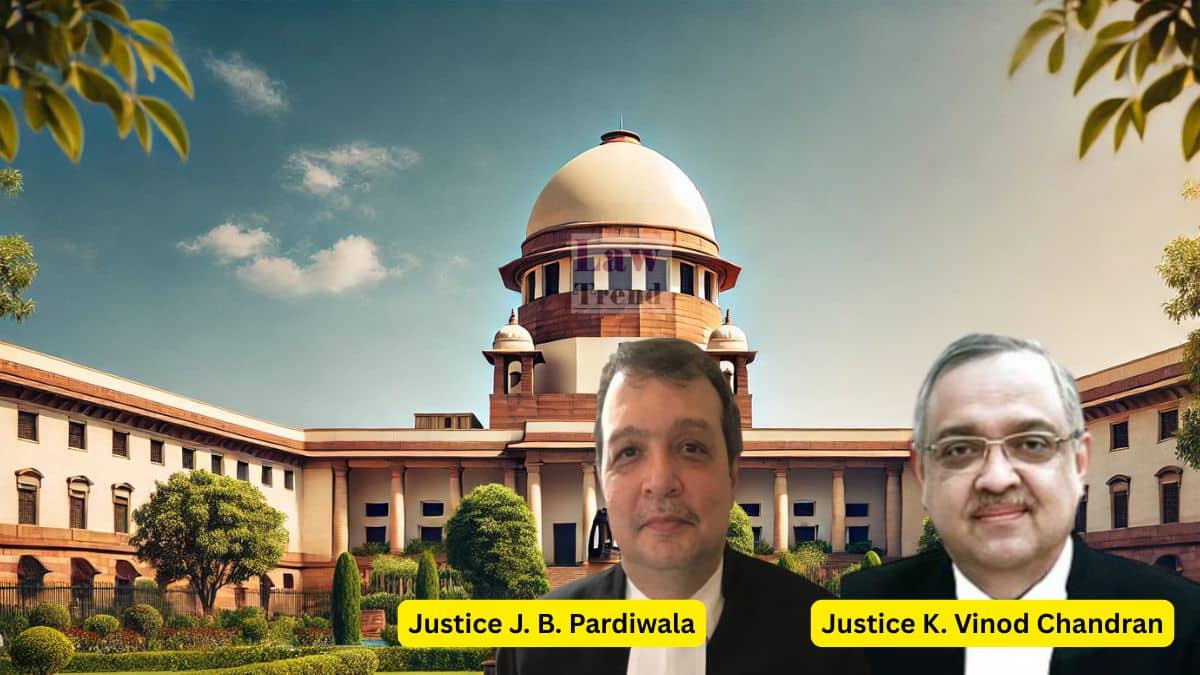

The Supreme Court has acquitted five men convicted of murder, holding that while a faulty investigation cannot inure to the benefit of the accused, a court cannot presume guilt in the absence of reliable evidence merely because the investigating officer was recalcitrant or collusive. Setting aside the convictions and life sentences upheld by the High Court, a Bench comprising Justice J.B. Pardiwala and Justice K. Vinod Chandran ruled that the prosecution failed to establish guilt beyond reasonable doubt due to material contradictions between eyewitness accounts and medical evidence, combined with an utter lack of investigative recoveries.

Background of the Case

The case arose out of an alleged broad-daylight murder that took place on an election day in Bihar. According to the prosecution, the deceased was walking towards his agricultural fields accompanied by his son (PW7), an employee (PW1), a nephew (PW2), and an independent villager. The accused persons allegedly ambushed the group, exhorted to kill everyone, and fired indiscriminately.

The deceased suffered a fatal gunshot wound to his back. While his companions fled, an election patrol vehicle carrying a Magistrate arrived at the spot, causing the assailants to flee. The victim was rushed to a hospital, where he was pronounced dead.

Following a trial involving nine prosecution witnesses, six accused were convicted under Sections 302 and 307 read with Section 149 of the Indian Penal Code, 1860 (IPC). Accused 1, 4, and 6 were additionally convicted under Section 148 IPC and Section 27 of the Arms Act, while Accused 2, 3, and 5 were convicted under Section 147 IPC. The first accused served his sentence and was released on remission, leaving five appellants before the Supreme Court.

Arguments Before the Court

The State’s Government Advocate argued that the conviction was sound and based on the consistent testimonies of eyewitnesses. Addressing the complete absence of spent cartridges recovered from the crime scene, the State submitted that the victims were proceeding along an uneven ridge bordered by unharvested crops and spiky grass, making recovery impossible. The State added that the scene of occurrence had been graphically detailed in the mahazar prepared by the Investigating Officer (PW9).

READ ALSO  Correction in Date of Birth is Within Jurisdiction Of Civil Court Not Industrial Disputes Act, Rules Supreme Court

The High Court, in upholding the convictions, took note of an extraneous complaint against the Investigating Officer alleging a collusive investigation. Using that complaint to explain the lack of seized cartridges, the failure to examine independent witnesses, and the omission to send blood-stained earth for chemical testing, the High Court held that the prosecution witnesses gave consistent evidence proving a common object to commit murder. It discarded contradictions in the medical evidence as conjecture, reasoning that a shooter’s hand shakes when firing at a moving target.

The Supreme Court’s Analysis

The Supreme Court found severe deficiencies in the prosecution’s case and rejected the High Court’s reasoning.

The Bench observed that the physical and investigative material directly contradicted the prosecution’s narrative:

  • Medical Contradictions: The doctor (PW4) who conducted the postmortem deposed that the oval bullet entry wound, trajectory, blackening, and tattooing established that the victim was in a sitting position and shot from a close distance of three to four feet. This directly contradicted the eyewitness accounts stating that the deceased was walking at the head of a single-file line when shot from behind.
  • Lack of Recoveries: Despite allegations of indiscriminate firing, the Investigating Officer made no effort to search for or seize spent cartridges, weapons, or the bullet that exited the deceased’s body. Furthermore, PW9 testified that the site was a pedestrian lane between ploughed fields, debunking the State’s claim of an uneven ridge with spiky grass.
  • Unexamined and Suspect Witnesses: The independent villager allegedly present was never examined. The remaining eyewitnesses were close relatives or an employee of the deceased who had a running dispute with the accused. None of them sustained injuries despite the alleged indiscriminate gunfire, and their clothes were never seized to verify whether they had carried the bleeding victim to the patrol car.
  • Flawed Procedure: The Investigating Officer admitted that the inquest was carried out before recording the First Information Statement (FIS), rendering the genesis of the prosecution case premeditated. Blood-stained earth collected from the site was never sent for chemical examination.
  • Specious Motive: The alleged motive—involving the kidnapping of a girl and political rivalry with the father of Accused 1—was unproven. Moreover, the father was never arrayed as an accused in the case.
READ ALSO  SC Orders audit of oxygen supplied to States but decisions made by doctors in good faith excluded

Addressing the High Court’s reliance on the complaint against the Investigating Officer, the Supreme Court observed:

“The case is not of a faulty investigation but of no investigation having been carried out. Even the inquest was carried out before the FIS was recorded; making it pre-meditated. The High Court egregiously erred in looking at a complaint against the I.O not produced in the trial, to find the evidence led to be clinching insofar as the culpability of the accused. A faulty investigation cannot inure to the benefit of the accused, but when there is no reliable evidence, merely because the I.O was recalcitrant or a complaint of collusion was raised against him, the Court cannot presume the guilt of the accused. There is complete lack of evidence in the present case and the testimonies, as we observed, do not inspire confidence.”

The Decision

Holding that the prosecution failed to establish the culpability of the accused beyond reasonable doubt, the Supreme Court allowed the appeals and set aside the convictions. The Bench directed that the appellants be released forthwith if in custody and not required in any other case, and ordered that their bail bonds be cancelled if on bail.

READ ALSO  Guard Posted At Judge's House Found Guilty of Consuming Alcohol on Duty: MP HC Upholds Compulsory Retirement

Case Title: Dhrub Singh Etc. v. The State of Bihar
Case No.: Criminal Appeal Nos. 1434-1438 of 2017
Bench: Justice J.B. Pardiwala and Justice K. Vinod Chandran
Date: September 01, 2026

Law Trend
Law Trendhttps://lawtrend.in/
Legal News Website Providing Latest Judgments of Supreme Court and High Court

Related Articles

Latest Articles

