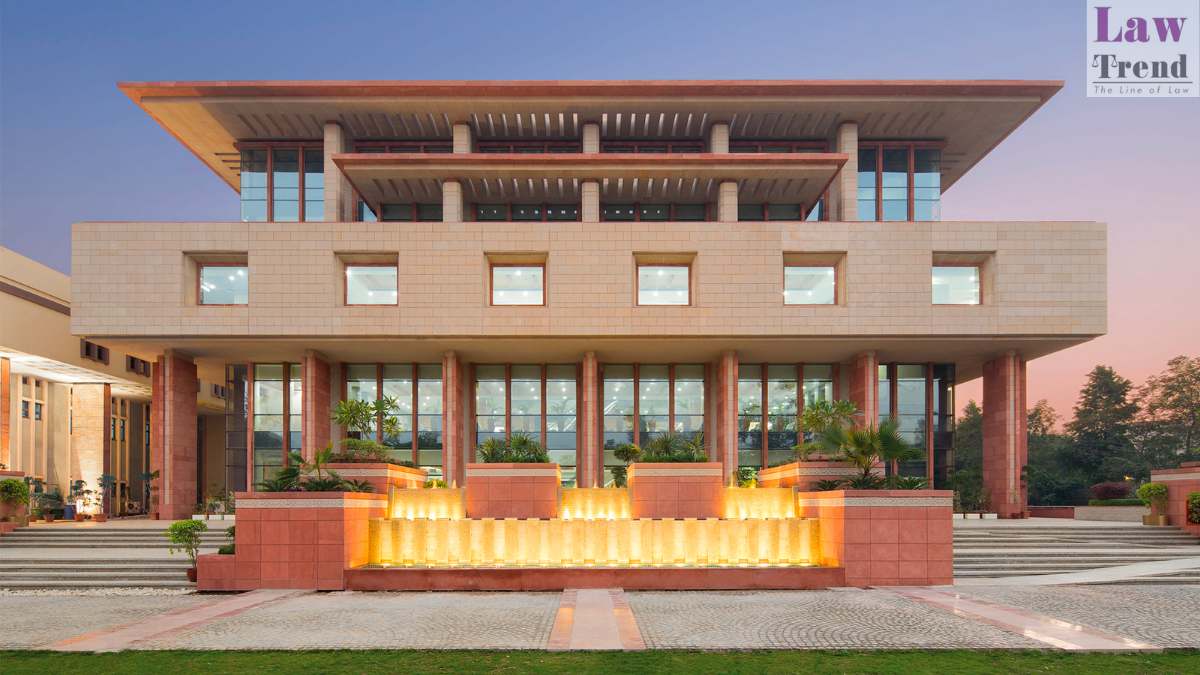
The High Court of Delhi, comprising a Division Bench of Justice Vivek Chaudhary and Justice Renu Bhatnagar, has dismissed an appeal challenging a Single Judge order that refused to reject a property suit on grounds of limitation under Order VII Rule 11(d) of the Code of Civil Procedure, 1908 (CPC). The Court held that where the plaint sets out grounds regarding the exclusion of time under Supreme Court orders issued during the COVID-19 pandemic and Section 14 of the Limitation Act, 1963, limitation becomes a matter to be adjudicated after framing issues and receiving evidence, rather than at the threshold stage.
Background of the Case
The dispute pertains to property bearing No. D-37, Kamla Nagar, Delhi. The respondent, Smt. Sunita Aggarwal, claims to be one of the legal heirs of the late Smt. Padmawati, the owner of the property. In November 2019, apprehending the creation of third-party rights by appellant No. 1, Shri Jai Prakash Tayal, the respondent instituted Civil Suit No. 3517/2019 before the Civil Judge seeking a permanent injunction to restrain him from alienating or creating third-party interests in the property.
On January 8, 2020, appellant No. 1 filed his written statement in that suit, relying for the first time upon a registered Gift Deed dated June 7, 2007, allegedly executed in his favor by Smt. Padmawati, along with a registered Will. The respondent asserted that she first became aware of these documents upon receiving the written statement.
The trial court disposed of the injunction suit on March 7, 2020, holding that a suit for injunction alone was not maintainable due to the title dispute, but granted liberty to the respondent to file a comprehensive suit seeking appropriate declaratory and consequential reliefs. The respondent challenged this judgment in an appeal, which was eventually withdrawn on May 27, 2024, leaving the liberty granted by the trial court undisturbed.
Thereafter, the respondent instituted CS(OS) 464/2024 before the High Court seeking declarations that the Gift Deed and Will were null and void, along with decrees for partition and permanent injunction. In response, appellant No. 1 filed an application under Order VII Rule 11 CPC, contending that the suit was barred by limitation under Article 58 of the Limitation Act, as the respondent admitted acquiring knowledge of the documents on January 8, 2020, but filed the suit only on May 27, 2024. The learned Single Judge dismissed this application on August 18, 2025, leading to the present appeal before the Division Bench.
Arguments of the Parties
The appellants contended that the relief of declaration is governed by Article 58 of the Limitation Act, which prescribes a three-year period from the date of knowledge (January 8, 2020). They argued that the suit was ex facie barred by limitation and that the liberty granted by the civil court did not enlarge or suspend the statutory limitation period. They further submitted that the Single Judge erred in holding that limitation was a mixed question of law and fact despite the bar being evident from the plaint itself.
Conversely, counsel for the respondent supported the Single Judge’s order, arguing that an application under Order VII Rule 11 CPC proceeds substantially on the defense set up by the defendants, which cannot be looked into at the rejection stage. The respondent asserted that when read in its entirety, the plaint sets out the legal and factual foundation demonstrating that the suit is within limitation. It was submitted that the question of limitation required evidence and could not be decided in isolation at the threshold.
Court’s Analysis and Observations
Evaluating the contentions of both sides, the Court noted: “The question before us is not whether the Respondent will succeed on her pleas of limitation, but whether the plaint reaches at only one conclusion, namely, that the suit is barred by limitation.”
The Bench observed that under Article 58 of the Limitation Act, the limitation period for declaration is three years from when the right to sue first accrues. While the three-year period from January 8, 2020, would ordinarily have expired on January 7, 2023, the respondent relied upon the Supreme Court’s orders in In Re: Cognizance for Extension of Limitation (Suo Motu Writ Petition (C) No. 3 of 2020), specifically the order dated January 10, 2022, which directed the exclusion of the period from March 15, 2020, to February 28, 2022.
Taking judicial notice of the correct dates to address a typographical error in the plaint, the Court observed that excluding this period of approximately 23 months and a few days extended the limitation period to around December. Consequently, the suit filed on May 27, 2024, fell within the prescribed period. The Bench noted: “In this view of the matter, it cannot be said that, from the readings of the averments in the plaint, a bar of limitation is made out so as so as to attract Order VII Rule 11(d) of the CPC.”
The Court further held that the respondent’s plea seeking benefit under Section 14 of the Limitation Act—which permits exclusion of time spent prosecuting a prior civil proceeding in good faith before a court unable to entertain it for want of jurisdiction or similar cause—cannot be discarded at the threshold.
The Bench stated: “Whether the Respondent, if required, is ultimately entitled to the benefit of Section 14 is a matter that will have to be examined on evidence at the appropriate stage. For the present, the existence of such a plea arising from the earlier proceedings is sufficient to indicate that the question of limitation is not clear and can be decided only after framing of issues and not in an application under Order VII Rule 11(d) CPC.”
Referencing the Supreme Court decision in Consolidated Engineering Enterprises v. Principal Secretary, Irrigation Department & Ors., (2008) 7 SCC 169 (paragraphs 52 and 54), the High Court noted that Section 14 does not enlarge limitation but permits exclusion of time spent in bona fide earlier proceedings for the same relief. The Court added: “Whether the earlier proceedings were in fact pursued bona fide and with due diligence within the meaning of Section 14 is a matter that can be properly examined only after the parties have led evidence, and at the time of trial.”
Concluding its analysis, the Bench observed: “In these circumstances, the plaint cannot be said to disclose an unequivocal bar of limitation on its face; consequently, rejection under Order VII Rule 11(d) CPC is not warranted.”
Decision
The High Court dismissed the appeal and disposed of all pending applications, with no order as to costs. The Bench clarified that nothing in its judgment should be construed as an expression of opinion on the merits of the rival contentions concerning limitation, leaving all questions open to be decided during trial.
Case Title: Shri Jai Prakash Tayal & Ors. v. Smt Sunita Aggarwal
Case No.: FAO(OS) 111/2025
Bench: Justice Vivek Chaudhary and Justice Renu Bhatnagar
Date: August 22, 2026