

Mere Occurrence of Caste Abuse in School Premises Does Not Satisfy ‘Public View’ Requirement Under SC/ST Act: Supreme Court
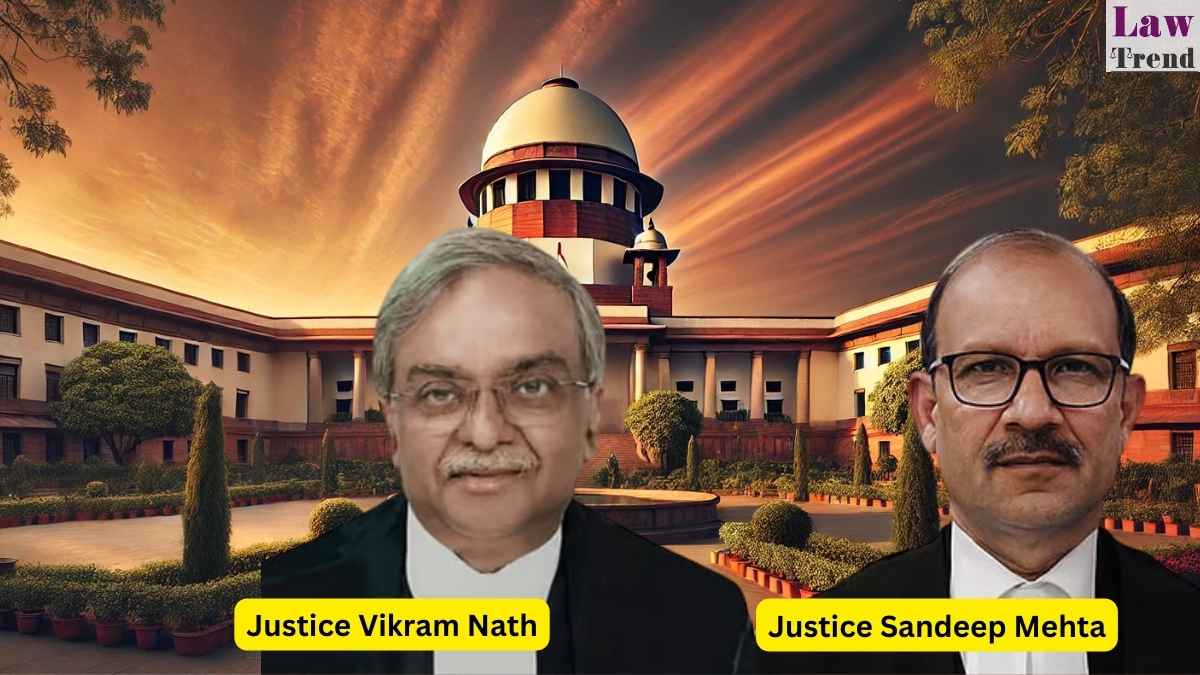

The Supreme Court has held that the mere occurrence of alleged caste-based abuse within school premises does not by itself satisfy the statutory requirement of a place “within public view” under Sections 3(1)(r) and 3(1)(s) of the Scheduled Castes and the Scheduled Tribes (Prevention of Atrocities) Act, 1989. A bench of Justice Vikram Nath and Justice Sandeep Mehta set aside an order of the Allahabad High Court and quashed criminal proceedings under the SC/ST Act against a school manager, ruling that an alleged incident occurring inside an enclosed room without members of the public witnessing or hearing it cannot be said to have taken place within public view.

Background of the Case

The matter arose from FIR No. 37 of 2020 registered on January 25, 2020, lodged by Respondent No. 2 against the appellant, Ramkrishna Chauhan, and other co-accused persons. The complainant alleged that on January 24, 2020, his sons—who were studying at a school where the appellant served as Manager—were involved in a quarrel with other students, resulting in injuries to one son.

When Respondent No. 2 went to the school, he alleged that the appellant and school staff assaulted him with lathis, sticks, and fists, and uttered caste-based abuses against him. The police filed a chargesheet on March 17, 2020, under Sections 147, 323, 342, and 504 of the Indian Penal Code, 1860 (IPC), alongside Sections 3(1)(r) and 3(1)(s) of the SC/ST Act. The Special Judge, SC/ST Act, took cognizance on August 8, 2022, in Sessions Case No. 642 of 2022.

The appellant pointed out that his wife had also registered a counter-FIR (FIR No. 39 of 2020) on January 25, 2020, against Respondent No. 2 under Sections 323, 504, and 506 of the IPC, alleging that Respondent No. 2 had entered the school office, abused, and assaulted her, leading to the appellant’s intervention. A chargesheet against Respondent No. 2 was filed in that case on April 27, 2020, and cognizance was taken on December 3, 2020.

The appellant challenged the summoning order before the High Court of Judicature at Allahabad under Section 14A(1) of the SC/ST Act. On April 10, 2023, the High Court dismissed Criminal Appeal No. 930 of 2023, holding that the existence of a counter-case was not a ground to quash the chargesheet and that a prima facie case was established. Aggrieved, the appellant approached the Supreme Court.

READ ALSO  SCLSC to Provide Legal Aid to Over 4,200 Prisoners Nationwide, Justice Surya Kant Directs Acceleration of Campaign

Arguments of the Parties

Learned senior counsel Mr. Siddharth Aggarwal, appearing for the appellant, argued that the High Court erred in concluding that the incident occurred within public view. Relying on the site plan dated February 25, 2020, prepared by the Investigating Officer, counsel submitted that the occurrence took place inside Room ‘A’ of the school premises—an enclosed room without windows or public access.

Counsel further contended that the FIR contained no specific caste-based words or slurs attributed to the appellant and that witness statements recorded under Section 161 of the Code of Criminal Procedure (CrPC) only established a scuffle. It was also submitted that the appellant had no prior acquaintance with Respondent No. 2 and no knowledge of his caste.

Learned counsel appearing for the Respondent-State supported the High Court’s judgment, contending that the incident occurred within public view and that at the stage of taking cognizance, the court only needs to evaluate whether a prima facie case is made out from the FIR, chargesheet, and investigation materials. Respondent No. 2 did not enter an appearance despite service of notice.

Court’s Analysis and Precedents

The Supreme Court examined whether the material on record disclosed the essential legal ingredients of Sections 3(1)(r) and 3(1)(s) of the SC/ST Act. Reaffirming the legal standard on what constitutes “any place within public view,” the Court cited its decision in Karuppudayar v. State represented by the Deputy Superintendent of Police, Lalgudi, Trichy & Others, which relied upon Hitesh Verma v. State of Uttarakhand:

“It could thus be seen that, to be a place ‘within public view’, the place should be open where the members of the public can witness or hear the utterance made by the accused to the victim. If the alleged offence takes place within the four corners of the wall where members of the public are not present, then it cannot be said that it has taken place at a place within public view.”

Applying this principle, the Supreme Court noted that neither the FIR nor the statement of Respondent No. 2 stated that the alleged abuses were uttered in the presence or hearing of members of the public. The site plan placed the scene of occurrence inside Room ‘A’, an enclosed space without public access.

Furthermore, the Court analyzed the Section 161 CrPC statements of four private witnesses—teachers Pradeep Kumar, Soorbeer, Sudha, and Pooja Chauhan. While the teachers confirmed that an altercation and scuffle took place in the school office, none of them stated that they were present inside the office during the alleged caste abuses or that they heard any caste-based slurs.

The Court emphasized:

READ ALSO  AP HC Upholds Detenu's Autonomy, Releases Detenu to In-Law's Custody

“The requirement of “public view” depends upon whether the alleged utterance was made in circumstances in which members of the public could witness or hear it. The mere fact that the occurrence took place within the premises of a school does not, by itself, satisfy this requirement.”

The bench observed that while meticulous appreciation of evidence is not required at the stage of cognizance, the basic statutory ingredients must still emerge from the record.

READ ALSO  Letter of Intent is "Promise in Embryo", Creates No Binding Rights; SC Upholds Cancellation for Non-Compliance in HP Tender Case

Decision of the Court

The Supreme Court held that the offences under Sections 3(1)(r) and 3(1)(s) of the SC/ST Act were not prima facie made out against the appellant.

Accordingly, the Supreme Court allowed the appeal and set aside the judgment and order dated April 10, 2023, passed by the Allahabad High Court. The proceedings arising out of FIR No. 37 of 2020 were quashed to the extent of the charges under Sections 3(1)(r) and 3(1)(s) of the SC/ST Act against the appellant. The Court clarified that criminal proceedings shall continue regarding the remaining offences under the IPC.

Case Details:

Case Title: Ramkrishna Chauhan v. State of U.P. & Anr.
Case No.: Criminal Appeal No. 3394 of 2026
Bench: Justice Vikram Nath, Justice Sandeep Mehta
Date: August 20, 2026

Law Trend
Law Trendhttps://lawtrend.in/
Legal News Website Providing Latest Judgments of Supreme Court and High Court

Related Articles

Latest Articles

