

UP Gangsters Act ‘Stillborn’ as It Prescribes Punishment Without Creating an Offence: Supreme Court
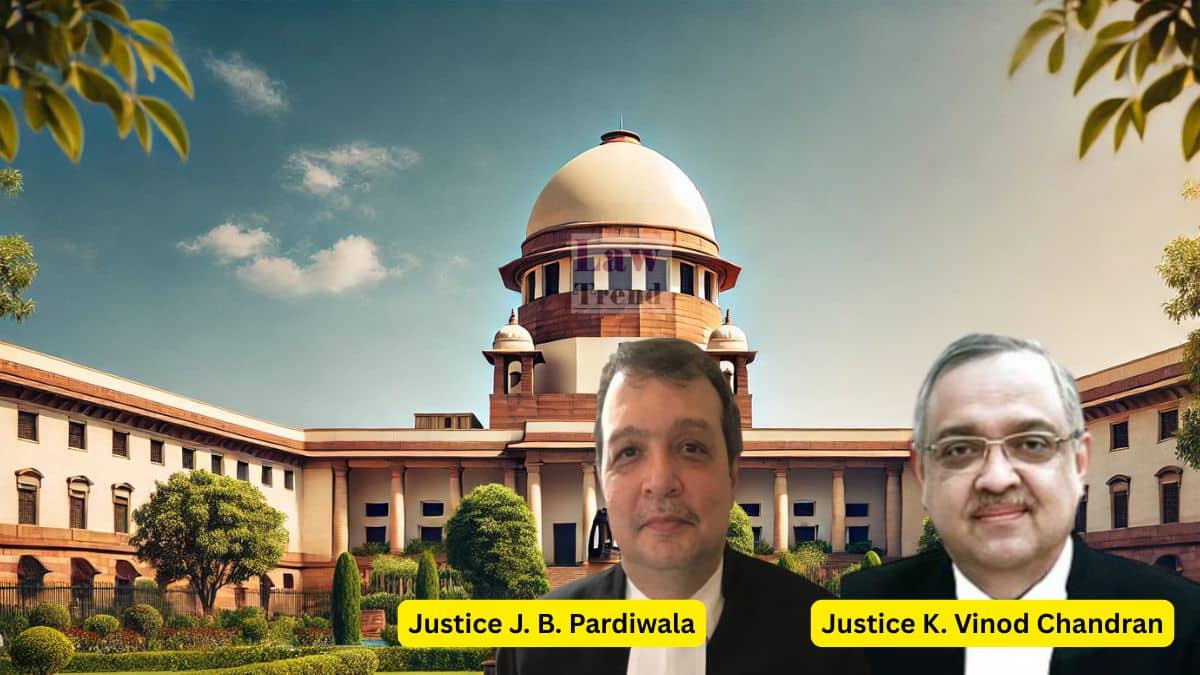

The Supreme Court of India, in a significant judgment delivered by a bench comprising Justice J. B. Pardiwala and Justice K. Vinod Chandran, has held that the Uttar Pradesh Gangsters and Anti-Social Activities (Prevention) Act, 1986 is _ “stillborn” _ because it fails to create or define any distinct statutory crime or offence. Quashing criminal proceedings under Sections 2 and 3 of the U.P. Act against two practicing advocates, the apex court ruled that prescribing punishment based solely on executive-prepared Gang Charts without an underlying statutory offence is illegal and constitutionally unsustainable.

Background of the Cases

The ruling stems from two criminal appeals challenging proceedings initiated under the U.P. Act of 1986 and the Uttar Pradesh Gangsters and Anti-Social Activities (Prevention) Rules, 2021.

In the first appeal, appellant Shiv Pratap Singh, a practicing advocate, was involved in disputes concerning elections to the Bar Association at Fatehgarh, Farrukhabad. Following disciplinary proceedings initiated by the Bar Council of Uttar Pradesh, an FIR (FIR No. 377 of 2023) was registered against him under the Indian Penal Code (IPC). Although the High Court stayed the direction of the State Bar Council and the Bar Council of India subsequently declared it a nullity, local police registered FIR No. 41 of 2024 under Section 2 of the U.P. Act. The action was based on a Gang Chart framing him alongside two others, alleging general anti-social activities under Chapters XVI, XVII, and XXII of the IPC. A chargesheet was filed on February 12, 2025.

In the second appeal, appellant Himanshu Srivastava, also an advocate, challenged proceedings initiated against him, his brother, and his father under Case Crime No. 740 of 2022 at Police Station Loni Border, District Ghaziabad Rural under Sections 2 and 3 of the U.P. Act. The proceedings were invoked following a prior case (Case Crime No. 61 of 2022) registered under IPC provisions and Section 3(2)(v) of the Scheduled Castes and Scheduled Tribes (Prevention of Atrocities) Act, 1989. Charge Sheet No. 1 dated December 5, 2023 was filed in Sessions Case No. 73 of 2024.

In both matters, the appellants filed applications under Section 482 of the Code of Criminal Procedure, 1973 (CrPC) before the High Court seeking to quash the chargesheets, but their petitions were rejected, leading to the appeals before the Supreme Court.

READ ALSO  धारा 138 NI एक्ट | आरोपी को कोर्ट में आगे की सभी तारीख़ पर पेशी से पूरी छूट नहीं मिल सकती है- जानिए सुप्रीम कोर्ट का निर्णय

Arguments of the Parties

The appellants submitted that proceedings initiated under the U.P. Act and Rules based merely on a Gang Chart are invalid and result in peremptory conviction and sentence under Section 3 without any underlying statutory offence created by the enactment itself.

The State of Uttar Pradesh strongly opposed the appeals, contending that the appellants were known offenders whose criminal antecedents justified the preparation of Gang Charts under the 2021 Rules. The State pointed to allegations in the FIR including disrupting court security systems, bringing ammunition inside court premises, causing explosions, and shooting with illegal firearms. However, the Supreme Court noted that there was no indication of any formal complaint having been raised by the District Judge or any Presiding Officer regarding these alleged acts within court premises.

The Supreme Court’s Analysis

Opening the judgment with George Orwell’s quote, _ “Those who abjure violence can do so only because others are committing violence on their behalf.” _, the Supreme Court undertook an in-depth analysis of the U.P. Act and Rules.

The Court emphasized the foundational legal maxim _ “nulla poena sine lege” _ (no punishment without law) and referred to the definition of an “offence” in the General Clauses Act as _ “an act or omission made punishable by any law for the time being in force” _.

Examining the statutory scheme, the Court observed:

  • Absence of Statutory Offence: While Sections 2(b) and 2(c) define “Gang” and “Gangster” by listing anti-social activities under other enactments (such as the IPC, U.P. Excise Act, NDPS Act, and Arms Act), the U.P. Act itself does not enact or define any distinct criminal act or omission as an offence under the statute.
  • Overreach of Executive Rules: The power to frame rules under Section 23 of the Act cannot be utilized to indirectly create offences or dictate criminal liability through executive Gang Charts. The determination of status as a gangster for punishment, left to subordinate legislation, constitutes an unbridled delegation of legislative function.
  • Constitutional Protections under Article 20: The Court surveyed precedents including Rao Shiv Bahadur Singh v. State of Vindhya Pradesh, S.A. Venkataraman v. Union of India, Maqbool Hussain v. State of Bombay, Keshavan Madhava Menon v. State of Bombay, Soni Devrajbhai Babubhai v. State of Gujarat, Mahipal Singh v. CBI, Union of India v. Ganpati Dealcom Pvt. Ltd., and CBI v. R.R. Kishore. The bench reaffirmed that Article 20(1) prohibits retroactive criminal liability and punishing individuals without an existing penal law creating the offence.
  • Comparison with Other Statutes: Unlike the Maharashtra Control of Organised Crime Act, 1999 (MCOCA) or the Gujarat Control of Terrorism and Organised Crime Act, 2015 (GUJCTOC), which explicitly create and penalize offences like “organised crime” or “terrorist acts” under Section 3, the U.P. Act contains no provision defining an offence created under the statute.
  • Res Integra Status: The Court pointed out that while a Full Bench of the Allahabad High Court in Ashok Kumar Dixit v. State of U.P. had upheld the Act, decisions of the Supreme Court such as Dharmendra Kirthal v. State of U.P., Kartar Singh v. State of Punjab, Subhash Yadav v. State of U.P., and Shraddha Gupta v. State of U.P. had not determined this specific question regarding the absence of a created offence, leaving the issue res integra for this decision.
READ ALSO  विलंबित भुगतान पर ब्याज को रोकने वाला अनुबंधात्मक खंड मध्यस्थ को लंबित वाद ब्याज देने से नहीं रोकता: सुप्रीम कोर्ट

Critiquing the operational mechanism of the U.P. Act, the Supreme Court observed that allowing trial and punishment based solely on an executive Gang Chart without a statutory offence is akin to the English proverb: _ “Give a dog a bad name and hang him” _. The Court noted that such mechanisms lack the procedural safeguards inherent even in preventive detention laws, exposing citizens—including _ “the innocent, the righteous, the virtuous, a whistleblower or plainly put, a thorn in the flesh” _—to arbitrary action.

READ ALSO  ‘तीर-कमान’ चुनाव चिन्ह पर उद्धव ठाकरे गुट की याचिका पर सुप्रीम कोर्ट में 12 नवंबर को सुनवाई

Court’s Decision

The Supreme Court concluded that the U.P. Act of 1986 is stillborn as no crime or offence is created under the statute. Consequently, proceedings initiated under it cannot survive.

Both appeals were allowed. The Court quashed Charge Sheet No. 1 of 2025 arising from FIR No. 41 of 2024 (Fatehgarh Kotwali) and Sessions Case No. 73 of 2024 arising out of Charge Sheet-Case Crime No. 01 of 2023 and FIR No. 740 of 2022 (Police Station Loni Border, District Ghaziabad Rural). The Court directed that the appellants, if in custody, be released forthwith if not required in any other case.

Concluding the ruling, the Supreme Court remarked that _ “the enactment under scrutiny on the pretext of adjuring violence, is in fact perpetuating it on un-suspecting citizens.” _ The bench clarified that its decision does not affect charges under other penal laws, which must proceed independently in accordance with the CrPC and respective statutes.

Case Title: Shiv Pratap Singh Alias Chinu v. State of U.P & Ors.
Case No.: Criminal Appeal No. 3979 of 2026
Bench: Justice J. B. Pardiwala and Justice K. Vinod Chandran
Date: August 20, 2026

Law Trend
Law Trendhttps://lawtrend.in/
Legal News Website Providing Latest Judgments of Supreme Court and High Court

Related Articles

Latest Articles

