

Accidental Drowning More Plausible Than Murder: Supreme Court Acquits Two Convicts Over Failure to Prove Homicidal Death
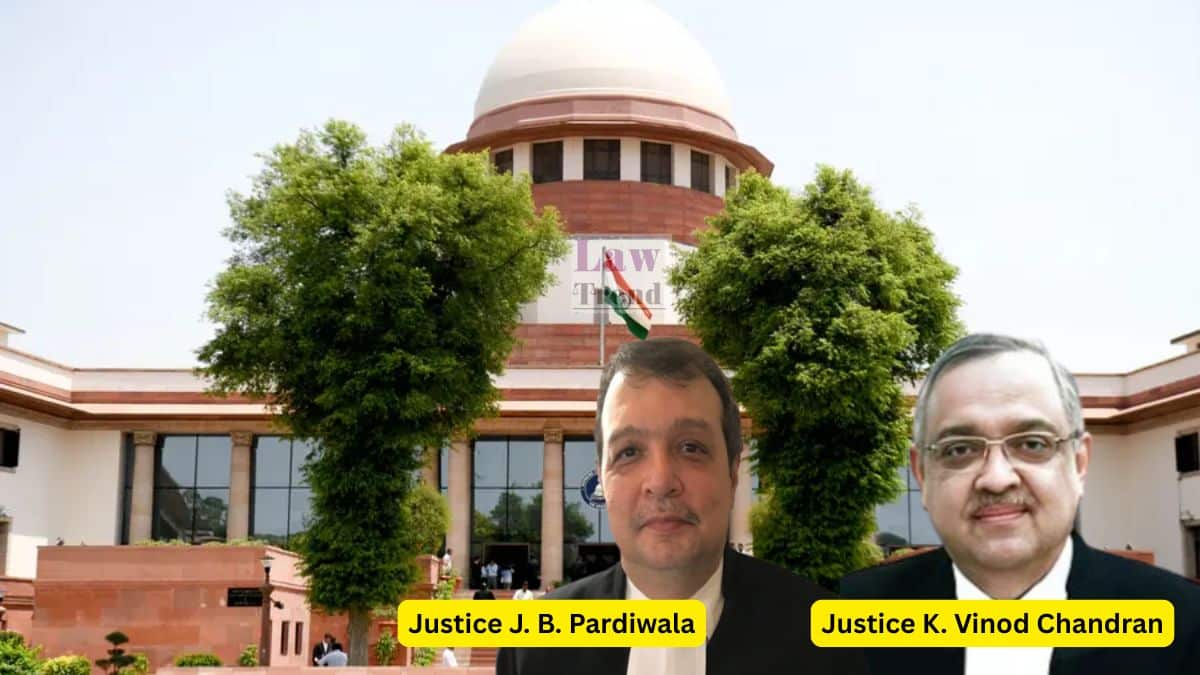

The Supreme Court of India, comprising Justice J. B. Pardiwala and Justice K. Vinod Chandran, has set aside the murder conviction of two men in a 2006 case, ruling that the evidence strongly pointed toward accidental drowning rather than a premeditated homicide. Reversing the decisions of the Trial Court and the Gujarat High Court, the apex court held that the prosecution failed to establish homicidal death or prove a chain of incriminating circumstantial evidence beyond reasonable doubt.

Background of the Case

The case dates back to July 17, 2006, when the appellants—Taher Vajiyuddin Rangwala and another—allegedly took their friend from his house in the early morning under the pretext of traveling to Ankleshwar to play volleyball. When the deceased failed to return by evening, his family initiated a search. Upon being contacted, the second accused initially claimed that he was at a cinema hall watching a movie and had dropped the deceased at Sahra Darwaja earlier in the day.

Later that day, local residents discovered wet clothes on a riverbank, which were identified by the victim’s brother as belonging to the deceased. The two accused subsequently arrived at the victim’s residence voluntarily and confessed inside a car to the victim’s brother that they had gone swimming together in the river, where the victim accidentally drowned. Fearing consequences, they fled the spot in panic and went to watch a movie.

The victim’s body was recovered the following morning, on July 18, 2006. The post-mortem examination determined the cause of death to be “Cardio-Respiratory arrest due to Asphyxia due to drowning.” Despite the incident occurring in July 2006, the First Information Statement (FIS) alleging murder and motive was lodged almost four months later, on November 3, 2006.

The Trial Court convicted both accused under Sections 302, 34, 201, and 120B of the Indian Penal Code (IPC), sentencing them to life imprisonment. The High Court of Gujarat subsequently affirmed the conviction and sentence in appeal.

READ ALSO  अनुच्छेद 226 | केवल अनुबंधित दायित्वों से उत्पन्न विवादों की सुनवाई हाईकोर्ट में नहीं की जा सकती: सुप्रीम कोर्ट

Arguments of the Parties

Senior Counsel appearing for the appellants submitted that the case was, at worst, an instance of a fatal misadventure during a swimming excursion. He contended that there was no evidence proving a homicidal death, the alleged motive was fabricated following an unexplained four-month delay in registering the FIR, and the injuries on the victim were consistent with accidental drowning or impact with sharp stones while being carried by the river current.

Conversely, the Counsel for the State argued that the conviction was well-founded. The State asserted that the accused had purchased four soda bottles prior to the incident, returned only three while drenched and inebriated, and used a broken soda bottle to strike the victim on the head before drowning him. The State argued that returning the soda bottles demonstrated premeditation and pointed to glass fragments allegedly recovered from the scene.

READ ALSO  Wife's Inaction on Missing Husband and Living with Another Man Not a Criminal Conspiracy: Orissa High Court

The Court’s Analysis

Upon evaluating the medical and circumstantial evidence, the Supreme Court observed that the post-mortem report and the medical testimony of the doctor (PW-1) failed to establish a homicidal death. The three minor injuries found on the victim’s frontal bone, eye-ear region, and clavicle were consistent with jumping into the river or being dragged against hard, sharp objects by the water current.

The Bench noted that no broken glass bottle was confronted to the doctor during examination, nor was any blood-stained bottle fragment seized or sent for forensic examination, contradicting the prosecution’s claim.

Addressing the alleged motive—a purported affair between the deceased and the sister of the first accused, alongside a prior quarrel over a cricket match—the Court held it to be an afterthought due to the four-month delay in registering the FIR. The Court observed that the victim’s family had willingly permitted him to leave with the accused, reflecting friendly relations at the time.

Regarding the scene of occurrence, the Court noted testimony showing that the riverbank was a public spot frequented by shepherds, laborers, and fishermen, making it highly unlikely to be chosen for a premeditated daylight murder. Furthermore, shop owners who identified the accused in court had not undergone a Test Identification Parade (TIP), rendering their dock identification unreliable.

Evaluating the conduct of the accused in fleeing the scene and attending a movie, the Court remarked:

“The human mind, as has often been held by this Court, is at the same time fickle, manipulative and imaginative and the actions, the result of a deprived or a foolish mindset, especially in the face of adversities, which cannot be predicted.”

The Court concluded that while the conduct of the accused in failing to seek help and going to a movie was reprehensible, it did not constitute an incriminating circumstance proving murder.

“The hypothesis of innocence is crystal clear, and circumstances indicate an accident and not a premeditated murder.”

Decision of the Court

Finding no evidence to sustain the conviction, the Supreme Court allowed the appeal, reversed the judgments of the Trial Court and the High Court, and acquitted both appellants of all charges. The Court directed their immediate release from custody, provided they were not required in any other case.

Case Title: Taher Vajiyuddin Rangwala & Anr. v. The State of Gujarat

READ ALSO  Supreme Court to Hear Manish Sisodia's Bail Pleas in Excise Policy Cases on August 5

Case No.: Criminal Appeal No. 76 of 2020

Bench: Justice J. B. Pardiwala and Justice K. Vinod Chandran

Date: August 13, 2026

Law Trend
Law Trendhttps://lawtrend.in/
Legal News Website Providing Latest Judgments of Supreme Court and High Court

Related Articles

Latest Articles

