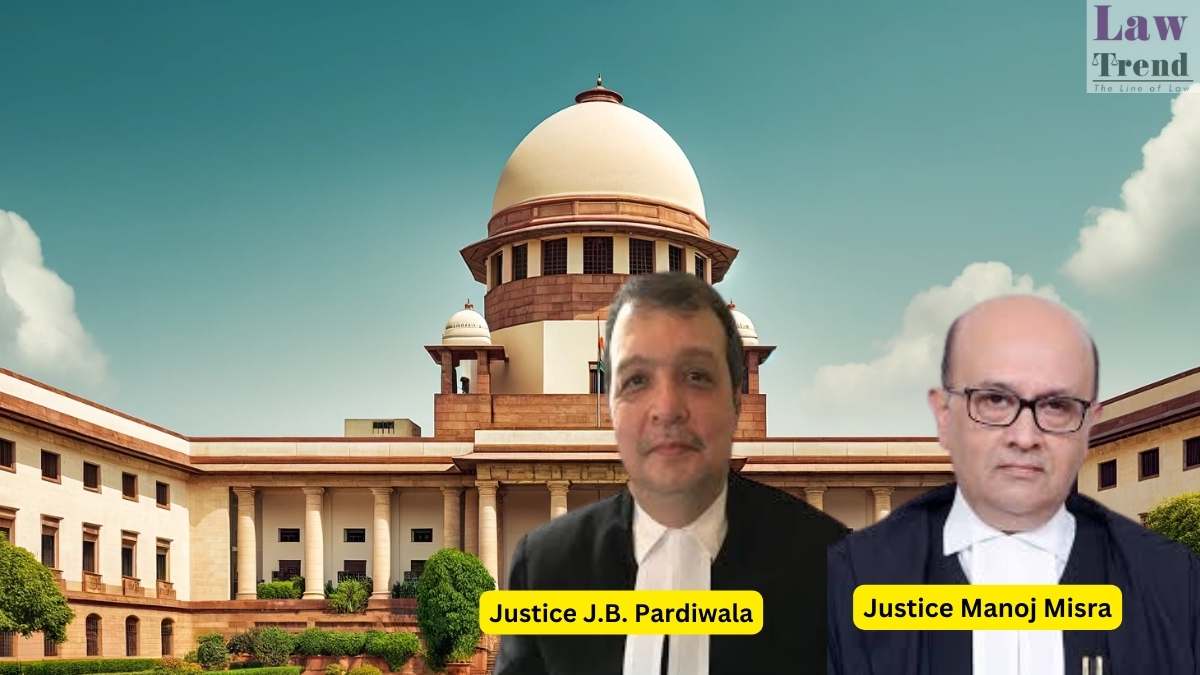
The Supreme Court of India has ruled that an employer cannot take advantage of its own wrongdoing in wrongfully discharging an employee to deny them promotional pay scales such as Selection Scale or Super Time Scale on the grounds that Annual Confidential Reports (ACRs) are unavailable for the period they were kept out of service. A Division Bench comprising Justice J.B. Pardiwala and Justice Manoj Misra clarified that when an officer is reinstated with continuity of service and all consequential benefits, the lack of ACRs caused by an unlawful discharge cannot be turned against the officer. The Court held that in such situations, eligibility for Selection Scale and Super Time Scale must be evaluated using the remaining valid ACRs available on record.
Background of the Case
The matter originated from a Miscellaneous Application filed on the administrative side by the High Court of Judicature for Rajasthan seeking clarification of a Supreme Court judgment dated March 15, 2022. The opponent judicial officer, Abhay Jain, was appointed to the District Judge Cadre of the Rajasthan Judicial Service in 2013 and was discharged from service in 2016. After the Rajasthan High Court dismissed his writ petition on October 21, 2019, Jain appealed to the Supreme Court.
On March 15, 2022, the Supreme Court allowed his appeal, quashing the discharge order and directing that Jain be reinstated with all consequential benefits, including continuity of service and seniority, along with 50% back wages. Following reinstatement on April 13, 2022, Jain submitted a representation to the Higher Judiciary Committee for the grant of Super Time Scale.
However, on May 19, 2023, the Committee noted that because Jain remained out of service from 2015 to 2021, ACRs for six out of the preceding seven years were unavailable as he had not performed judicial work. The Committee decided to seek clarification from the Supreme Court on whether consequential benefits automatically included Selection Scale and Super Time Scale without six years of ACRs.
When the Supreme Court directed the High Court to first take an administrative decision, a Full Court meeting of the Rajasthan High Court was convened on August 21, 2024. Considering Rules 49 and 50 of the Rajasthan Judicial Service Rules, 2010 (RJS Rules, 2010) and a Full Court Resolution dated January 15, 2011—which required specific minimum ‘Good’, ‘Very Good’, or ‘Outstanding’ entries in the preceding seven years—the Full Court found Jain not suitable for Selection Scale or Super Time Scale without recording specific reasons. Aggrieved by this decision, both parties presented their arguments before the apex court.
Arguments of the Parties
Senior Advocate P.S. Patwalia, representing the judicial officer, submitted that Jain was granted seniority from his initial 2013 appointment, but denying him Selection Scale and Super Time Scale rendered the Supreme Court’s direction of “all consequential benefits” otiose. He argued that Jain could not be blamed for the non-availability of ACRs from 2016 to 2021 since he was wrongfully kept out of service. Under Rule 54 of the Rajasthan Service Rules, 1951, an exonerated officer’s period of absence is treated as duty for all purposes. He stressed that uncommunicated or uninitiated ACRs cannot prejudice an officer, and evaluations must proceed based on available valid ACRs (2013: Very Good; 2014 Part I: Very Good; 2014 Part II: Good). He also pointed out that officers junior to Jain were granted Selection Scale in 2019 and Super Time Scale in 2023.
Advocate-on-Record Gopal Jha, appearing for the Rajasthan High Court, submitted that the Full Court found the officer unsuitable due to the absence of the requisite number of qualitative ACR entries for the preceding years. He pointed out that the officer had only four ACRs (2013, 2014, 2015, and 2022) because he was out of service from January 2016 to May 2022. Regarding the 2015 ACR, he explained that it could not be conveyed as it was still in process when Jain was discharged in August 2016, and prevalent practice dictates not conveying ACRs to officers who are no longer in service.
The Court’s Analysis
The Supreme Court examined whether the non-availability of ACRs could be attributed to the judicial officer. Citing the three-judge bench decision in Union of India v. K.V. Jankiraman, the Court highlighted: The normal rule of “no work no pay” is not applicable to cases such as the present one where the employee although he is willing to work is kept away from work by the authorities for no fault of his.
Relying on Central Bank of India v. Dragendra Singh Jadon, the Court underscored: The appellant Bank cannot take advantage of its own wrong of wrongfully dismissing the respondent from service, to deny him the benefit of seniority, promotion and other benefits to which he would have been entitled, if he had attended to his duties.
Referring back to its main judgment of March 15, 2022, the Court noted that Jain’s single bail order dated April 27, 2015, passed within competent jurisdiction, did not constitute misconduct, observing: This negligence cannot be treated to be misconduct. The Court reiterated its finding that …there was no material to showcase unsatisfactory performance of the appellant in terms of requirement under Rule 45 and 46 of the RJS Rules, 2010.
The Bench held that because the High Court itself caused the wrongful discharge, it could not rely on the resulting absence of ACRs to deny career progression. Drawing upon Prabhu Dayal Khandelwal v. Chairman, UPSC and R.K. Jibanlata Devi v. High Court of Manipur, the Court affirmed that where required ACRs are short due to employer fault, assessment must be conducted on the basis of the remaining valid ACRs.
Regarding the 2015 ACR, the Bench cited Sukhdev Singh v. Union of India and Maneka Gandhi v. Union of India, ruling that an uncommunicated ACR cannot be used to an employee’s detriment. Consequently, the Court held that Jain’s entitlement must be assessed strictly on his valid ACRs for 2013 and 2014 (Part I and Part II), which reflected “Very Good” and “Good” ratings along with integrity certificates, completely free from any material warranting denial of career progression.
The Decision
The Supreme Court held that Abhay Jain is entitled to the grant of Selection Scale with effect from July 16, 2018, upon completing five years of service under Rule 49 of the RJS Rules, 2010, matching the eligibility timeline of his peers and juniors. Furthermore, upon completing three years in Selection Scale under Rule 50, he is entitled to the grant of Super Time Scale with effect from July 16, 2021.
The Court directed that arrears arising from the grant of Selection Scale and Super Time Scale be computed in accordance with the 50% back wages directive issued in its March 15, 2022 judgment. The Rajasthan High Court on its administrative side was ordered to re-fix the officer’s pay, revise all consequential benefits, and disburse the arrears within three months. The Registry was also instructed to forward a copy of the judgment to all High Courts across the country.
Case Details:
Case Title: High Court of Judicature for Rajasthan v. Abhay Jain
Case No.: Miscellaneous Application No. 2228 of 2026 in Civil Appeal No. 2029 of 2022
Bench: Justice J.B. Pardiwala and Justice Manoj Misra
Date: July 29, 2026