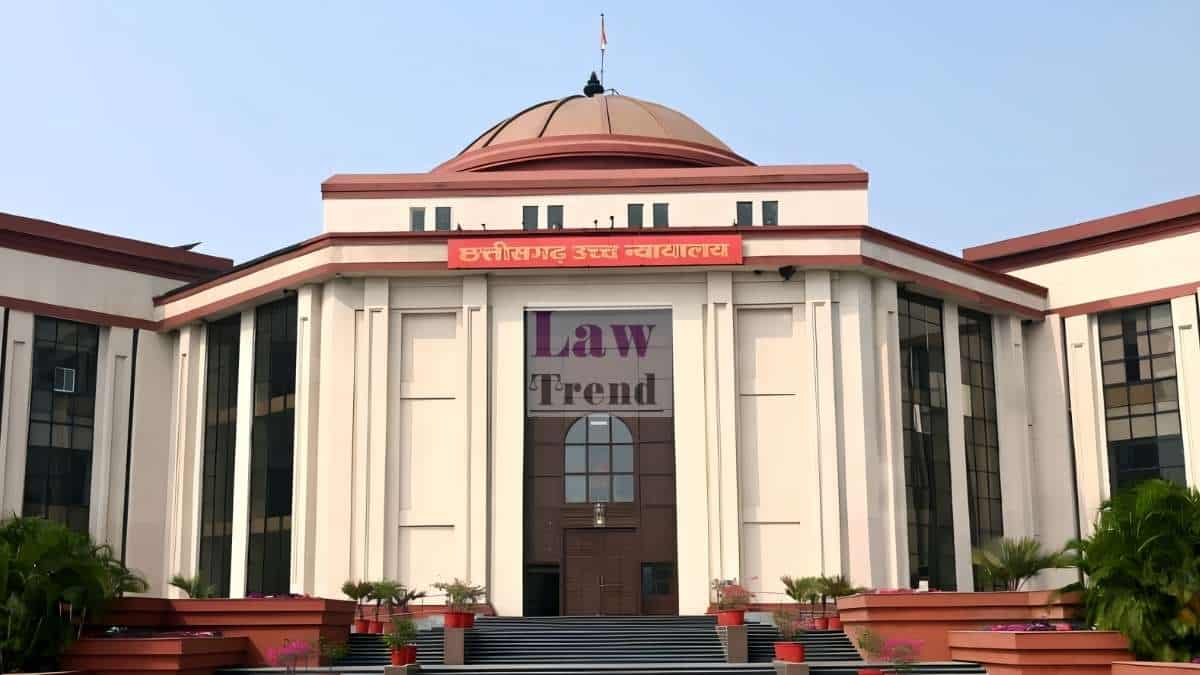
A Full Bench of the High Court of Chhattisgarh, comprising Chief Justice Ramesh Sinha, Justice Ravindra Kumar Agrawal, and Justice Bibhu Datta Guru, has held that service land granted to a Kotwar (village servant) prior to the abolition of proprietary rights cannot be recognized or converted into Bhumiswami rights in favor of such Kotwar or their successors under the M.P./C.G. Land Revenue Code, 1959 and the M.P. Abolition of Proprietary Rights (Estates, Mahals, Alienated Lands) Act, 1950. Answering a reference referred by a Single Judge to resolve conflicting Division Bench decisions, the Full Bench answered the question in the negative, holding that Kotwars are village servants whose service lands remain non-transferable and subject to statutory service conditions rather than proprietary ownership.
Background of the Case
The petitioners, Gajendra Das and Sukrit Das, being successors of erstwhile Kotwars, filed writ petitions under Article 226 of the Constitution of India seeking directions to the state authorities to confer Bhumiswami rights over land originally granted to their forefathers as service land by ex-proprietors or Zamindars prior to 1950 for rendering village services.
During the hearing before a Single Judge, the petitioners contended that under Section 45(3) of the M.P. Abolition of Proprietary Rights Act, 1950, persons holding land on favorable terms for services rendered stood declared as occupancy tenants from the date of vesting. Consequently, under Section 190 of the C.G. Land Revenue Code, 1959, Bhumiswami rights accrued to them.
However, observing a direct conflict between two Division Bench judgments—Vijay Das Manikpuri v. State of M.P. (which supported the claims subject to factual verification) and Gambhir Das Panika v. Chairman, Board of Revenue, Chhattisgarh (which held that service land vested in the State free from encumbrances and conferred no Bhumiswami rights)—the Single Judge referred the following legal question to the Full Bench:
“Whether, in light of the conflicting Division Bench judgments, service land granted to a Kotwar for rendering services prior to the abolition of proprietary rights can be recognized and converted into Bhumiswami rights in favour of such Kotwar or his successors under the provisions of the M.P./C.G. Land Revenue Code, 1959 and the M.P. Abolition of Proprietary Rights (Estates, Mahals, Alienated Lands) Act, 1950?”
Arguments of the Parties
Advocate Ankit Pandey, appearing for the petitioners, submitted that the legal question depended upon the statutory source of title. He argued that Section 3 of the Abolition Act of 1950 vested proprietary rights in the State but did not extinguish subordinate interests saved under Section 45(3), which created a statutory occupancy tenancy by operation of law. He contended that service lands under Section 183 constituted only one category of Kotwar holdings, whereas hereditary holdings, occupancy holdings, and independently acquired lands constituted separate classes requiring individual adjudication.
On the other hand, Advocate General Vivek Sharma, assisted by Deputy Government Advocate Shobhit Mishra for the State, submitted that the issue was settled by the Division Bench in Gambhir Das Panika. He argued that land granted to a Kotwar as service land by an ex-Malguzar or proprietor conferred no proprietary rights and vested in the State free from all encumbrances under Section 3 of the 1950 Act. The State counsel emphasized that Gambhir Das Panika had declared earlier contrary Single Bench decisions—including Chhabil Das v. State of M.P., Tikaram v. State of M.P., and Lalla Singh Chouhan v. State of Chhattisgarh—as per incuriam. Furthermore, Special Leave Petitions challenging Gambhir Das Panika had been dismissed by the Supreme Court.
Court’s Analysis and Case Precedents
Examining the historical origin of the office of Kotwar under the Government of India Act, 1935 and the Central Provinces Land Revenue Act, 1917, the Full Bench noted that a Kotwar is a village servant holding office in a master-servant relationship. Referring to the statutory scheme, the Court noted:
“The expression ‘holding office’ clearly implies that kotwar is a form of employment and it can never be a class of land holder. In fact the expression conveys an existence of a ‘master servant relationship’.”
The Court analyzed that under the Abolition Act of 1950, the State substituted the ex-proprietor, Malguzar, or Gaontia as the employer. The master-servant relationship continues by force of statute, and grants made to Kotwars cannot escape Section 3 of the 1950 Act, which vests all proprietary rights in the State free from all encumbrances.
Revisiting prior judgments, the Court noted that the Constitution Bench of the Supreme Court in State of M.P. v. Yakinuddin held that:
“whatever may have been the nature of the grant by the outgoing proprietors by contracts to convey proprietary rights to grantees, those grants have no legal effect as against the State except in so far as the State may have recognized them.”
The Full Bench observed that the earlier Division Bench decision in Vijay Das Manikpuri had relied on Gaurishankar Choubey v. Baktha and Jiwanlal v. Board of Revenue, but had failed to consider Section 3 of the 1950 Act:
“The judgment of Vijay Das (supra) did not at all considered the provisions of Section 3 of the Abolition Act of 1950 and as such, it cannot lay down the correct law.”
In contrast, the Court held that Gambhir Das Panika comprehensively evaluated Section 3 of the 1950 Act alongside Section 183 of the C.G. Land Revenue Code, 1959. The Bench also took note of Charan Das v. State of Chhattisgarh, Kanak Chandra Dutta v. State of Assam, Maharaja Pravir Chandra Bhanj Deo Kakatiya v. State of M.P., Smt. Reena Bai v. State of C.G., State of C.G. v. Gopal Agrawal, Sheocharan v. Shah Mahomed, State of Bombay v. Pandurang Vinayak, State of Karnataka v. State of Tamilnadu, State of Maharashtra v. Atma Ram Sadashiv Dongarwar, and Kunhayammed v. State of Kerala.
Addressing the scheme of Section 183 of the Land Revenue Code, 1959, the Court emphasized:
“After coming into the force of the Abolition Act, 1950 the master-servant relationship continued between the State and the Kotwars. Further, on perusal of Section 183 of Land Revenue Code, 1959 it is evident that the Kotwars are vested with the land on the condition of rendering the service as village Servant and he shall cease to be entitled to such a land once he resigns or is lawfully dismissed from the post of Kotwar and the subject land shall pass to successor in the office.”
The Bench further cited Charan Das:
“Further, it is also held that if there is any service land which is directed to be settled in the name of Kotwar as he was rendering his services towards village in such cases the property cannot be declared to be the Bhoomiswami land of such Kotwar.”
Decision of the Court
The Full Bench concluded that all estates held by Malguzars and proprietors vested in the State upon the commencement of the Abolition Act, 1950, and service lands granted to Kotwars similarly passed under State ownership. Because the judgment in Gambhir Das Panika correctly laid down the law and was upheld through the dismissal of Special Leave Petitions by the Supreme Court, judicial discipline required adherence to its principles.
Accordingly, the Full Bench answered the reference in the negative and directed the Registry to place the writ petitions before the single roster bench for decision on merits.
Case Title: Gajendra Das v. State of Chhattisgarh & Ors. (along with Sukrit Das v. State of Chhattisgarh & Ors.)
Case No.: WPC No. 1571 of 2020 and WPC No. 1569 of 2020
Bench: Chief Justice Ramesh Sinha, Justice Ravindra Kumar Agrawal, Justice Bibhu Datta Guru
Date: 23/07/2026