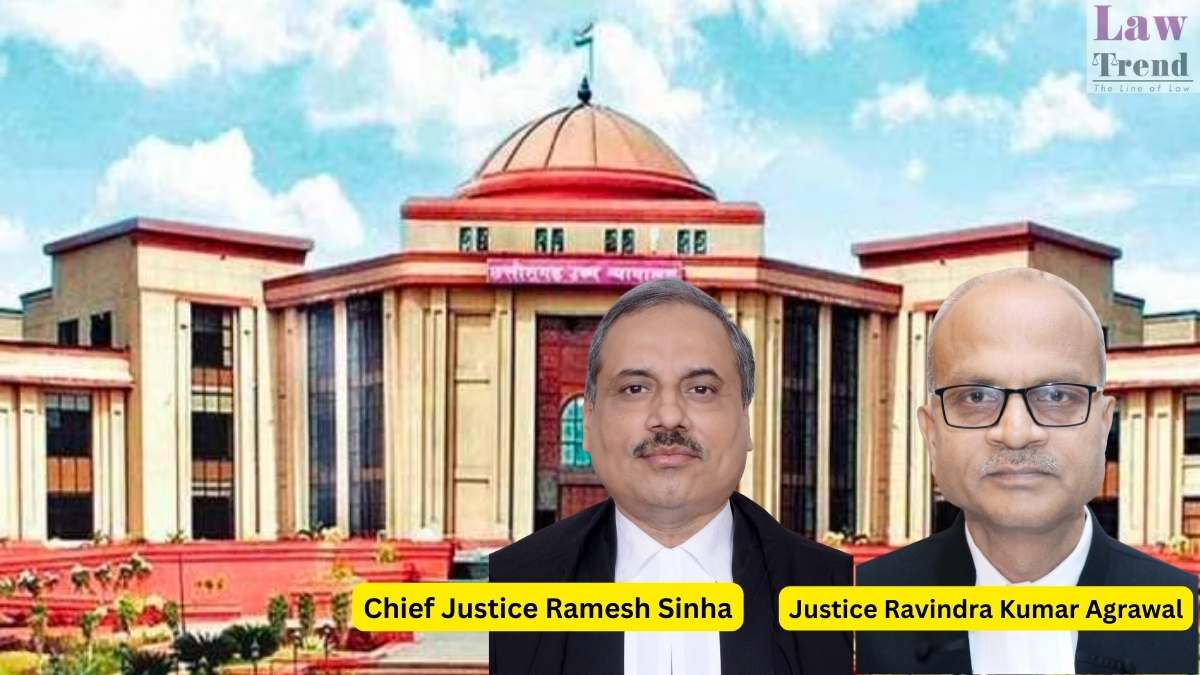
A Division Bench of the High Court of Chhattisgarh at Bilaspur, comprising Chief Justice Ramesh Sinha and Justice Ravindra Kumar Agrawal, has held that where the age of a child victim is established and her testimony is consistent and credible, a conviction for sexual assault can be sustained on her sole testimony without requiring independent corroboration. Dismissing an appeal filed by a stepfather convicted of raping his 13-year-old stepdaughter, the High Court affirmed his 20-year rigorous imprisonment sentence under the Bharatiya Nyaya Sanhita, 2023 (BNS) and the Protection of Children from Sexual Offences (POCSO) Act, 2012.
Background of the Case
The case stems from an incident that occurred during the Hareli festival in 2024. According to the prosecution, on July 31, 2024, the victim’s mother returned home from work at around 3:00 PM to find her 13-year-old daughter crying. Her younger daughter, aged 9, informed her that their stepfather, Jeetu Patel, had subjected the victim to sexual assault. The victim revealed that while she was sleeping at around 2:00 PM, her stepfather pulled her towards his bed, forcibly removed her clothes, stuffed a cloth in her mouth to stifle her screams, and raped her.
Following a complaint submitted at the Supela Police Station, an FIR was registered at Mohan Nagar Police Station. Investigating authorities seized the victim’s leggings, the bedsheet from the scene, and later the appellant’s lower garment. The victim underwent a medical examination and a radiological test to establish her age. The radiological report (Ex.P-15) assessed her age to be between 13 and 14 years. While the medico-legal case (MLC) report noted a ruptured hymen, the examining doctor noted that a definitive opinion regarding rape could not be given. However, the Regional Forensic Science Laboratory, Bhilai, detected human sperm and semen on several seized items, including the victim’s leggings, vaginal slides, the bedsheet, and the appellant’s lower garment.
On October 31, 2025, the Additional Sessions Judge, Fourth F.T.S.C. Special Court, Durg, convicted the appellant under Sections 64(2)(f) and 65(1) of the BNS and Section 6 of the POCSO Act, sentencing him to 20 years of rigorous imprisonment with a fine of Rs. 1,000. Aggrieved by the verdict, the appellant approached the High Court.
Arguments of the Parties
Counsel for the appellant argued that the trial court failed to properly evaluate material evidence and overlooked significant inconsistencies between the victim’s statement recorded during investigation and her deposition before the court. It was further submitted that the medical evidence was inconclusive as the doctor could not form a definite opinion regarding rape, and the trial court misappreciated the forensic evidence.
Conversely, the State Counsel supported the trial court’s judgment, arguing that minor discrepancies in prosecution statements do not affect the core of the case. The State emphasized that medical evidence is corroborative and a lack of a conclusive medical opinion does not invalidate reliable oral testimony. Furthermore, the State pointed out that the forensic report confirmed the presence of human sperm/semen on both the victim’s and the appellant’s garments, establishing strong corroborative proof.
Court’s Analysis and Key Observations
Evaluating the evidence, the High Court first confirmed that the prosecution had proved the victim’s minority at the time of the incident through the unchallenged radiological report, establishing her as a child under Section 2(d) of the POCSO Act.
Examining the testimony of the victim (PW-1) and her younger sister (PW-2), the Court noted that the victim gave a consistent and cogent account of the assault, matching her statement recorded under Section 164 of the CrPC. The Court observed that minor discrepancies in witness statements naturally arise due to the passage of time and do not dismantle an otherwise trustworthy prosecution case.
Addressing the weight of victim testimony in sexual assault matters, the High Court reiterated settled legal principles, emphasizing that a victim of a sex offense is a victim of crime, not an accomplice, and her testimony carries great weight. Referencing the Supreme Court decision in Rameshwar v. The State of Rajasthan (AIR 1952 SC 54), the Court highlighted the observation of Vivian Bose, J.:
“The rule, which according to the cases has hardened into one of law, is not that corroboration is essential before there can be a conviction but that the necessity of corroboration, as a matter of prudence, except where the circumstances make it safe to dispense with it, must be present to the mind of the judge…”
The Court also discussed the standard of a “sterling witness” as articulated in Rai Sandeep @ Deenu v. State of NCT of Delhi (2012) 8 SCC 21, and cited Ranjit Hazarika v. State of Assam (AIR 1998 SC 635) to reiterate that the testimony of a victim of sexual assault stands on par with an injured witness.
On the medical and scientific aspects, the High Court held that the absence of a conclusive medical opinion on rape does not discredit the victim’s credible ocular account. The Court observed that the Regional Forensic Science Laboratory report provided additional scientific corroboration by detecting human sperm/semen on the appellant’s lower garment, the victim’s clothing, slides, and the bedsheet.
Underscoring the statutory mandate and societal imperative of protecting children, the Court referred to the Supreme Court rulings in Nawabuddin v. State of Uttarakhand (2022) 5 SCC 419, State of Rajasthan v. Om Prakash (2002) 5 SCC 745, and Nipun Saxena v. Union of India (2019) 2 SCC 703. Quoting Nawabuddin, the Court stated:
“Any act of sexual assault or sexual harassment to the children should be viewed very seriously and all such offences of sexual assault, sexual harassment on the children have to be dealt with in a stringent manner and no leniency should be shown to a person who has committed the offence under the POCSO Act.”
The Court further quoted:
“Children are precious human resources of our country; they are the country’s future. The hope of tomorrow rests on them. But unfortunately, in our country, a girl child is in a very vulnerable position. There are different modes of her exploitation, including sexual assault and/or sexual abuse. In our view, exploitation of children in such a manner is a crime against humanity and the society.”
Decision
Finding no perversity or legal error in the trial court’s decision, the High Court concluded that the prosecution had proved its case beyond reasonable doubt. The conviction and 20-year sentence awarded to the appellant were upheld, and the criminal appeal was dismissed.
Case Title: Jeetu Patel @ Jitendra v. State Of Chhattisgarh
Case No.: CRA No. 113 of 2026
Bench: Chief Justice Ramesh Sinha and Justice Ravindra Kumar Agrawal
Date: 22/07/2026