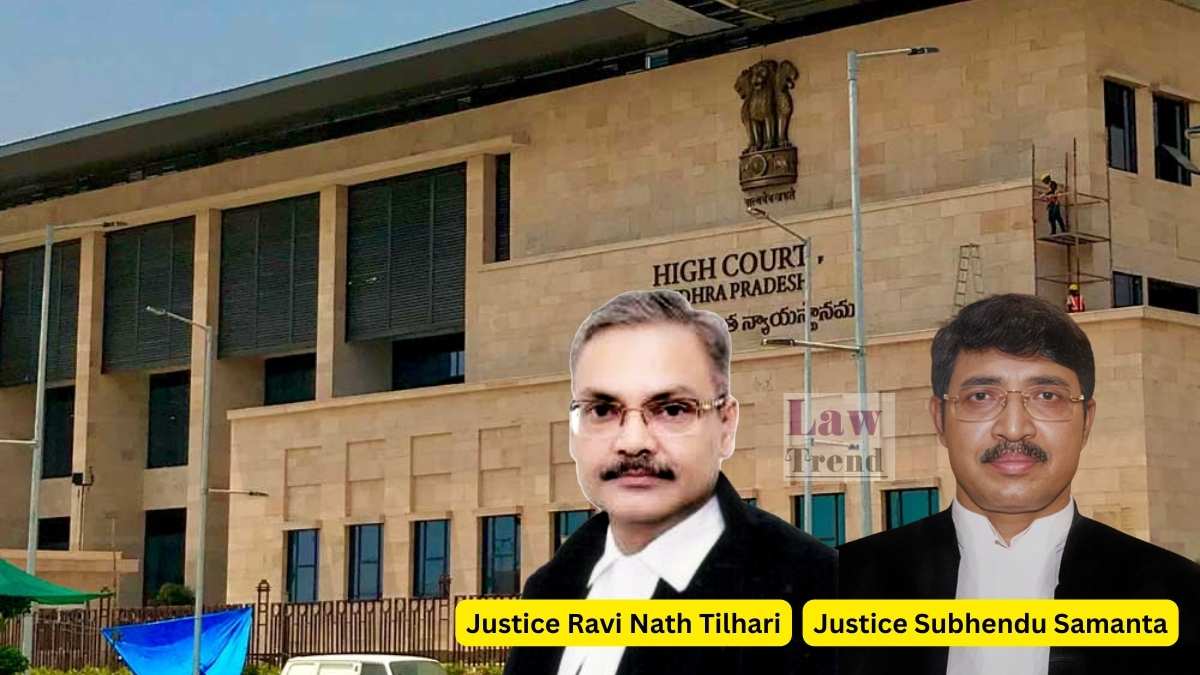
The High Court of Andhra Pradesh has ruled that judicial and quasi-judicial orders must contain reasons, setting aside a one-line order by the Central Administrative Tribunal (CAT) that rejected interim relief to an income tax department official facing departmental proceedings. The division bench comprising Justice Ravi Nath Tilhari and Justice Subhendu Samanta held that reasons are the essential foundation of any order, allowing the writ petition and directing the tribunal to reconsider the prayer for interim relief.
Background of the Case
The petitioner, A. Rajasekhar Gowd, who works as an Office Superintendent in the Office of the Principal Commissioner of Income Tax in Tirupati, was facing departmental proceedings. These proceedings were initiated pursuant to a remitting order passed by the Disciplinary Authority (The Principal Commissioner of Income Tax, Tirupati Charge) on November 20, 2025, under Rule 15(1) of the Central Civil Services (Classification, Control and Appeal) Rules, 1965.
Challenging these proceedings, the petitioner filed Original Application (O.A.) No. 424 of 2026 before the Central Administrative Tribunal, Hyderabad Bench, where he also prayed for interim relief to stay all further departmental proceedings.
By an order dated April 23, 2026, the Tribunal admitted the application and granted the respondents time to file a reply, but summarily rejected the petitioner’s prayer for interim relief. The Tribunal’s order on the interim request simply read:
“Interim Relief, as sought in the O.A., is rejected.”
Aggrieved by this rejection, the petitioner filed the present writ petition under Article 226 of the Constitution of India before the High Court of Andhra Pradesh, seeking a stay on the departmental proceedings and a declaration that the Tribunal’s rejection order was arbitrary, illegal, and violative of the principles of natural justice.
Arguments of the Parties
During the hearing, Sri A. Naga Surya Venkatesh, learned counsel appearing for the petitioner, submitted that the Tribunal’s order was a non-speaking, one-line order. He pointed out that the prayer for interim relief was rejected without providing any justification or analysis.
Conversely, Sri Y.N. Vivekananda, learned counsel appearing on behalf of the respondents (Union of India and others), defended the timeline of the proceedings. He submitted that the Tribunal had listed the matter for a relatively short date—July 23, 2026—before the Registrar’s Court for the completion of pleadings, and therefore, the matter was moving expeditiously.
The Court’s Analysis
Upon considering the submissions and examining the impugned order of the Central Administrative Tribunal, the division bench noted that the rejection of the interim prayer lacked any reasoning whatsoever. The High Court emphasized that the assignment of reasons is an indispensable requirement of law.
The Court observed:
“It is well settled in law that the order must contain the reasons. The reasons are the back bone of the order.”
Evaluating the Tribunal’s decision against this standard, the bench further remarked:
“The impugned order does not stand for reasonable ground.”
Decision of the Court
Consequent to its findings, the High Court allowed the writ petition and quashed the specific portion of the Tribunal’s order by which the prayer for interim relief had been rejected.
The Court directed the Central Administrative Tribunal to reconsider the petitioner’s prayer for interim relief in accordance with the law, ensuring that an opportunity of hearing is afforded to both sides. The bench ordered that this reconsideration must be done expeditiously, specifically on the next scheduled date of July 23, 2026, or, if that is not possible, positively within one week of that date.
The High Court clarified that it has not made any observations regarding the merits of the case itself, either way, and ordered no costs.
Case Details
Case Title: A Rajasekhar Gowd v. Union of India and Others
Case No.: Writ Petition No: 12292/2026
Bench: Justice Ravi Nath Tilhari and Justice Subhendu Samanta
Date: June 19, 2026