

Quashing of Criminal Proceedings Requires Defence Material That Completely Discredits Prosecution Case and Remains Unrefuted: Chhattisgarh High Court
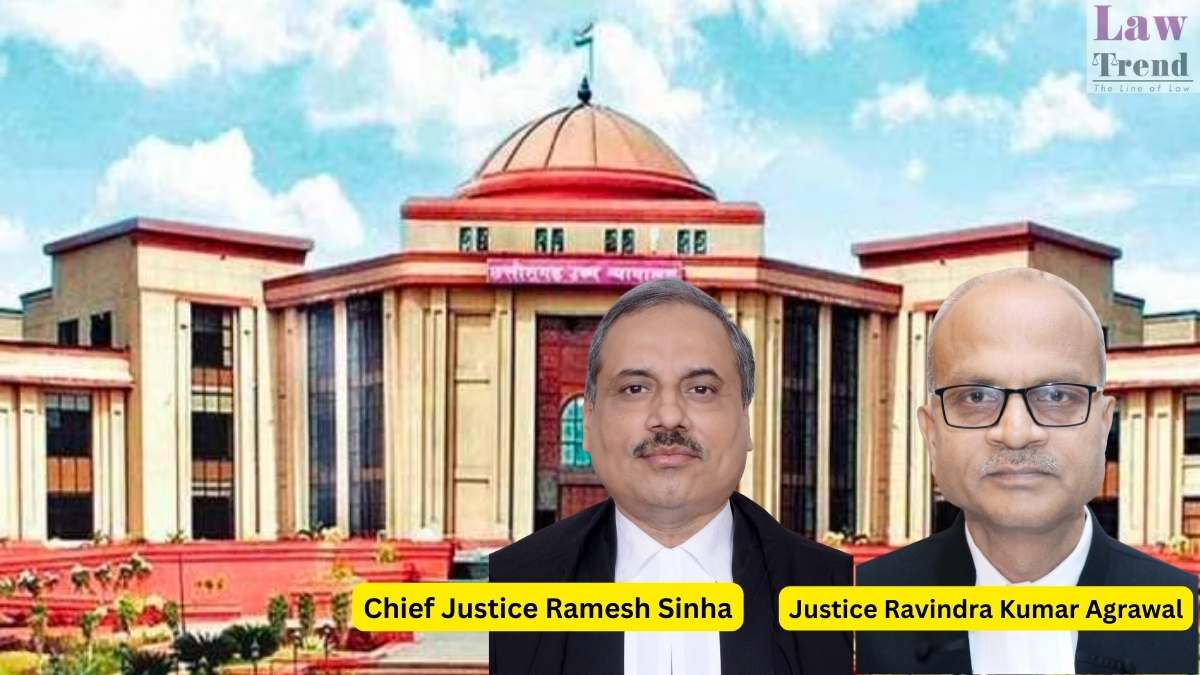

The High Court of Chhattisgarh has ruled that the quashing of an FIR, charge-sheet, or criminal proceedings is permissible only when the defense material is of unimpeachable quality, completely rules out the prosecution’s case, and remains unrefuted. A Division Bench comprising Chief Justice Ramesh Sinha and Justice Ravindra Kumar Agrawal passed the ruling while dismissing a petition filed by Nishant Sahu. The petitioner sought to quash an FIR, a charge-sheet, and subsequent criminal proceedings registered under Sections 420, 467, and 34 of the Indian Penal Code (IPC).

The court observed that unless all conditions of the strict legal test for quashing are cumulatively met, a criminal matter must proceed to trial.

Background of the Case

The petitioner, Nishant Sahu, was the proprietor of M/s Sai Nath Enterprises and had obtained registration under the Chhattisgarh Value Added Tax (VAT) Act, 2005, on October 2, 2013, to trade in coal and coke. The prosecution alleged that several registered dealers had claimed wrongful input tax credit using bogus bills issued under the petitioner’s firm name.

While the petitioner disclosed sales of approximately Rs 47.37 lakh in his VAT returns, departmental software and online records reflected transactions totaling approximately Rs 356.25 lakh. This discrepancy led to allegations that bogus bills were generated to facilitate wrongful tax evasion of Rs 17.81 lakh, causing a corresponding loss to the State exchequer.

An FIR (Crime No. 361/2014) was registered against the petitioner on June 27, 2014, at Police Station Civil Lines, Bilaspur. Following an investigation, the police submitted a charge-sheet on July 16, 2025. The Chief Judicial Magistrate, Bilaspur, took cognizance on July 23, 2025, and subsequently framed charges under Sections 420, 467, and 34 of the IPC on November 6, 2025, which were challenged in these proceedings.

READ ALSO  No One Should be Vexed Twice in a Litigation For One and the Same Cause: SC Reiterates on Constructive Res Judicata

Arguments of the Parties

The petitioner’s counsel argued that the allegations, even if accepted, arose out of violations of the Chhattisgarh VAT Act, 2005, which is a special fiscal statute providing an exclusive mechanism for tax assessment, adjudication, and penalties. It was contended that because the offences under the VAT Act are bailable, the invocation of IPC sections for cheating and forgery was an abuse of the process of law.

The petitioner further contended that no reassessment proceedings under Section 22 of the VAT Act were conducted to determine the actual tax liability, nor was any prior sanction obtained from the competent authority before registering the FIR. The defense also argued that an inordinate delay of nearly eleven years in completing the investigation violated the petitioner’s right to a speedy trial under Article 21 of the Constitution. Finally, the petitioner relied on witness statements to argue that another individual, Sonu @ Piyush Singh, was the actual mastermind behind the bogus bills, and that the alleged tax liability had already been discharged.

Opposing the petition, the State counsel submitted that the FIR was registered based on a written complaint by the Commercial Tax Officer, Bilaspur. The State argued that the investigation revealed that the petitioner and co-accused Sonu @ Piyush Singh had acted in concert to generate fake invoices to facilitate wrongful input tax credit for various traders.

Addressing the delay, the State explained that the petitioner had absconded immediately after the registration of the crime, shifted outside the state, and was only apprehended on May 29, 2025, in Pune, Maharashtra, after his mobile location was traced. The co-accused, Sonu @ Piyush Singh, remains at large. The State asserted that disputed factual questions must be tested during trial rather than in a quashing petition.

READ ALSO  दिशा-निर्देशों का पालन न करने वाले डॉक्टर मरीजों के लिए मुश्किलें खड़ी कर रहे हैं: छत्तीसगढ़ हाईकोर्ट ने स्वास्थ्य सेवाओं में जवाबदेही का निर्देश दिया 

The Court’s Analysis

The High Court examined the well-settled principles governing the exercise of inherent powers under Section 528 of the Bharatiya Nagarik Suraksha Sanhita, 2023 (BNSS). Referring to landmark Supreme Court judgments, including Rupan Deol Bajaj v. K.P.S. Gill, Rajesh Bajaj v. State of NCT of Delhi, and Medchl Chemicals & Pharma (P) Ltd. v. Biological E Ltd., the bench reiterated that if a prima facie case is made out, the court should not quash the proceedings.

The court also cited Neeharika Infrastructure Pvt. Ltd. v. State of Maharashtra and Pradeep Kumar Kesharwani v. State of Uttar Pradesh, which incorporates the four-step test from Rajiv Thapar v. Madan Lal Kapoor, to emphasize that the High Court cannot conduct a mini-trial or evaluate the truthfulness of the allegations at the threshold stage.

Evaluating the petitioner’s argument on the exclusivity of the VAT Act, the High Court held:

“It is well settled that merely because a transaction has civil, commercial or fiscal ramifications, criminal proceedings do not become untenable if the allegations prima facie disclose the ingredients of a criminal offence.”

The court observed that the prosecution case extended beyond a mere fiscal irregularity, pointing instead to a deliberate system of generating bogus sales invoices and fictitious transactions. Regarding the delay in completing the investigation, the court accepted the prosecution’s explanation that the petitioner had absconded, stating:

“Mere delay in investigation, by itself, cannot be a ground for quashing criminal proceedings when the materials collected during investigation prima facie disclose commission of cognizable offences.”

The court also declined to evaluate the evidentiary value of witness statements or the petitioner’s defense that the tax liability had already been discharged, emphasizing that:

“the High Court, while exercising its inherent jurisdiction, does not function as a trial Court and cannot undertake a roving enquiry into the truthfulness, reliability or admissibility of the material collected during investigation.”

Decision of the Court

Finding that the allegations were neither inherently improbable nor patently frivolous, the Division Bench concluded that the case does not satisfy the strict cumulative conditions required to quash criminal proceedings.

Consequently, the High Court dismissed the petition, refusing to quash the FIR, charge-sheet, cognizance order, or the framing of charges. The court, however, clarified that its observations are confined solely to the disposal of the petition and must not be construed as an expression of opinion on the merits of the case during the trial.

READ ALSO  सजा में छूट विवेकाधीन है, लेकिन संविधान के अनुच्छेद 14 और 21 का पालन करना होगा: छत्तीसगढ़ हाईकोर्ट

Case Title: Nishant Sahu S/o Ramesh Sahu v. State of Chhattisgarh
Case No.: CRMP No. 1451 of 2026
Bench: Chief Justice Ramesh Sinha and Justice Ravindra Kumar Agrawal
Date: 16.06.2026

Law Trend
Law Trendhttps://lawtrend.in/
Legal News Website Providing Latest Judgments of Supreme Court and High Court

Related Articles

Latest Articles

