

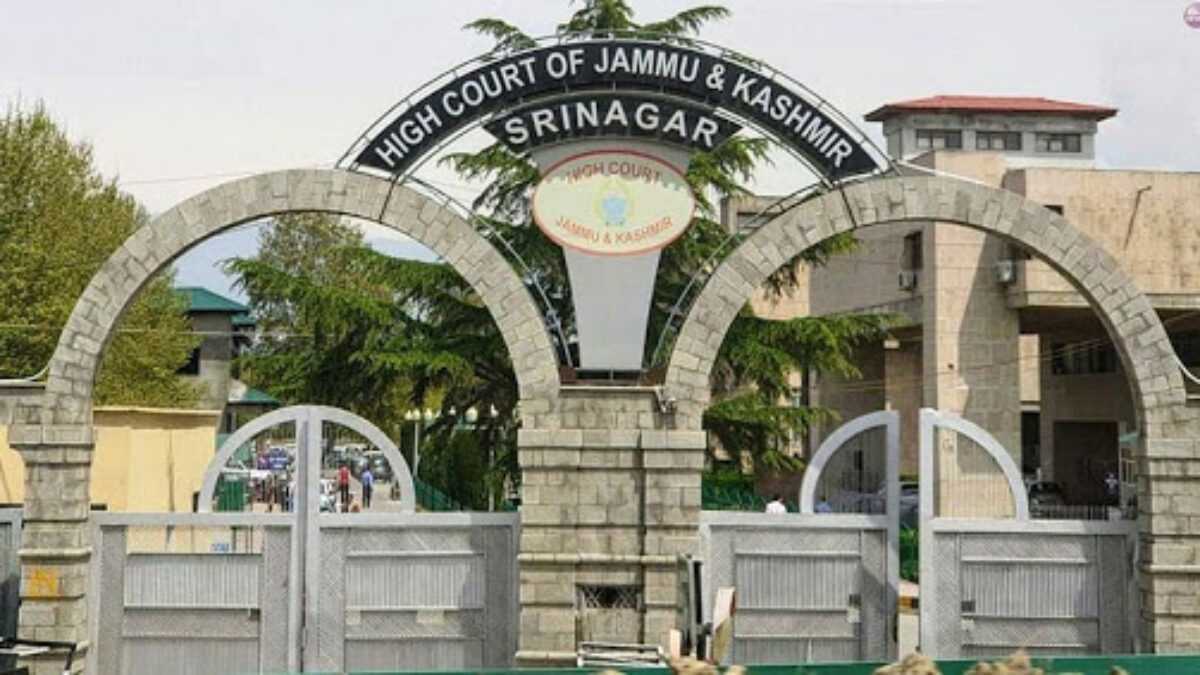
The Jammu and Kashmir and Ladakh High Court has ruled that the central government cannot restrict disability pension arrears to three years prior to a claim once a retired soldier’s eligibility has been legally recognized.
Upholding an Armed Forces Tribunal (AFT) order, a division bench of Justices Sindhu Sharma and Shahzad Azeem affirmed that a former Army Naik is entitled to have his disability pension rounded off from 20 percent to 50 percent for life. The court, in its June 4 decision, slightly modified the AFT’s November 10, 2022 order, directing that the benefits be paid starting October 1, 2001, instead of January 1, 1996.
The case involved former Naik Ranjit Singh, who joined the Indian Army in September 1984 and was discharged in 2001 after completing his term of engagement. At the time of his discharge, a release medical board diagnosed him with Bilateral Sensori Neural Deafness and assessed his disability at 20 percent for two years, after which he was granted a disability pension.
Arguments And Legal Precedents
The central government challenged the tribunal’s order, arguing that because Singh completed his service term rather than being medically boarded out, he was only entitled to the rounded-off benefits starting January 1, 2016, under a February 2018 policy circular. The Centre also contended that the pension arrears should only be calculated from the date Singh filed his application with the tribunal, rather than his original discharge date.
However, the High Court rejected these arguments, noting that the entitlement of personnel who complete their term of engagement to receive rounded-off disability benefits is already established by the Supreme Court of India in the case of Union of India v. Ram Avtar.
Furthermore, the bench cited the Supreme Court precedent in Union of India v. Sgt Girish Kumar, which settled that once an individual’s entitlement to a disability pension or its re-computation is established, the benefits cannot be limited by restricting arrears to the three years preceding the legal filing. The apex court had also ruled that objections regarding delays or limitations in these matters lack merit.
Similar Rulings By Punjab And Haryana High Court
In parallel developments, the Punjab and Haryana High Court recently dismissed challenges filed by the central government against AFT orders granting disability pensions to two other veterans.
On May 25, a division bench of Justices Harsimran Singh Sethi and Deepak Manchanda upheld an order granting disability pension and rounding off benefits from 30 percent to 50 percent for life to a former Army member. The soldier had developed primary hypertension during his service. The court ruled that since the individual was declared medically fit during his initial enrolment, any disability arising during service must be attributed to military service, adding that unsubstantiated medical board reports cannot override a veteran’s right to these benefits.
On May 29, the same bench of Justices Sethi and Manchanda upheld disability pension and rounding-off benefits from 20 percent to 50 percent for life for a retired sergeant who developed Diabetes Mellitus Type-II after serving for 27 years. The court repeated its stance that any medical condition arising during service is presumed to be service-related if the soldier was fit at the time of enlistment.




