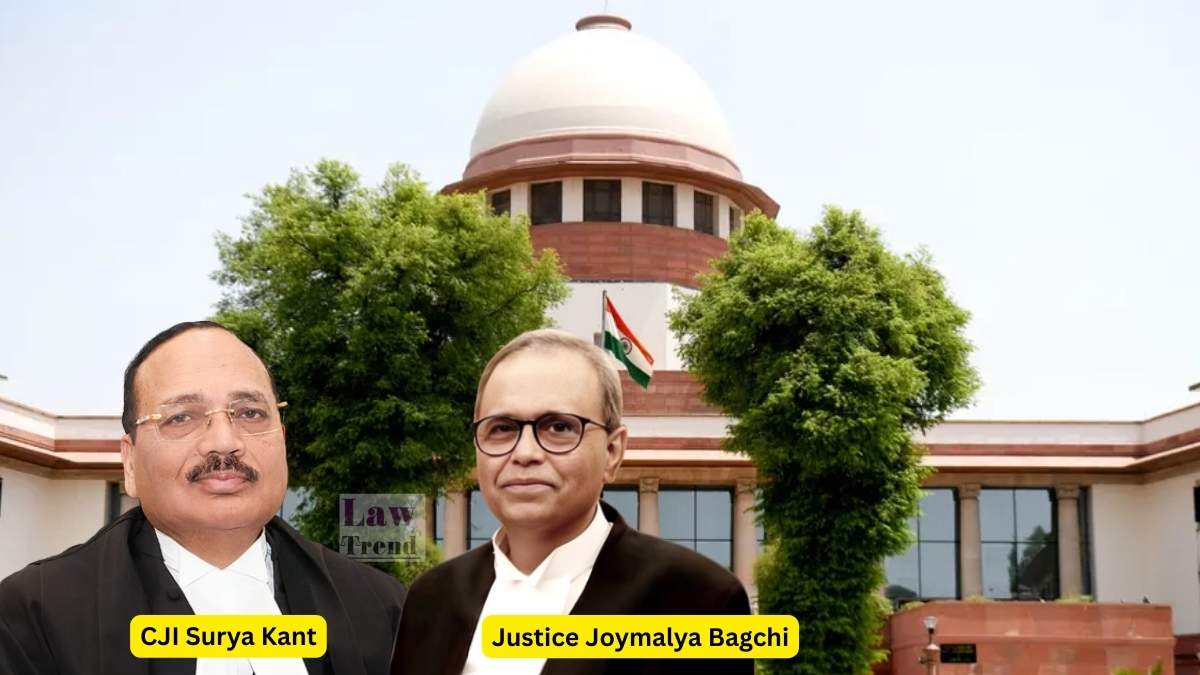
A division bench comprising CJI Surya Kant and Justice Joymalya Bagchi has upheld the authority of the Election Commission of India (ECI) to conduct a Special Intensive Revision (SIR) of electoral rolls and carry out a limited inquiry into the citizenship of voters. In a landmark judgment, the Supreme Court ruled that while the ECI has the administrative power to verify an elector’s citizenship for electoral purposes, any final deletion of a voter’s name on suspicion of non-citizenship must be referred to the competent authority under the Citizenship Act, 1955, within four weeks for formal adjudication.
The judgment disposed of a batch of writ petitions led by the Association for Democratic Reforms (ADR), which challenged the ECI’s order dated June 24, 2025, directing a Special Intensive Revision in the State of Bihar. While some petitioners alleged that the exercise would lead to arbitrary disenfranchisement, other connected petitions supported the exercise to prevent the inclusion of ineligible persons due to illegal influx.
Behind the Case: How the Dispute Reached the Top Court
The controversy began on June 24, 2025, when the ECI ordered a Special Intensive Revision (SIR) of the electoral rolls across all Assembly constituencies in Bihar. Explaining its decision, the ECI noted that the last intensive revision in Bihar had occurred in 2003, and the rolls had since been updated only through summary revisions. Over more than two decades, substantial changes in the demographic structure of the electorate had occurred due to rapid urbanization, large-scale migration, non-reporting of deaths, and duplicate entries.
Under Clause 11 of the ECI’s order, the 2003 electoral roll was treated as probative evidence of eligibility, unless rebutted. Under Clause 12, any person not listed in the 2003 roll was required to produce one or more of eleven prescribed government documents along with a new Enumeration Form by July 25, 2025. Failure to submit the form resulted in the provisional exclusion of the voter’s name from the draft rolls.
On August 1, 2025, the ECI published a Draft Roll of approximately 7.24 crore electors. Since the electoral roll prior to the SIR featured about 7.89 crore electors, nearly 65 lakh individuals stood excluded from the draft stage for non-submission of the form.
To safeguard the rights of eligible voters, the Supreme Court stepped in with several crucial interim directives during the proceedings:
- July 10, 2025: The Court directed the ECI to accept Aadhaar Cards, Electors Photo Identity Cards (EPIC), and Ration Cards as valid proof of identity and residence alongside the 11 already prescribed documents.
- August 14, 2025: The Court directed the ECI to publish the list of the 65 lakh excluded electors along with the reasons for their exclusion, and to widely publicize this list through print, electronic, and radio media.
- August 22, 2025: The Court impleaded twelve recognized national and state political parties, directing them to instruct their Booth Level Agents (BLAs) to assist voters in submitting claims.
- September 1, 2025: The Court directed the Bihar State Legal Services Authority to deploy para-legal volunteers to assist voters in filing claims, objections, and corrections.
- September 8, 2025: The Court clarified that while an Aadhaar Card is not proof of citizenship under the Aadhaar Act, 2016, Section 23(4) of the Representation of the People Act, 1950 (RP Act) allows it to establish identity. The ECI was directed to treat Aadhaar as the twelfth valid document of identity.
Following these corrective measures, the ECI declared the culmination of the SIR on September 30, 2025. It deleted 3.66 lakh names and added 21.53 lakh names, publishing a final roll of 7.42 crore electors. Bihar’s Legislative Assembly elections were subsequently held in November 2025 under the newly revised rolls, and results were declared on November 14, 2025.
Clashing Arguments: Plenary Powers vs. Civil Rights
The Petitioners’ Arguments
Represented by Senior Counsel including Mr. Kapil Sibal, Dr. Abhishek Manu Singhvi, Mr. Gopal Sankaranarayanan, and others, the petitioners argued that the SIR was unconstitutional, arbitrary, and exclusionary.
They first argued that Article 324 is not a freestanding reservoir of plenary power that can override existing statutes. Citing Mohinder Singh Gill v. Chief Election Commissioner (1978) and A.C. Jose v. Sivan Pillai (1984), they contended that where Parliament has enacted laws (such as the RP Acts of 1950 and 1951, and the Registration of Electors Rules, 1960), the ECI cannot bypass them. They also urged that Section 21(3) of the RP Act is constituency-specific (“any constituency or part of a constituency”) and does not authorize a sweeping statewide or nationwide intensive revision.
Furthermore, relying on Lal Babu Hussein v. Electoral Registration Officer (1995) and Inderjit Barua v. Election Commission of India (1985), the petitioners argued that already-enrolled electors carry a presumption of citizenship and eligibility. Requiring them to undergo a fresh, onerous verification process unlawfully shifts the burden of proof onto the citizen. They contended that removing names from the draft rolls for mere non-submission of the enumeration form bypasses the safeguards in Rule 21A of the 1960 Rules, which mandate a list of proposed deletions, public display, notice, and a reasonable opportunity to be heard.
Lastly, they argued that the formal determination of citizenship falls exclusively within the domain of the Ministry of Home Affairs and the Central Government under the Government of India (Allocation of Business) Rules, 1961, and Section 9(2) of the Citizenship Act, 1955.
The ECI’s Arguments
Senior Counsel Mr. Rakesh Dwivedi, Mr. Maninder Singh, and others defended the ECI’s actions, arguing that the preparation of electoral rolls is a core constitutional duty under Article 324, and parliamentary law cannot extinguish this mandate. Citing Sadiq Ali v. Election Commission of India (1972) and All Party Hill Leaders’ Conference v. Captain W.A. Sangma (1977), they argued that the ECI is not a mere delegate of Parliament and can issue general directions to ensure free and fair elections.
They also submitted that the non-obstante clause in Section 21(3) (“Notwithstanding anything contained in sub-section (2)”) and the phrase “in such manner as it may think fit” free the ECI from the procedural limitations of ordinary summary revisions. Under Section 13(2) of the General Clauses Act, 1897, singular terms include the plural, meaning the word “any” can mean “many” or “all” constituencies, justifying a statewide exercise when systemic, state-wide issues like migration and duplication exist.
The ECI argued that treating 2003 as a baseline was rational because the last intensive revision occurred in 2003, and the Citizenship (Amendment) Act, 2003 introduced a statutory cut-off on January 7, 2004. They clarified that the ECI was not adjudicating citizenship per se but was conducting an administrative inquiry into eligibility, as Section 16 of the RP Act disqualifies non-citizens from being registered as electors.
The Court’s Analysis: Balancing Authority with Due Process
Article 324 and Section 21(3): complementary, not competing powers
The Supreme Court analyzed the constitutional interplay between Article 324 (ECI’s power of superintendence) and Article 327 (Parliament’s power to legislate on elections). The Court held that they are not competing power centers but are complementary.
Quoting In Re: Special Reference No. 1 of 2002 (Gujarat Assembly Election Matter), the Court observed: “…the general power of superintendence, direction, control and conduct of election although vested in the Election Commission under Article 324(1), yet it is subject to any law either made by Parliament or State Legislature, as the case may be, which is also subject to the provisions of the Constitution…”
Similarly, referencing Mohinder Singh Gill, the Court noted that while the ECI must conform to valid legislative provisions, it retains a “reservoir of power” where the law is silent: “…when Parliament or any State Legislature has made valid law relating to or in connection with elections, the Commission, shall act in conformity with, not in violation of, such provisions but where such law is silent Article 324 is a reservoir of power to act for the avowed purpose of, not divorced from, pushing forward a free and fair election with expedition…”
The Court rejected the petitioners’ contention that Section 21(3) could not be applied statewide. Applying a contextual reading and referencing Prabhakaran v. P. Jayarajan (2005), the Court noted that the word “any” can mean “all” or “every” depending on the context. The Court ruled that reading “any” as “only one” would defeat the purpose of the law, forcing the ECI to issue hundreds of individual constituency orders even when state-wide demographic changes required a unified response.
Addressing the procedural autonomy of the ECI during a special revision, the Court held: “The usage of the expression ‘notwithstanding anything contained in sub-section (2)’ is not a mere drafting formality, but a deliberate legislative device to confer an overriding force upon the provision.”
Proportionality and the “Least Restrictive” Option
The Court applied the four-pronged proportionality test to evaluate the ECI’s decision. It found that maintaining an accurate roll directly supports Articles 325 and 326 of the Constitution, ensuring only eligible citizens participate in elections. Standardized physical verification through house-to-house enumeration and forms bears a direct connection to updating demographic changes.
Referencing Vivek Narayan Sharma v. Union of India (2023), the Court noted that deciding complex administrative measures lies within the specialized domain of the ECI. A targeted, piecemeal approach would be “ill-suited” to remedy structural, statewide deficiencies built up over 22 years.
The Court noted that the right to vote is a constitutional right but is subject to statutory verification. Quoting In Re: Section 6A of the Citizenship Act 1955 (2024), the Court observed: “…the right to vote under Article 326 was not merely a statutory right but was a constitutional right that conferred upon citizens the right to vote, subject to certain limitations…”
The Court emphasized that the procedural safeguards introduced during the litigation—such as the inclusion of Aadhaar as a twelfth document, publishing the list of 65 lakh excluded voters, and providing legal and political assistance—ensured a fair balance between electoral integrity and voter inclusion.
Presumption of Regularity and Rule 21A Safeguards
The Court addressed the petitioners’ reliance on Lal Babu Hussein, noting that while an entry in the electoral roll enjoys a presumption of regularity under Section 114 of the Evidence Act, this presumption is rebuttable.
The Court observed: “Such a presumption cannot be elevated into a rule of substantive law that forecloses enquiry. To do so would be to conflate a rebuttable evidentiary device with a conclusive legal fiction, a position neither contemplated by the statute nor supported by precedent.”
The Court defined the ECI’s role in an intensive revision as one of “systemic oversight” rather than bilateral adjudication: “When the Commission embarks upon such an exercise, it acts not as a mere adjudicator between competing claims but as a constitutional authority discharging a duty of systemic oversight. The constitutional power of superintendence, direction, and control over the preparation of electoral rolls, vested in the Commission, necessarily carries with it the authority to verify, scrutinise, and, where necessary, revisit the basis upon which entries have been made.”
Regarding Rule 21A of the 1960 Rules, the Court held that the ECI’s guidelines did not bypass the statutory rule but distributed its safeguards across different stages. Since provisional non-inclusion in the draft roll was followed by a claims-and-objections process featuring notice, physical verification, a reasoned order, and a right of appeal, the substance of Rule 21A was fully preserved.
Evaluating the ECI’s Documentation Regime
The Court ruled that formulating a documentation framework falls within the ECI’s administrative discretion. The ECI’s exclusion of Ration Cards (due to reliability concerns) and EPIC (to avoid circular verification) was held to be reasonable. For Aadhaar, the Court observed that although Section 9 of the Aadhaar Act, 2016 prevents it from being proof of citizenship, the Court’s interim order rightly permitted its use for the limited statutory purpose of establishing identity under Section 23(4) of the RP Act.
Who Decides Citizenship? A Key Jurisdictional Line
The Court drew a clear constitutional distinction between the administrative satisfaction of eligibility and a formal determination of citizenship: “In our considered view, there is a clear and principled distinction between an adjudication of citizenship on the one hand, and an administrative satisfaction as to eligibility for enrolment on the other. The former involves a conclusive determination of status under the Citizenship Act; the latter is a limited enquiry undertaken for the purposes of electoral representation.”
The Court clarified that the ECI’s duty to ensure non-citizens are not registered under Section 16 of the RP Act permits it to inspect citizenship claims administratively: “In view of the statutory requirement under Section 16 of the RP Act, the Commission, in the course of preparing or revising electoral rolls, is undoubtedly empowered to examine questions bearing upon citizenship. However, such an enquiry can only be made from the standpoint of determining inclusion or exclusion from the electoral roll and must be undertaken with due regard to the presumption operating in favour of an elector whose name is already borne on the roll.”
A denial of registration by the ECI does not operate as a final declaration of non-citizenship under the Citizenship Act, nor does it permanently strip an individual of their citizenship claims. It only reflects the ECI’s inability to be satisfied for electoral purposes.
The Supreme Court’s Decision and Directions
Upholding the Special Intensive Revision, the Supreme Court disposed of the writ petitions with the following directions:
- Validity of the SIR: The SIR in Bihar is constitutionally and statutorily valid under Section 21(3) of the RP Act read with Article 324 of the Constitution. It satisfies the test of proportionality and is backed by sufficient procedural safeguards.
- Limited Citizenship Scrutiny: The ECI is empowered to conduct a limited administrative inquiry into the citizenship of electors solely for determining inclusion or exclusion from electoral rolls. This does not amount to a final adjudication of citizenship.
- Four-Week Referral Mandate: In cases where the ECI deleted names from the electoral roll on suspicion of non-citizenship, the ECI is directed to refer such cases to the competent authority under the Citizenship Act, 1955, within four weeks for formal adjudication.
- Timebound Adjudication: The Competent Authority under the Citizenship Act must adjudicate these referred cases in accordance with the law, preferably before the next Parliamentary, Legislative Assembly, or Local Body elections. The authority must provide adequate notice and an opportunity of hearing to the affected individuals.
- Re-inclusion on Positive Adjudication: If the Competent Authority holds that the referred individuals are indeed citizens, they shall be included in the electoral roll.
- Judicial Review for Erroneous Deletions: All persons domiciled in Bihar whose names were erroneously deleted on other grounds—such as being absent, dead, shifted, or duplicated—retain the right to challenge the ECI’s decision through judicial review.
Case Details
Case Title: Association For Democratic Reforms & Ors. v. Election Commission of India & Ors.
Case No.: Writ Petition (Civil) No. 640 of 2025 (with connected matters)
Bench: CJI Surya Kant, Justice Joymalya Bagchi
Date of Judgment: May 27, 2026