

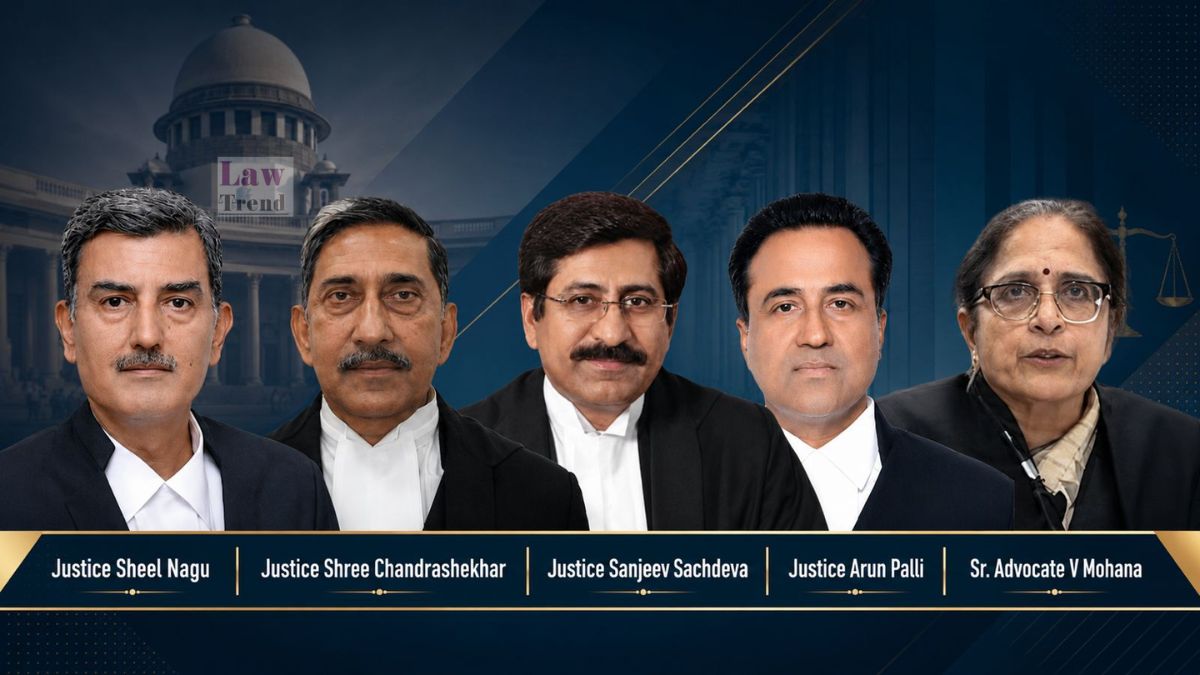
In a major step toward tackling the judicial backlog and enhancing the capacity of the nation’s highest court, five newly appointed judges of the Supreme Court of India took their oaths of office on Tuesday, June 2, 2026.
Chief Justice of India (CJI) Surya Kant administered the oath of office during a formal swearing-in ceremony held at 10:30 a.m. in the Auditorium of the Administrative Buildings Complex at the Supreme Court.
With these high-profile inductions, the working strength of the Supreme Court has risen to 37 judges, leaving only one vacancy against the newly expanded sanctioned strength of 38. Prior to the ceremony, the apex court was functioning with 32 judges.
The Swearing-In Ceremony: A Walkthrough
The solemn proceedings commenced precisely at 10:30 a.m. as the dignitaries took their places on the dais. The ceremony followed the strict, time-honored protocols of the Supreme Court:
- Reading of the Warrants: The Secretary General of the Supreme Court formally requested the Chief Justice of India’s permission to initiate the proceedings. He then read out the Warrants of Appointment issued by the President of India, Droupadi Murmu, for each of the five appointees.
- The Oath Taking: In order of seniority, each judge-designate stepped forward to the podium. Standing opposite CJI Surya Kant, they took the oath of office in the name of God (or solemnly affirmed), pledging to bear true faith and allegiance to the Constitution of India.
- Signing of the Roll: After subscribing to the oath, each newly sworn-in judge signed the formal oath form, shook hands with the Chief Justice, and was presented with a welcoming folder amidst warm applause from the gallery.
The auditorium was packed to capacity, attended by sitting and retired judges of the Supreme Court, senior law officers of the Union Government, office-bearers and members of the Supreme Court Bar Association (SCBA), and the family members of the newly appointed judges.
Meet the New Appointees
The five new additions to the bench comprise four distinguished Chief Justices of various High Courts and one prominent Senior Advocate directly elevated from the Supreme Court Bar. The appointees are:
- Justice Sheel Nagu: Formerly the Chief Justice of the Punjab and Haryana High Court, with his parent High Court being Madhya Pradesh. He was first appointed as a High Court judge in May 2011.
- Justice Shree Chandrashekhar: Formerly the Chief Justice of the Bombay High Court, with his parent High Court being Jharkhand. He was elevated to the High Court bench in January 2013.
- Justice Sanjeev Sachdeva: Formerly the Chief Justice of the Madhya Pradesh High Court, with his parent High Court being Delhi.
- Justice Arun Palli: Formerly the Chief Justice of the High Court of Jammu & Kashmir and Ladakh, with his parent High Court being Punjab and Haryana.
- Senior Advocate V. Mohana: A veteran advocate who has extensively practiced before the Supreme Court in constitutional, civil, and service law matters.
The elevation of Senior Advocate V. Mohana marks a significant milestone in the history of the Indian judiciary. She becomes only the second woman advocate to be directly elevated from the Bar to the Supreme Court bench, following Justice Indu Malhotra’s historic elevation in 2018.
Her appointment also doubles the representation of women on the country’s highest judicial bench. Prior to today, Justice B.V. Nagarathna was the sole serving female judge on the Supreme Court. No female judge had been appointed to the apex court since August 2021, making Mohana’s elevation a crucial step forward for gender diversity in the upper echelons of the judiciary.
The swift appointments follow recommendations made by the Supreme Court Collegium, headed by CJI Surya Kant, in its meetings on May 22 and May 27, which were cleared by the Union Ministry of Law and Justice on Monday.




