

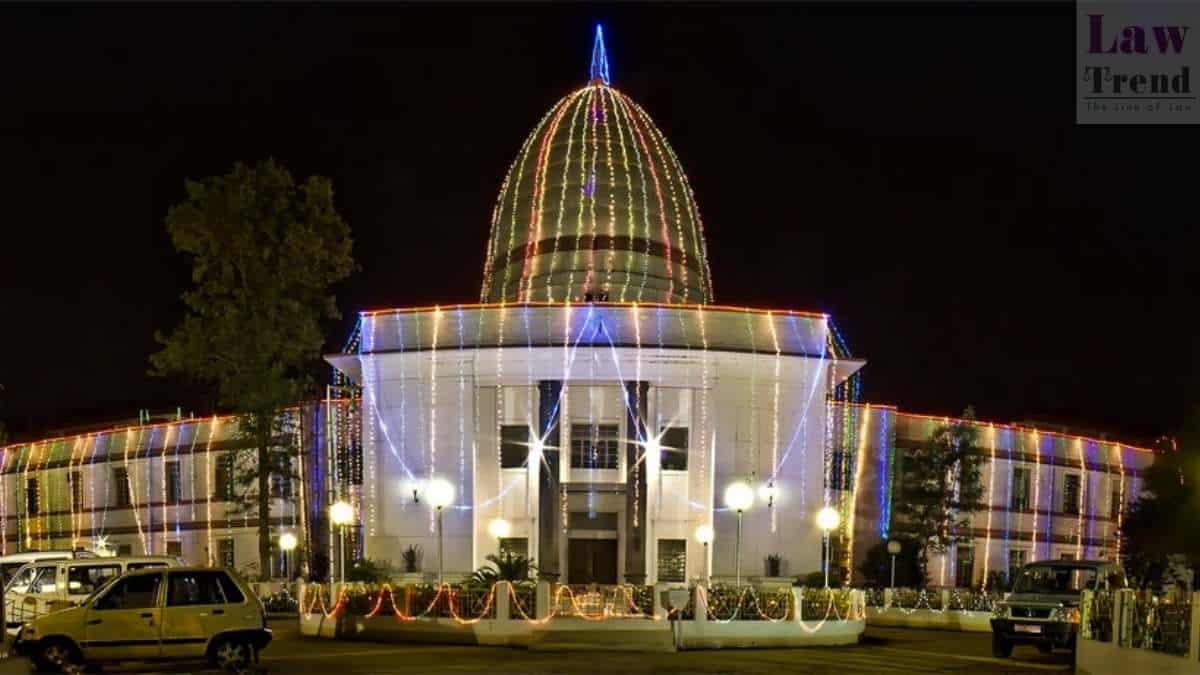
In a major development balancing infrastructure growth with environmental conservation, the Gauhati High Court has directed that no construction work or tree felling for the Rs 5,730-crore Guwahati Ring Road project can begin inside the Amchang Wildlife Sanctuary until a comprehensive ecological impact study is completed.
The order, delivered on Tuesday by a Division Bench comprising Chief Justice Ashutosh Kumar and Justice Arun Dev Choudhury, mandates the Wildlife Institute of India (WII) to conduct the assessment to prevent ecological damage to the sanctuary and its neighboring elephant corridors.
Protecting the ‘Lungs of the Capital’
The High Court’s intervention came in response to a Public Interest Litigation (PIL) filed by citizens Arkasish Chaliha and Mahesh Deka. The petitioners voiced serious concerns over how the mega-highway project was being executed, particularly regarding its threat to the Amchang Wildlife Sanctuary—frequently referred to as the “lungs of the state capital.”
Controversy arose in February when the Guwahati Wildlife Division issued an e-tender seeking bids for felling trees inside the sanctuary to widen the road. The tender pegged the cost for the “operation of trees in connection with diversion of forest land” at Rs 65,15,654, with a tight 90-day completion window.
Responding to environmental concerns, the Assam state government clarified to the High Court that the e-tender was strictly for selecting a contractor in advance and was never intended to initiate immediate logging before an official impact assessment was conducted.
Strict Conditions and Funding Guarantees
While the Standing Committee of the National Board for Wildlife has already granted conditional approval for the project, the High Court has solidified these conditions into strict legal undertakings. The court ruled that:
- No Logging Before Study: Government counsel assured the court that no trees will be felled inside the sanctuary until the WII study is finalized and made available.
- Strict Construction Protocols: All advisories, mitigation measures, and proscriptions—including bans on night-time construction—must be strictly followed to protect local wildlife.
- Rapid Study Timeline: WII has already received the project’s Detailed Project Report (DPR). The institute will draft its technical and financial proposals within two weeks, and the final impact report must be submitted within 90 days of receiving funds.
- NHAI Funding: The National Highways Authority of India (NHAI) has guaranteed the prompt release of funds required to conduct the environmental study.
With these concrete assurances from both the state government and the NHAI, the High Court officially closed and disposed of the PIL. The court noted that the petitioners themselves did not oppose the ring road, acknowledging its critical importance for regional traffic management, provided local wildlife habitats are safeguarded.
The Scale of the Rs 5,730-Crore Guwahati Ring Road
The foundation stone for the massive 121.43 km Guwahati Ring Road was laid by Prime Minister Narendra Modi in September last year. Designed to bypass the capital city, the project aims to ease major traffic congestion and facilitate the seamless movement of heavy vehicles and long-distance trucks traveling from states like West Bengal and Bihar.
The mega-project represents a total investment of Rs 5,730 crore, split into two main financial allocations:
- Road Development: Rs 4,530 crore
- Brahmaputra Bridge: Rs 1,200 crore for a massive 2.9 km bridge connecting Narengi on the southern bank to Kuruwa on the northern bank.
Project Layout: Three Key Sections
The 121.43 km project is split into three distinct phases:
- Section 1 (55 km): Connecting Baihata Chariali to Sonapur via Kuruwa and Chandrapur. This section features a four-lane road, multiple six-lane bridges (including the Kuruwa-Narengi bridge over the Brahmaputra), five additional bridges, three flyovers, and three road over-bridges.
- Section 2: Upgrading the existing four-lane stretch on NH-27 from Jayanagar underpass to Jorabat into a six-lane highway, complete with two new flyovers.
- Section 3: Upgrading the current four- and six-lane highway on NH-27 stretching from Baihata Chariali to Sonapur.
By ensuring that the WII’s mitigation measures are fully integrated into these construction phases, the High Court hopes to establish a sustainable path forward that delivers vital infrastructure while preserving Assam’s rich biodiversity.




