

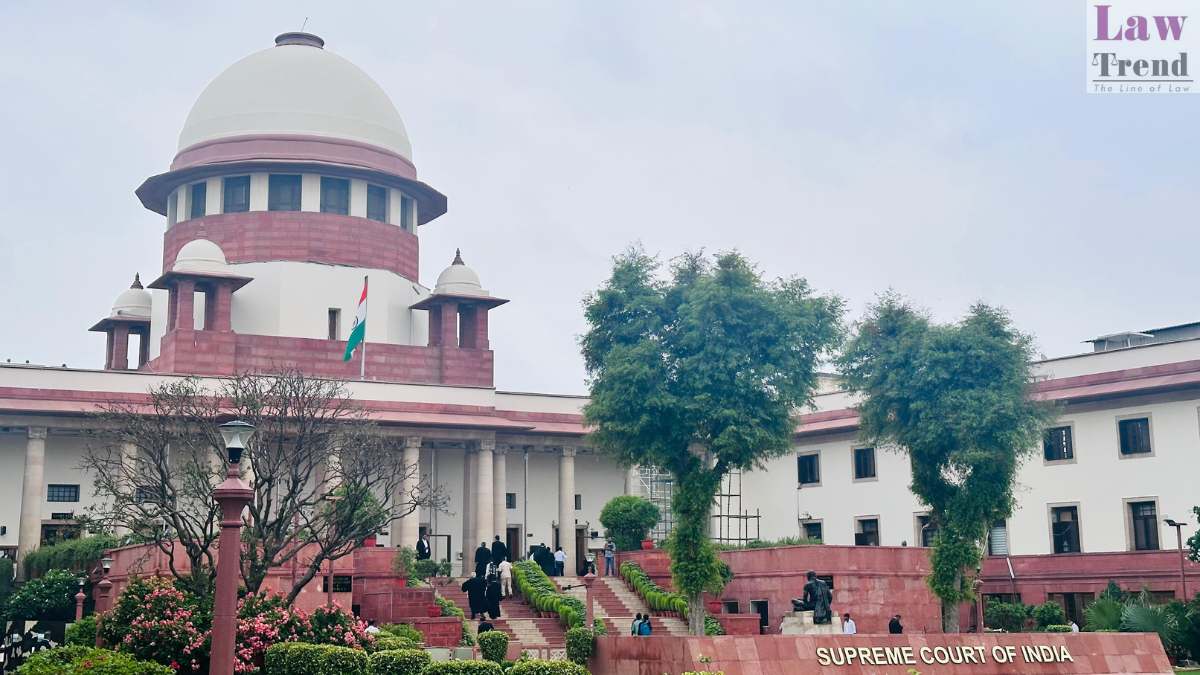
In a major development for legal education, the Supreme Court of India on Tuesday, May 26, 2026, stayed a landmark Delhi High Court order that had prohibited law colleges and universities from detaining students for failing to meet minimum attendance requirements.
A Bench of Justices Vikram Nath and Sandeep Mehta issued the stay after observing that all National Law Universities (NLUs) were “suffering” because of the ruling, adding that students simply do not want mandatory attendance. The apex court warned that if students are not required to attend classes, law school hostels could risk becoming “just boarding and lodging facilities.”
The Supreme Court has scheduled the next hearing on the matter for July 21, 2026.
Prospective Stay on Student Detentions
The Supreme Court’s interim order specifically targets the execution of paragraph 249 of the High Court’s November 2025 verdict, which had stripped law institutions of their power to block students from taking semester exams or progressing academically due to short attendance.
“In the meantime, effect and operation of paragraph 249 of the impugned judgement shall remain stayed. However, the same shall be effective prospectively,” the Bench ruled.
The court made it clear, however, that the ongoing proceedings before the Supreme Court will not prevent other High Courts across the country from deciding similar pending petitions regarding attendance norms.
The stay comes in response to several petitions, including a challenge filed by the Bar Council of India (BCI). During Tuesday’s proceedings, the Supreme Court bench questioned senior advocate Manan Kumar Mishra, who also serves as the Chairman of the BCI, about why it took the council nearly six months to challenge the High Court’s November ruling. The top court had previously agreed to hear a challenge to the verdict on May 13.
Senior advocate Mukul Rohatgi, representing parties in the matter, argued strongly in favor of halting the High Court’s directive.
“Does the judgment give a right to the students not to go to the classes?” the Bench remarked, questioning what teachers at NLUs and other universities would do if students were entirely excused from classroom attendance.
The Delhi High Court’s Landmark November Verdict
The dispute stems from a sweeping November 2025 judgment by the Delhi High Court. In its ruling, the High Court had declared, “No student enrolled in any recognised law college, university, or institution in India shall be detained from taking examination or be prevented from further academic pursuits or career progression on the ground of lack of minimum attendance.”
The High Court’s decision was aimed at reforming what it viewed as overly rigid academic structures. It argued that attendance rules should not be made so stringent that they cause mental trauma, let alone lead to the death of a student.
This ruling was delivered during the disposal of a suo motu petition, which had originally been initiated by the Supreme Court before being transferred to the High Court. The case was tied directly to the tragic death of Sushant Rohilla, a third-year law student in New Delhi. Rohilla was found dead at his home on August 10, 2016, after his college allegedly barred him from sitting for semester exams due to a lack of requisite attendance. He left behind a note stating that he was a failure and did not wish to live.
In its attempt to prevent similar tragedies, the High Court had issued several directives, including:
- Attendance Re-evaluation: Directing the BCI to re-evaluate mandatory attendance rules for both three-year and five-year LLB courses.
- Alternative Academic Credits: Advising the BCI to modify rules so students could receive attendance credit for participating in moot courts, seminars, model parliaments, debates, and attending court hearings.
- Institutional Limits: Mandating that no law school or university be permitted to enforce attendance standards stricter than the minimum percentage prescribed by the BCI under the Legal Education Rules.
- Student Welfare Support: Requiring all educational institutions and universities to establish Grievance Redressal Committees (GRCs) under the University Grants Commission (UGC) Regulations, 2023, to safeguard student interests and mental health. The UGC was also directed to consider amending its regulations to support this.
By staying paragraph 249, the Supreme Court has temporarily restored the authority of law colleges to enforce minimum attendance rules, setting up a high-stakes legal debate over student welfare versus academic discipline ahead of the July 2026 hearing.




