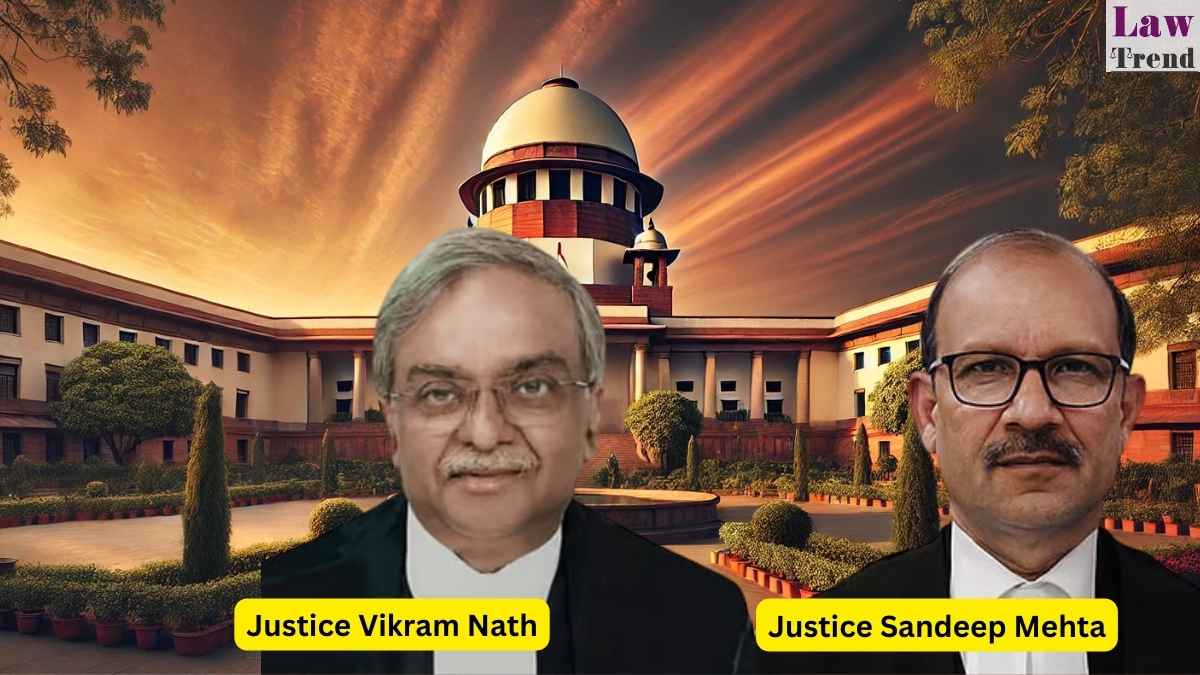
The Supreme Court of India has set aside a Gauhati High Court Division Bench judgment and ruled that the State of Assam cannot deny the benefit of regularization to a left-out group of Muster Roll, Work Charged, and Casual workers who were excluded from a 2005 State policy purely due to clerical errors and administrative lapses.
A Bench of Justice Vikram Nath and Justice Sandeep Mehta held that once the State frames a policy to benefit a defined class and implements it for a vast majority, it is constitutionally obligated under Article 14 of the Constitution to apply it uniformly. The Court affirmed a 2013 Single Judge order directing the State to regularize the eligible left-out workers—who were engaged prior to April 1, 1993—with all consequential pensionary and retiral benefits.
Background of the Case
In the year 1980, the Government of Assam began engaging Muster Roll workers across various departments to meet the growing manpower requirements for public works development and road maintenance. On September 23, 1983, the Assam Cabinet took a decision to regularize all Muster Roll workers who had completed 15 years of service as Grade-IV employees.
Though no formal guidelines were initially framed, the Chief Secretary communicated on March 15, 1984, that Muster Roll workers with 15 years of continuous service would be regularized with effect from August 1, 1984. Additionally, Work Charged employees with five years of continuous service were to be brought under the regular establishment.
Due to persistent administrative delays, the Chief Secretary issued an Office Memorandum on April 20, 1995 (the “1995 O.M.”), directing all departments to initiate steps to regularize Work Charged and Muster Roll workers engaged prior to April 1, 1993. This was followed by an October 11, 1995 O.M. prohibiting any fresh engagement of such workers after the cut-off date. Subsequent circulars in 1998 and 2000 reiterated instructions for prioritization based on seniority.
While a reference on the validity of the 1995 O.M. was pending before a Full Bench of the Gauhati High Court in Jitendra Kalita & Ors. v. State of Assam & Ors., the Assam Cabinet on July 22, 2005, reiterated its decision to regularize workers engaged prior to April 1, 1993, who were in continuous service. Under this policy, the Finance Department concurred with the creation of 5,892 Work Charged grade posts and 25,069 Grade-IV posts, leading to the regularization of approximately 30,000 workers.
Although the Full Bench in Jitendra Kalita subsequently declared on May 17, 2006, that no further regularizations could occur under the 1995 O.M., it did not express an opinion on the validity of the July 22, 2005 Cabinet decision.
A large number of eligible workers engaged prior to April 1, 1993, were excluded from the 2005 regularization process due to clerical lapses, spelling mistakes, or inadvertent omissions. This led to multiple writ petitions, including Ramani Deka and Others v. State of Assam and Others (W.P. (C) No. 1271 of 2006). In those proceedings, the State filed undertakings and affidavits through the Chief Secretary, admitting that approximately 3,720 workers engaged prior to April 1, 1993, remained eligible and that a draft policy was being framed to regularize them against personal posts.
However, in 2012, the State filed a miscellaneous application seeking the High Court’s leave to implement the policy, asserting that the Supreme Court’s ruling in Secretary, State of Karnataka v. Umadevi (2006) created a legal embargo. After a Division Bench of the High Court declined to grant the prayer on March 27, 2012, the Finance Department issued an O.M. on June 16, 2012 (the “2012 O.M.”), declaring that no further regularizations would be undertaken.
The appellants challenged the 2012 O.M. before a learned Single Judge of the Gauhati High Court. On December 20, 2013, the Single Judge quashed the 2012 O.M. and directed the State to regularize the eligible workers. However, on June 8, 2017, a Division Bench of the High Court reversed the Single Judge’s decision in Writ Appeal No. 45 of 2014 (State of Assam v. Upen Das), holding that regularization was impermissible under Umadevi since the workers were not appointed against sanctioned vacant posts. The appellants then approached the Supreme Court.
Arguments of the Parties
For the Appellants
Senior Counsel Shri Manish Goswami and Ms. Anitha Shenoy, representing the appellants, argued that:
- Denying regularization to the appellants while extending it to approximately 30,000 similarly placed workers is manifestly arbitrary and violative of Article 14 of the Constitution.
- The appellants were engaged prior to April 1, 1993, and have rendered continuous service extending over decades. Their exclusion was entirely due to clerical and administrative lapses on the part of the State.
- The State committed itself through clear and unequivocal undertakings before the High Court to frame a policy for left-out workers and cannot now resile from those commitments by citing Umadevi.
- Umadevi does not impose an absolute embargo on regularization. The appellants are not seeking a judicial mandate contrary to the constitutional scheme, but are simply seeking the uniform implementation of an existing, valid executive policy (the 2005 Cabinet decision) which was enacted prior to Umadevi.
- Under the principles of M.L. Kesari, a partial or incomplete “one-time measure” cannot be treated as exhausted for those left out due to administrative oversight.
For the Respondents (State of Assam)
Senior Counsel Shri Jaideep Gupta, appearing for the State of Assam, countered that:
- The appellants were engaged de hors the regular cadre, were never appointed against sanctioned posts, and were not recruited through a legally recognized selection process.
- Executive instructions or Cabinet decisions cannot override the constitutional scheme under Articles 14 and 16, especially after the Constitution Bench ruling in Umadevi.
- The exception under paragraph 53 of Umadevi (as clarified in M.L. Kesari) is narrowly tailored to irregular—and not illegal—appointments of qualified persons working against sanctioned vacant posts for over ten years.
- Past regularizations of other similarly placed employees do not confer a legal right to claim parity, as the principle of equality under Article 14 is a positive concept and cannot be used to perpetuate an illegality.
- Courts cannot direct the creation of posts, as such decisions lie within the executive domain and carry significant financial and administrative implications.
The Court’s Analysis
The Supreme Court examined whether executive action in long-standing administrative arrangements conformed to constitutional standards. Delivering the judgment, Justice Sandeep Mehta observed:
“In matters concerning long-standing administrative arrangements, particularly where the State and its instrumentalities, over time, continue to utilize the services of certain categories of workers in the discharge of its functions, Courts are often required to examine whether executive action conforms to constitutional standards of fairness and consistency. The exercise of public power cannot be divorced from practical realities created by sustained governmental reliance on such workers.”
The Court noted that there was no dispute that the appellants were engaged prior to April 1, 1993, had served continuously for decades, and were indistinguishable from the 30,000 workers regularized under the 2005 policy.
On the Applicability of Umadevi and M.L. Kesari
The Court held that the Division Bench’s reliance on Umadevi and M.L. Kesari was misplaced. The appellants were not invoking the court-mandated “one-time measure” under paragraph 53 of Umadevi, but were instead seeking equal treatment under a voluntary, pre-existing Cabinet policy.
“If two sets of employees stand on the same footing in terms of date of engagement, nature of duties, length of service and eligibility under a declared policy, the State cannot extend a benefit to one large group and deny it to the smaller group without demonstrating a valid distinction. Equality does not allow selective or partial implementation of a policy.”
The Court pointed out that the exclusion of the appellants was entirely due to clerical and administrative mistakes by the State machinery:
“The remaining workers who were left out, though otherwise eligible, cannot be excluded and denied the same benefit. It is crucial to note that the exclusion of the appellants… is not attributable to the appellants but is rather predicated in the actions of the State machinery…”
On the State as a “Model Employer”
The Supreme Court criticized the State of Assam for seeking court permission in 2012 to implement its own 2005 Cabinet policy under the pretext of Umadevi’s legal embargo. The Court observed that seeking prior judicial approval to execute policy measures amounted to an abdication of executive power:
“Regularization, where permissible in law, is an executive function… Seeking permission in the manner done by the State amounted, in effect, to a surrender of its executive authority. The executive cannot abdicate its responsibility by placing the burden upon the Court…”
The Court further noted that the State, as a model employer, must act with probity, fairness, and candor:
“Constantly giving undertakings before a constitutional Court and thereafter resiling from them does not comport with the standards expected of a model employer. An undertaking recorded by a Court is not a casual statement, but is a solemn representation on the basis of which judicial orders are passed. The State cannot approbate and reprobate.”
Relying on its rulings in Jaggo v. Union of India (2024), Bhola Nath v. State of Jharkhand (2026), and Dharam Singh v. State of U.P. (2025), the Court emphasized that the State cannot rely on nominal designations to exploit workers in perpetuity:
“Umadevi (supra) cannot be invoked as a blanket barrier to justify prolonged and continued engagements of a temporary or ad hoc nature, especially where the employees have been discharging essential and recurring functions of the State… The practice of retaining employees for decades under deceptively titled designations, while simultaneously extracting regular work integral to the administration, has been disapproved consistently.”
The Court concluded that since the State had utilized the appellants’ services for decades and regularized 30,000 identically situated employees under its own 2005 policy, it could not reject the remaining fraction of workers:
“The State, having engaged the appellants prior to 1st April, 1993, utilised their services continuously for decades, and having itself framed and implemented a Cabinet policy regularizing nearly 30,000 similarly situated workers, cannot now exclude the appellants by taking shelter behind a rigid or technical reading of Umadevi (supra).”
The Decision
The Supreme Court allowed the appeals, set aside the Gauhati High Court Division Bench judgment dated June 8, 2017, and affirmed the Single Judge’s judgment dated December 20, 2013.
The Court passed the following directions:
- Regularization: The appellants shall be treated as regularized in service in terms of the Cabinet decision dated July 22, 2005, from the date on which the other 30,000 employees were given the benefit.
- Post Creation: The State of Assam shall identify and verify the eligible appellants and create supernumerary posts where necessary.
- Consequential Benefits: The appellants shall be entitled to pay scale fixation, continuity of service, and all applicable pensionary and post-retiral benefits.
- Retired Appellants: Retired appellants shall receive notional regularization with consequential monetary benefits and arrears for recalculating pension, gratuity, and terminal dues.
- Deceased Appellants: Arrears and terminal benefits shall be released to the legal heirs of deceased appellants.
- Timeline: The entire exercise, including calculation and payment of all financial arrears, must be completed within one year from the date of the judgment.
- Scope Limitation: The benefit of these directions applies only to those appellants who were working in State departments before the cut-off date of April 1, 1993.
Connected Appeals
- Work Charged Employees (Civil Appeal Nos. 4519 & 4520 of 2025): The Court clarified that Work Charged employees constitute a distinct class from Muster Roll workers. It set aside the adverse findings against them in the 2017 judgment and gave members of the All Assam Work Charge Employee Association liberty to independently agitate their pensionary and retiral claims before the State Government.
- Inland Water Transport Workers (Civil Appeal No. 4523 of 2025): The Court set aside the High Court’s orders dismissing the pension claims of Muster Roll ferry workers appointed between 1993 and 1995, giving them liberty to pursue their claims before appropriate forums under the applicable policy framework.
Case Details
- Case Title: Sukhendu Bhattacharjee and Others v. The State of Assam and Others
- Case No.: Civil Appeal No. 4514 of 2025 (with Civil Appeal Nos. 4515, 4516, 4517, 4518, 4519, 4520, and 4523 of 2025)
- Bench: Justice Vikram Nath and Justice Sandeep Mehta
- Date of Judgment: May 21, 2026