

No Vested Right To Promotion Under Superseded Executive Instructions When New Service Rules Apply: Supreme Court
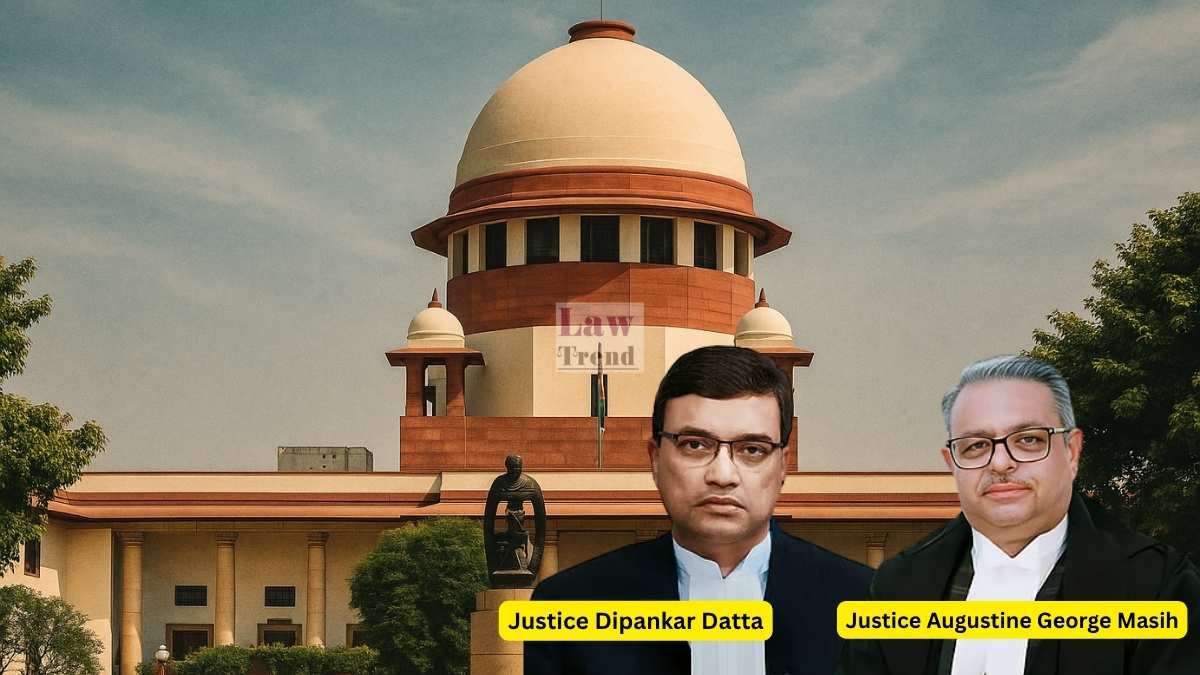

The Supreme Court of India has held that an employee does not have a vested right or legitimate expectation to be promoted under old executive instructions when new statutory service rules have been established. Reversing the judgment of the High Court of Orissa, the Supreme Court ruled that vacancies do not necessarily have to be filled based on the rules in place when they arose, re-emphasizing that the “rule in force” at the time of actual consideration must govern promotional and selection exercises.

A Division Bench comprising Justice Dipankar Datta and Justice Augustine George Masih set aside the orders of both the Single Judge and the Division Bench of the High Court of Orissa, which had directed the state to convene a Departmental Promotion Committee (DPC) to consider two employees for promotion under 1981 Executive Instructions.

Background of the Case

The dispute arose within the Transport Department of the Government of Odisha. On November 17, 1981, the Commerce & Transport (Transport) Department issued Executive Instruction No. 17315 for the recruitment and filling up of four posts of Assistant Regional Transport Officer (ARTO). This gazetted post was created to collect and assess Motor Vehicle Tax and Passenger Tax, with the Transport Commissioner designated as the appointing authority. Under these instructions, a Grade I Assistant (Senior Assistant) with five years of service was eligible for promotion based on merit and suitability, pending the finalization of formal cadre rules.

The respondents, Sreepati Ranjan Dash and Aditya Bhanjan Sahoo, were appointed as Junior Assistants on March 16, 2013, and joined duty on March 18, 2013. On June 10, 2016, both were promoted to the post of Senior Assistant.

In April 2017, all border check gates in the state were abolished, requiring the adjustment of ARTO posts. Subsequently, on October 17, 2017, the Government of Odisha restructured the cadre, making the ARTO, Additional Regional Transport Officers (General), and Regional Transport Officers (General) part of the “Odisha Transport Service.” The ARTO post was upgraded from Group C to Group B, and the appointing authority shifted from the Transport Commissioner to the Government of Odisha.

On January 24, 2019, the General Administration and Public Grievance Department restructured the ministerial cadre, re-designating the post of Senior Assistant as Assistant Section Officer (ASO). Both respondents were redesignated as ASOs on February 16, 2019.

In June 2021, Sahoo submitted a representation for promotion to the post of ARTO under the original 1981 Executive Instructions. The Additional Commissioner of Transport requested the state government to convene a DPC to fill 16 vacant ARTO posts, noting that Dash, Sahoo, and one other officer had completed five years of service as Senior Assistants/ASOs and were eligible.

When the state government rejected the proposal to hold a DPC on July 26, 2021, the respondents successfully moved the High Court. After the High Court remanded the matter for a reasoned decision, the Commerce and Transport (Transport) Department issued formal orders on October 11, 2021, and December 10, 2021, rejecting the recommendations to convene a DPC. The government noted that the post of ARTO was historically an ex-cadre and selection post, and was not part of the respondents’ direct promotional hierarchy, which instead included internal promotional posts like Section Officer, Establishment Officer, and Administrative Officer.

Dash and Sahoo challenged these rejections before a Single Judge of the High Court of Orissa. While their writ petitions were pending, on January 5, 2022, the State framed the Odisha Transport Service (Method of Recruitment and Conditions of Service) Rules, 2021 (the “2021 Rules”) under the proviso to Article 309 of the Constitution of India. These rules mandated that Group B posts in the Odisha Transport Service, including the ARTO post, be filled only through a combined competitive recruitment examination conducted by the Odisha Public Service Commission (OPSC).

READ ALSO  DRT Cannot Entertain a Claim for an Amount Less Than Rs.10 Lakhs Under the SARFAESI Act: Delhi HC

On February 24, 2023, and February 28, 2023, the Single Judge allowed the respondents’ writ petitions, quashing the government’s rejection orders and directing the Transport Commissioner to immediately convene a DPC to consider their promotions under the 1981 Executive Instructions. The State’s subsequent intra-court appeals were dismissed by a Division Bench of the High Court of Orissa on November 7, 2025 (referred to also as November 7, 2023, at certain places in the text), which held that the pending DPC process was saved from supersession by the savings clause in the 2021 Rules.

The State of Odisha subsequently appealed to the Supreme Court.

Arguments of the Parties

Appellants (State of Odisha)

The State of Odisha argued that:

  • The High Court erred in directing the Transport Commissioner to convene a DPC because, after the restructuring of the cadre on October 17, 2017, the Government of Odisha became the sole appointing authority, and the Transport Commissioner had no jurisdiction to hold a DPC.
  • The 1981 Executive Instructions were temporary and stood superseded by the statutory 2021 Rules framed under Article 309.
  • Under the 2021 Rules, the post of ARTO must be filled through a competitive examination conducted by the OPSC, and no promotion via selection is permitted.
  • The mere existence of vacancies does not confer any vested right of promotion upon the respondents. An employee is only entitled to be considered in accordance with the rules in force when the competent authority actively decides to undertake such consideration.
  • The High Court’s findings directly contradict the Supreme Court’s three-judge bench decision in State of H.P. v. Raj Kumar (2023) 3 SCC 773.

Respondents (Sreepati Ranjan Dash and Aditya Bhanjan Sahoo)

The respondents contended that:

  • Their claims were considered and rejected in October and December 2021, which was prior to the enactment of the 2021 Rules on January 5, 2022.
  • Until the 2021 Rules came into force, the 1981 Executive Instructions remained fully operative and held statutory force under Article 162 of the Constitution, as supported by Dr. Sharmad v. State of Kerala 2025 SCC OnLine SC 71.
  • The change in their designation from Senior Assistant to Assistant Section Officer was minor and did not alter their roles, functions, or eligibility.
  • Under the principle in Shankarshan Dash v. Union of India & Ors (1991) 3 SCC 47, any decision by the government not to fill up vacancies must be backed by bona fide and appropriate reasons.
  • The ruling in Raj Kumar (supra) should not apply because it was delivered after their case was considered, and it should only have prospective application.
READ ALSO  Injunction Order Against Third Party Can’t be Passed Without Hearing that Party: Supreme Court

The Court’s Analysis

The Supreme Court examined the legal framework surrounding promotional rights, the restructuring of cadres, and the supersession of executive instructions by statutory rules.

1. The High Court’s Failure to Apply Raj Kumar

The Supreme Court expressed strong disapproval of the Orissa High Court Division Bench’s summary dismissal of the Raj Kumar precedent. Justice Dipankar Datta noted:

“We are pained to observe that a bare perusal of the law laid down in Raj Kumar (supra) would have set the entire controversy at rest, particularly when the portion extracted above was set out in the arguments on behalf of the State. Reliance placed by learned counsel for the State on a precedent, having a bearing on the issue, ought to receive due judicial consideration. Mere reference of the precedent in the passing without engaging with it in the analysis is not sufficient compliance with the duty to assign reasons.”

2. Overruling of Y.V. Rangaiah and No Vested Right to Promotion

The Court reiterated that an employee has no fundamental right to be promoted. Citing Haryana SEB v. Gulshan Lal (2009) 12 SCC 231, the Bench observed:

“This Court has observed that an employee does not have a vested right to be promoted nor does he possess a legitimate expectation to be promoted… The limited right that an employee can legitimately claim is for consideration of his candidature. However, should the government, being the appointing authority choose, in its wisdom, to not fill up vacancies by promotion, especially when there is a change in cadre and restructuring of posts, it cannot be compelled to carry out the appointments.”

The Court explained that the landmark ruling in State of H.P. v. Raj Kumar (supra) had explicitly overruled the decades-old principle in Y.V. Rangaiah v. J. Sreenivasa Rao (1983) 3 SCC 284, which previously mandated that vacancies must be filled under the rules in force when they arose. The Court quoted the key holdings from Raj Kumar:

“82.1. There is no rule of universal application that vacancies must be necessarily filled on the basis of the law which existed on the date when they arose, Rangaiah case must be understood in the context of the rules involved therein.”

“82.2. It is now a settled proposition of law that a candidate has a right to be considered in the light of the existing rules, which implies the ‘rule in force’ as on the date consideration takes place. The right to be considered for promotion occurs on the date of consideration of the eligible candidates.”

“85.1. The statement in Y.V. Rangaiah that, ‘the vacancies which occurred prior to the amended Rules would be governed by the old Rules and not by the amended Rules’, does not reflect the correct proposition of law governing services under the Union and the States under Part XIV of the Constitution. It is hereby overruled.”

The Bench concluded that because the High Court’s orders proceeded on the logic of Y.V. Rangaiah, they were legally unsustainable.

3. Executive Instructions vs. Article 309 Rules

The Bench pointed out that the 1981 Executive Instructions were explicitly a temporary, pro-tem arrangement. Paragraph 4 of the instructions started with: “Pending finalization of the cadre rules for recruitment to the posts of Asst. Regional Transport Officer, selections may be made…” This temporary arrangement ended when the 2021 Rules were enacted under Article 309 of the Constitution.

Citing Union of India v. Somasundaram Viswanath (1989) 1 SCC 175, the Court held:

READ ALSO  Even If the Custodial Interrogation Is Not Required or Necessitated by Itself, Cannot Be Ground to Grant Anticipatory Bail: Kerala HC

“If there is a conflict between the executive instructions and the rules made under the proviso to Article 309 of the Constitution of India, the rules made under proviso to Article 309 of the Constitution of India prevail…”

4. Interpretation of ‘Supersession’ and Saving Clauses

The High Court Division Bench had reasoned that because the 2021 Rules superseded earlier instructions “except as respect things done or omitted to be done before such supersession,” the ongoing process to hold a DPC was saved. The Supreme Court rejected this, clarifying that “things done” refers only to fully completed actions, such as promotions already finalized:

“On the contrary, in the present facts, not only were the appointments not made, even the DPC was not constituted. In such a case, there is no act for the 2021 Rules to save it from ‘supersession’. An act which was permissible and, in fact, done in pursuance of the Executive Instructions and found inconsistent with the 2021 Rules could certainly be saved, if so warranted. However, the Transport Commissioner’s letter, requesting that the DPC be convened cannot, by any stretch of imagination, be construed as an act done under the Executive Instructions.”

5. Promotion vs. Selection Post

The Supreme Court drew a sharp distinction between a routine promotional post and a selection post. Citing H.P. SEB v. K.R. Gulati (1998) 2 SCC 624 and Sant Ram Sharma v. State of Rajasthan AIR 1967 SC 1910, the Court observed that for selection posts, ranking in a gradation list does not guarantee promotion, as merit and policy considerations take precedence. The Bench observed:

“The post being a selection post and not one of promotion, the manner of selection is a matter of policy which completely vests with the Government. If the Government deemed it fit to change the method of selection, it was within its power, authority and competence and unless the changed policy is proved to be arbitrary, Dash and Sahoo cannot have a claim to the post.”

The Decision

The Supreme Court allowed the appeals filed by the State of Odisha and set aside the impugned orders passed by the Single Judge and the Division Bench of the High Court of Orissa. All interim orders protecting the respondents’ claims were vacated, and the parties were ordered to bear their own costs.

Case Details:

  • Case Title: State of Odisha & Ors. v. Sreepati Ranjan Dash (with Civil Appeal No. 13122 of 2025: State of Odisha & Ors. v. Aditya Bhanjan Sahoo)
  • Case No.: Civil Appeal No. 13121 of 2025 with Civil Appeal No. 13122 of 2025
  • Bench: Justice Dipankar Datta and Justice Augustine George Masih
  • Date: May 18, 2026

Law Trend
Law Trendhttps://lawtrend.in/
Legal News Website Providing Latest Judgments of Supreme Court and High Court

Related Articles

Latest Articles

