


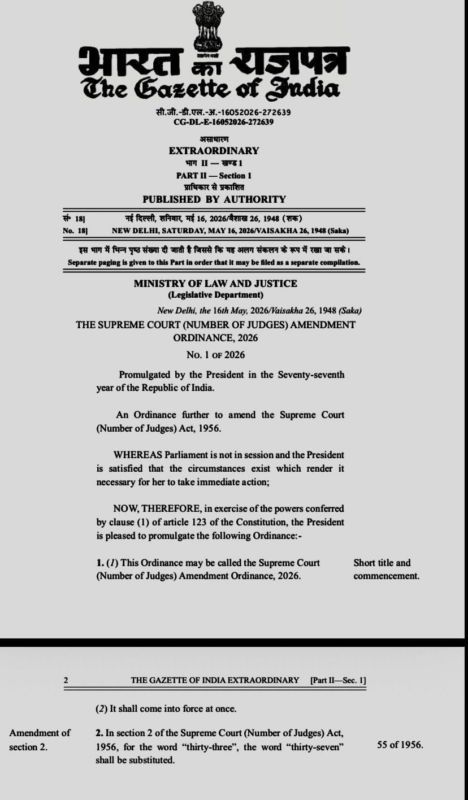
In a major legislative development, the President of India has promulgated The Supreme Court (Number of Judges) Amendment Ordinance, 2026 (No. 1 of 2026) to increase the sanctioned strength of the Supreme Court of India from 33 to 37 judges, excluding the Chief Justice of India (CJI). Published in the Gazette of India on May 16, 2026, the Ordinance amends the Supreme Court (Number of Judges) Act, 1956, taking the total sanctioned judicial strength of the apex court to 38, including the CJI.
Background of the Legislation
Under Article 124(1) of the Constitution of India, the Supreme Court of India originally comprised the Chief Justice of India and not more than seven other judges, subject to Parliament prescribing a larger number by law. To regulate this, Parliament enacted the Supreme Court (Number of Judges) Act, 1956 (Act 55 of 1956).
Over the years, the sanctioned strength of the court has been periodically increased to manage mounting pendency and case filings:
- 1956: Increased to 11 judges (including the CJI)
- 1960: Increased to 14 judges
- 1977: Increased to 18 judges
- 1986: Increased to 26 judges
- 2008: Increased to 31 judges
- 2019: Increased to 34 judges (33 judges excluding the CJI)
The current working strength of the Supreme Court stands at 32 judges (including the CJI) against the previous sanctioned strength of 34. Following the Union Cabinet’s approval of the proposal on May 5, 2026, the executive has now issued this Ordinance to expand the bench strength by four additional posts.
Constitutional Authority and Promulgation
The legislative measure has been taken by the executive during a period when the legislature is in recess. In accordance with the preamble of the gazette notification:
“WHEREAS Parliament is not in session and the President is satisfied that the circumstances exist which render it necessary for her to take immediate action;”
Consequently, in exercise of the powers conferred by clause (1) of Article 123 of the Constitution of India, the President has promulgated the Ordinance in the seventy-seventh year of the Republic of India. The notification was officially issued by the Legislative Department of the Ministry of Law and Justice on May 16, 2026 (Vaisakha 26, 1948 Saka).
Key Provisions of the Ordinance
The Gazette notification sets out the legislative changes in two primary sections:
- Short Title and Commencement (Section 1):
- Section 1(1) states: “This Ordinance may be called the Supreme Court (Number of Judges) Amendment Ordinance, 2026.”
- Section 1(2) dictates its immediate operation: “It shall come into force at once.”
- Amendment of Section 2 (Section 2):
- The core of the amendment alters Section 2 of the Supreme Court (Number of Judges) Act, 1956 (55 of 1956).
- It mandates that: “In section 2 of the Supreme Court (Number of Judges) Act, 1956, for the word ‘thirty-three’, the word ‘thirty-seven’ shall be substituted.”
Through this substitution, the statutory cap on the number of puisne judges in the Supreme Court is legally raised to 37, establishing a new maximum benchmark of 38 judges for the institution.




