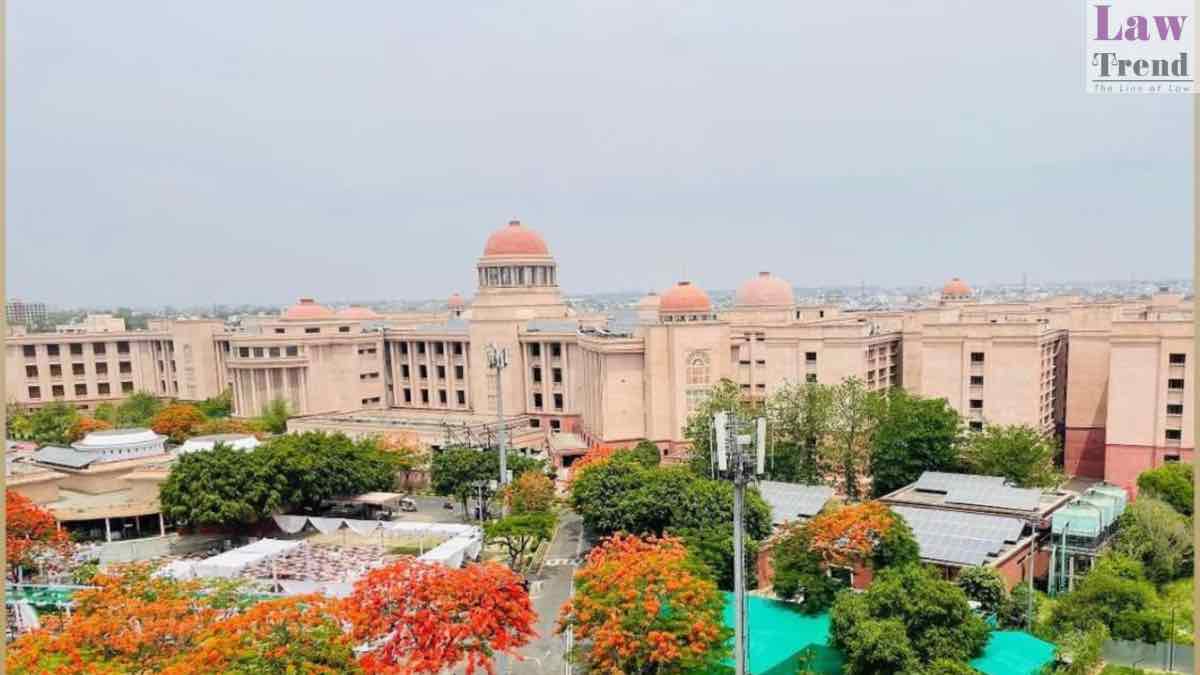
The High Court of Judicature at Allahabad, Lucknow Bench, has set aside an interim order that directed the restoration of possession of a secured asset to Bharat Petroleum Corporation Limited (BPCL) and its sub-lessee. The Division Bench ruled that writ petitions under Article 226 of the Constitution of India are not maintainable when the parties have already availed the statutory alternative remedy under Section 17 of the SARFAESI Act, 2002, and such proceedings are still pending before the Debt Recovery Tribunal (DRT).
Background
The case involved a dispute over an immovable property situated at Khasra No. 131, Shekhpur Kasaila, Faizabad Road, Lucknow. The property was a secured asset against which recovery proceedings were initiated under the Securitization and Reconstruction of Financial Assets and Enforcement of Security Interest Act, 2002 (SARFAESI Act).
BPCL claimed to be the lessee of the property, and M/s Arora Auto Center was operating a retail outlet as a sub-lessee. Following a default by the borrower, the secured creditor (Phoenix ARC Private Limited) obtained an order under Section 14 of the Act and took physical possession on October 27, 2025. The property was subsequently auctioned, and M/s Waheguru Projects Pvt. Ltd. emerged as the highest bidder.
Both BPCL and its sub-lessee had filed multiple Securitization Applications (S.A.s) before the DRT, Lucknow, challenging the recovery measures. Despite the pendency of these statutory proceedings, they approached the High Court via writ petitions. On November 28, 2025, a learned Single Judge passed an interim order directing the restoration of possession to the petitioners within 24 hours.
Arguments of the Parties
The appellants (the auction purchaser and the financial institution) argued that the writ petitions were not maintainable before a Single Judge as per the High Court Rules and the Roster. They further contended that since the respondents had already invoked the jurisdiction of the DRT under Section 17 of the Act, they could not simultaneously seek the same reliefs through a writ petition.
Per contra, the respondents (BPCL and Arora Auto Center) argued that the recovery proceedings were “void ab initio” as they were initiated against dead persons (guarantors) and that BPCL’s leasehold rights were not properly considered. They also raised concerns regarding petroleum products stored in tanks on the property, claiming they posed a security risk.
Court’s Analysis
The Division Bench comprising Justice Rajan Roy and Justice Syed Qamar Hasan Rizvi scrutinized the maintainability of the writ petitions on two primary grounds: jurisdictional competence and the existence of an alternative remedy.
The Court observed that the writ petitions were cognizable by a Division Bench, not a Single Judge, and deprecated the practice of counsel making endorsements to bypass reporting deficiencies. On the merits of maintainability, the Court noted:
“The writ petition was filed by BPCL for substantially the same relief regarding which S.A.s were already pending before DRT, Lucknow… the learned Single Judge passed the impugned interim order for restoring the possession back… which he could not have done.”
Citing the Supreme Court’s decision in Bombay Metropolitan Region Development Authority v. Gokak Patel Volkart Ltd., the Bench held:
“This is a case, where there is not only the existence of an alternative remedy but the writ petitioner actually had availed of that remedy. The writ petitioner’s appeal before the statutory authority was pending. In that view of the matter this writ petition should not have been entertained.”
The Court also referred to Phoenix ARC (P) Ltd. v. Vishwa Bharati Vidya Mandir, noting that a writ petition against a private financial institution/ARC performing commercial functions is generally not maintainable under Article 226 for actions taken under the SARFAESI Act. Regarding the merits discussed by the Single Judge, the Bench remarked:
“The learned Single Judge has veritably entered into merits of the issues which are pending consideration before the DRT, Lucknow… Factual issues requiring adducing of evidence and their appreciation have been considered and opinion expressed by the learned Single Judge which could not have been done.”
Decision
The High Court allowed all the special appeals and quashed the interim orders dated November 28, 2025. Consequently, the Court dismissed the underlying writ petitions (Writ C No. 11298 of 2025 and Writ C No. 11302 of 2025) as not maintainable.
The Court provided that BPCL and its sub-lessee could approach relevant authorities under the Petroleum Rules, 2002, to safely remove any petroleum products. It also noted that the appellants had no objection to the respondents removing their structures from the premises, subject to the proceedings before the DRT.
Counsels for the Parties:
- For the Appellants: Shri Sudeep Seth (Senior Advocate) assisted by Shri Pushkar Srivastava, Shri Satendra Kumar Rai, Sri L.P. Mishra along with Sri Prashant Kumar, Sri Deepanshu Das, and Sri Sarvesh Kumar Tiwari.
- For Respondent-BPCL: Shri Jaideep Narayan Mathur (Senior Advocate) assisted by Shri Ashish Chaturvedi.
- For Respondent-M/s Arora Auto Centre: Shri Dhruv Mathur (Senior Advocate) assisted by Ms. Aishvarya Mathur.
- For the State: Sri Nishant Shukla (Additional Chief Standing Counsel).
- For the Applicant-Smt. Krishna Devi: Sri Anurag Srivastava.
Case Details:
Case Title: M/s Waheguru Projects Pvt. Ltd. Lko. Thru. its Auth. Signatory Mr. Divya Ahuja vs. M/s Arora Auto Center Lko. Thru. its Partner Rishab Chhabra and 12 others
Case No.: Special Appeal No. 420 of 2025
Bench: Justice Rajan Roy and Justice Syed Qamar Hasan Rizvi
Date: April 24, 2026