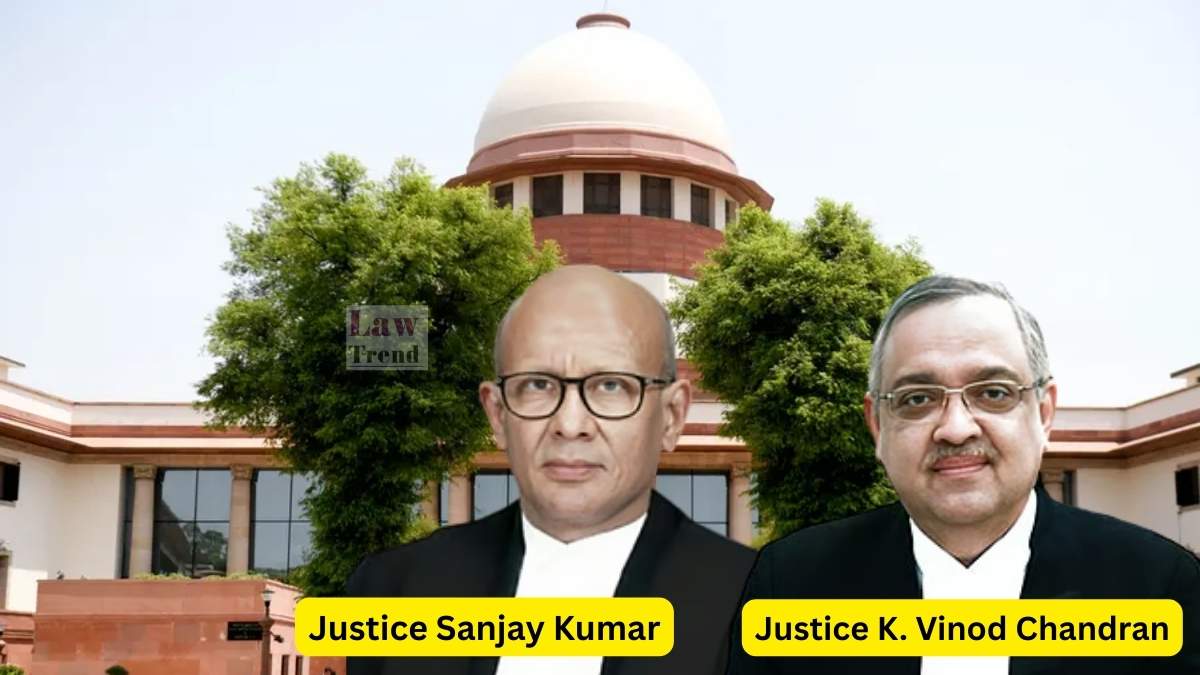
The Supreme Court of India has ruled that once an Interim Resolution Professional (IRP) is appointed under the Insolvency and Bankruptcy Code, 2016 (IBC), the management of a corporate debtor vests in the IRP, making it incompetent for a suspended director to file an appeal in the name of the company.
A Bench comprising Justice Sanjay Kumar and Justice K. Vinod Chandran held that such an appeal is not merely “defective” but “wholly incompetent” from its inception. The Court further clarified that the National Company Law Appellate Tribunal (NCLAT) cannot allow the conversion of such an incompetent appeal into a maintainable one after the expiry of the statutory limitation period.
Background of the Case
The appeal was filed by Nitendra Kumar Tomer, a suspended director of Ambro Asia Private Limited (the Corporate Debtor). The litigation originated from an order dated April 18, 2024, passed by the National Company Law Tribunal (NCLT), New Delhi, which admitted an application under Section 9 of the IBC filed by Unox S.P.A. (the Operational Creditor).
Following the admission, Tomer challenged the NCLT’s order before the NCLAT. However, the appeal was filed in the name of “Ambro Asia Private Limited” and was verified by Tomer claiming to be its director and authorized representative.
Procedural History at NCLAT
The NCLAT, on August 12, 2025, noted that the appeal was filed in the name of the Corporate Debtor, even though it could only be represented by the IRP after the Section 9 application was admitted. Despite finding the appeal unmaintainable as filed, the NCLAT granted Tomer an opportunity to amend the memo of appeal “for the ends of justice.”
On August 29, 2025, the NCLAT allowed the amendment, permitting Tomer to prosecute the appeal in his own name. Subsequently, on January 7, 2026, the NCLAT dismissed the appeal on its merits, confirming the NCLT’s admission order. Tomer then approached the Supreme Court under Section 62 of the IBC.
Court’s Analysis of Sections 16, 17, and 61 of the IBC
The Supreme Court focused on the legal standing of the Corporate Debtor’s management post-admission. Referring to Section 16 and Section 17(1)(a) of the Code, the Court observed:
“From the date of appointment of the interim resolution professional, the management of the affairs of the corporate debtor shall vest in the interim resolution professional… it was not open to the suspended director of the corporate debtor to file an appeal in the name of the corporate debtor… claiming to be its director and authorized representative.”
The Bench emphasized that the appeal filed on April 24, 2024, was “wholly incompetent” because the right to represent the company had already shifted to the IRP, Piyush Moona, who was named in the NCLT’s admission order.
On the issue of limitation under Section 61(2), the Court noted that an appeal must be filed within 30 days, with a maximum condonable delay of 15 days. The Court stated:
“The NCLAT ought not to have permitted him to do so, whereby a time-barred appeal in the name of the suspended director was presented and entertained.”
The Bench held that since the original appeal was incompetent, it did not have a “curable” defect. Therefore, modifying the cause title in August 2025—long after the limitation period expired—amounted to “desecrating the statutory prescription.”
Distinguishing Precedents
The appellant relied on several cases, including Uday Shankar Triyar vs. Ram Kalewar Prasad Singh (2006) and Varun Pahwa vs. Renu Chaudhary (2019), to argue that procedural defects should not defeat substantive rights. The Supreme Court rejected these arguments, stating that those cases dealt with inadvertent drafting errors or procedural irregularities in validly instituted proceedings.
In contrast, the Court found:
“The appeal, as framed and filed in the name of the corporate debtor by a suspended director… was contrary to the mandate of the Code and was, therefore, not at all maintainable. Permitting it to be converted to an appeal by the suspended director at a later point of time, throwing the prescription of limitation to the winds, was a further violation of the Code.”
Final Decision
The Supreme Court concluded that the NCLAT “erred grievously” in adjudicating the appeal on its merits after permitting an invalid conversion. Although the NCLAT’s final decision had gone against the suspended director, the Supreme Court declined to examine the merits of that decision, ruling that the appeal should never have been entertained in the first place.
The Court dismissed the appeal, giving “primacy to the provisions of the Code, which lay down strict mandates in terms of time, which are sacrosanct and cannot be lightly discarded.”
Case Details Block:
- Case Title: Nitendra Kumar Tomer, Suspended Director, Ambro Asia Private Limited vs. Unox S.P.A. and another
- Case No.: Civil Appeal No. 3607 of 2026
- Bench: Justice Sanjay Kumar and Justice K. Vinod Chandran
- Date: April 10, 2026