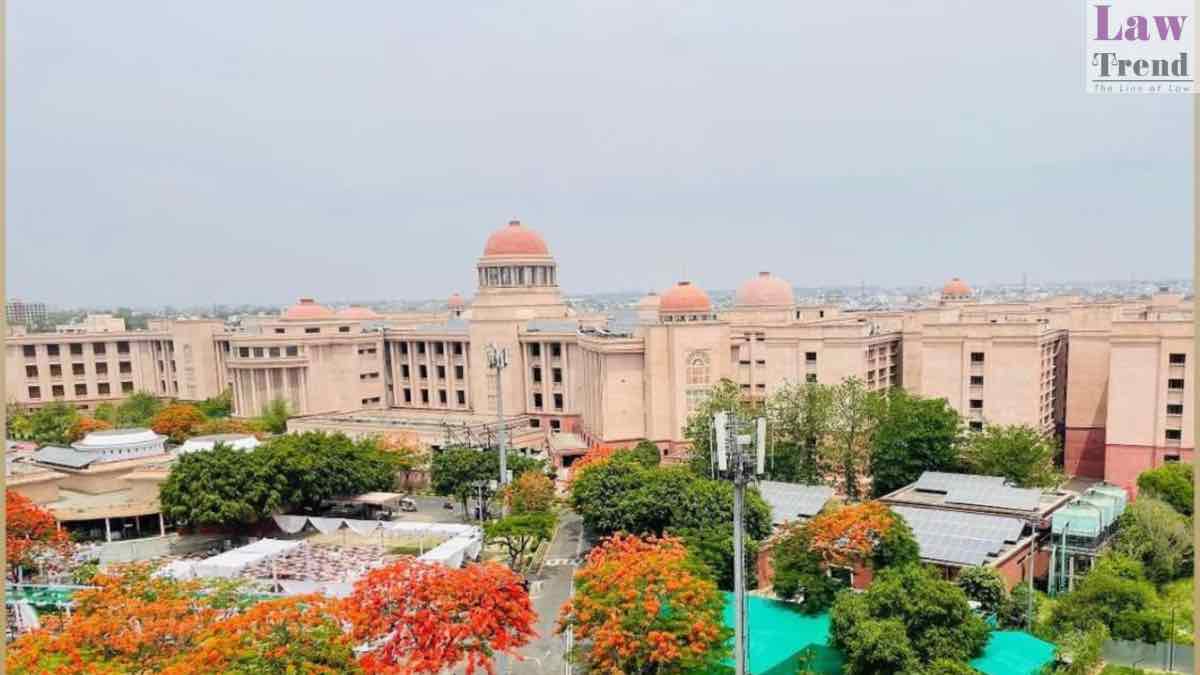
The High Court of Judicature at Allahabad, Lucknow Bench, has quashed a summoning order passed against a son, his father-in-law, and a bank manager in a case involving allegations of cheating over a property dispute. Justice Subhash Vidyarthi, presiding over Court No. 14, observed that the matter was essentially of a civil nature and that criminal proceedings were being used as an instrument of harassment.
The court allowed two applications filed under Section 482 Cr.P.C. (Case Nos. 4460 of 2022 and 3270 of 2022), setting aside the order dated April 8, 2022, passed by the Additional Chief Judicial Magistrate-V, Lucknow, which had summoned the applicants for the offence under Section 420 of the Indian Penal Code (IPC).
Background of the Dispute
The case originated from an application under Section 156(3) Cr.P.C. filed by Rakeshwar Dayal Saxena (Opposite Party No. 2). He alleged that his son, Rajat Saxena, and late wife, Raj Laxmi Saxena, had purchased a house and taken loans totaling ₹29 lakhs from HDFC Ltd. After his wife’s death in 2013, the complainant claimed he continued to pay the loan installments since June 2014.
According to the complainant, a conspiracy was hatched between his son, his son’s father-in-law (Anil Saxena), and the then Senior Manager of HDFC Ltd. (Anshul Srivastava). He alleged that the bank manager initially declined to receive installments to declare the loan a Non-Performing Asset (NPA) but later accepted ₹45,95,000 from him following an order from the Debts Recovery Tribunal (DRT). The complainant’s grievance was that despite him paying the dues under an expected “private treaty” for the transfer of the house, the bank handed over the title deeds to his son, Rajat Saxena.
Arguments of the Parties
The applicants contended that Rajat Saxena was the registered owner and sole surviving mortgagor of the property. They argued that mere repayment of loan installments by the father would not alter the legal status of the mortgagor or the registered owner. They further submitted that the filing of the complaint was an “abuse of the process of law to put undue pressure” during an ongoing civil dispute.
The bank manager, Anshul Srivastava, argued that he was duty-bound to recover the bank’s dues and had not committed any offence by accepting the money. Conversely, the counsel for the complainant argued that the non-execution of a transfer deed in favor of the father amounted to cheating.
The Court’s Analysis
Justice Subhash Vidyarthi examined the facts in light of several Supreme Court precedents, including Mitesh Kumar J. Sha v. State of Karnataka (2022) and Dinesh Gupta v. State of Uttar Pradesh (2024). The Court noted that there was a growing tendency to convert purely civil disputes into criminal cases to seek “quick relief” or settlement through pressure.
Regarding the allegations of cheating under Section 415 IPC, the Court observed:
“The ingredient of ‘cheating’… is existence of a fraudulent or dishonest intention of making initial promise or representation thereof, from the very beginning of the formation of contract.”
The Court found that:
- No Inducement: The bank manager had not demanded money; the complainant himself approached the bank for repayment.
- Ownership Rights: The house was owned by the son and the deceased mother. The complainant’s payment of installments did not make him the owner. The Court noted that the complainant had concealed that he had already filed a civil suit for partition.
- Legal Status of ‘Private Treaty’: The Court clarified that “there can be no treaty between a Bank and an individual willing to repay the loan taken by his son and wife” and that handing over title deeds does not divest true owners of their rights.
The Court remarked that the trial court had passed the summoning order in a “mechanical manner and without application of mind.”
Decision of the Court
The High Court concluded that the facts did not prima facie make out a case of cheating. It observed that the complainant appeared to have “devised a mala fide design to grab the entire house and divest his son and daughters of their share” by paying the bank dues.
The Court held:
“Criminal proceedings must not be used as instruments of harassment… Whether a complaint discloses criminal offence or not depends on the nature of the allegation and whether the essential ingredients of a criminal offence are present or not.”
The applications were allowed, the summoning order was quashed, and the original complaint was dismissed.
Case Details
Case Title: Rajat Saxena and another vs. State of U.P. and another (along with connected matter)
Case Number: APPLICATION U/s 482 No. 4460 of 2022 and 3270 of 2022
Bench: Justice Subhash Vidyarthi
Counsel for Applicants: Chandra Shekhar Sinha, Nadeem Murtaza, Vivek Pandey, Akshat Sinha, Gaurav Sinha.
Counsel for Opposite Parties: G.A. (State), G.D. Bhatt (AGA-I), Abhishek Khare, Pramendra Kumar Singh, Mohit Sharma, Pooja Mishra.
Date: April 03, 2026