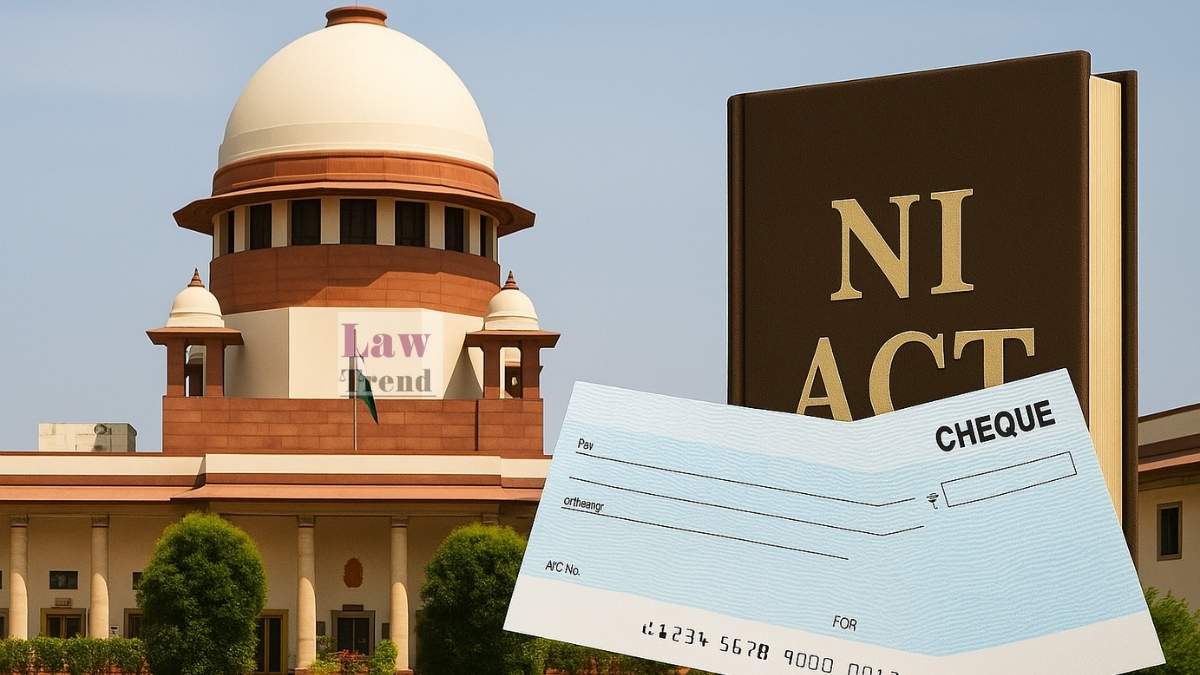
The Supreme Court of India has quashed the criminal proceedings against Saroj Pandey, a Director of Projtech Engineering Private Limited, in a cheque bounce case. The Court held that simply being a Director or signing Board Resolutions does not automatically imply involvement in the day-to-day management of a company’s affairs, which is a prerequisite for prosecution under the Negotiable Instruments Act, 1881.
A Bench comprising Justice Sanjay Karol and Justice Augustine George Masih set aside the orders of the Delhi High Court and the Additional Sessions Judge, Dwarka Courts, which had earlier refused to quash the summoning order issued against Pandey.
Background of the Case
The case originated from a complaint under Sections 138 and 142 of the Negotiable Instruments Act (NI Act). Projtech Engineering Private Limited had issued three cheques dated April 20, 2021, totaling ₹50 lakhs (₹15L, ₹20L, and ₹15L) as payment for the supply of iron and steel.
When deposited, the cheques were returned unpaid with the reason: “DRAWERS SIGNATURES DIFFERS AND ALTERATIONS/CORRECTIONS ON INSTRUMENTS OTHER THAN DATE.”
Following a legal notice sent in May 2021, proceedings were initiated. On September 23, 2021, the Metropolitan Magistrate (NI Act), Dwarka Courts, issued summons. Saroj Pandey challenged this before the Additional Sessions Judge, who rejected her revision on the grounds that she was a Director and had signed a Board Resolution, which allegedly evidenced her involvement in the day-to-day management.
The Delhi High Court subsequently dismissed her petition under Section 482 of the CrPC, adopting similar reasoning and observing that its jurisdiction was circumscribed since a revision had already been preferred.
Analysis of Section 141 of the NI Act
The Supreme Court examined the scope of Section 141, which deals with offences by companies. The Court observed that for a person to be held liable, they must be “in charge of, and responsible to, the company for the conduct of the business” at the time the offence was committed.
Citing the three-judge bench decision in S.M.S. Pharmaceuticals Ltd. v. Neeta Bhalla (2005), the Court noted:
“It is necessary to specifically aver in a complaint under Section 141 that at the time the offence was committed, the person accused was in charge of, and responsible for the conduct of business of the company. This averment is an essential requirement… Merely being a director of a company is not sufficient to make the person liable under Section 141 of the Act.”
The Bench also referred to Gunmala Sales (P) Ltd. v. Anu Mehta (2015), noting that while a basic averment may allow a Magistrate to issue process, the High Court can quash a complaint if there is an absence of particulars regarding the Director’s role or if there is “unimpeachable, incontrovertible evidence” indicating the Director could not have been concerned with the issuance of cheques.
Observations on Board Resolutions
The Court specifically addressed the lower courts’ reliance on the fact that the appellant had signed Board Resolutions. The Bench remarked that such documents are signed for major directional decisions and do not indicate awareness of everyday transactions.
The judgment stated:
“This, however, does not in any manner mean that each and every member of the Board of Directors is aware of all decisions taken in the everyday transactions that are involved in running a business concern. That apart, there is not even as much as a whisper of direct allegation against the present appellant in the complaint made…”
Concurrent Jurisdiction of Section 482 and Section 397 CrPC
The Supreme Court also corrected the Delhi High Court’s view that a Section 482 petition is limited if a revision under Section 397 has already been entertained.
Referring to Krishnan & Anr. v. Krishnaveni & Anr (1997) and Dhariwal Tobacco Products Ltd. v. State of Maharashtra (2009), the Court held:
“The inherent power of the High Court is not conferred by statute but has merely been saved thereunder. It is, thus, difficult to conceive that the jurisdiction of the High Court would be held to be barred only because the revisional jurisdiction could also be availed of.”
The Decision
The Court concluded that the High Court had erred in its statement of law on both counts—the liability of the Director and the maintainability of the Section 482 petition.
The Bench ordered:
“The proceedings against the instant appellant namely Saroj Pandey, shall stand quashed and set aside. It is clarified that any observation made herein… have no bearing or impact on the trial of the co-accused persons.”
The appeal was allowed, and all pending applications were disposed of.
Case Details:
- Case Title: Saroj Pandey v. Govt. of NCT of Delhi and Ors.
- Case No.: Criminal Appeal of 2026 (@ SLP (Crl.) No. 21322 of 2025)
- Coram: Justice Sanjay Karol and Justice Augustine George Masih
- Date: April 7, 2026