

Long-Standing Revenue Entries Without Legal Basis Can Be Expunged: Allahabad High Court Dismisses Writ Petition
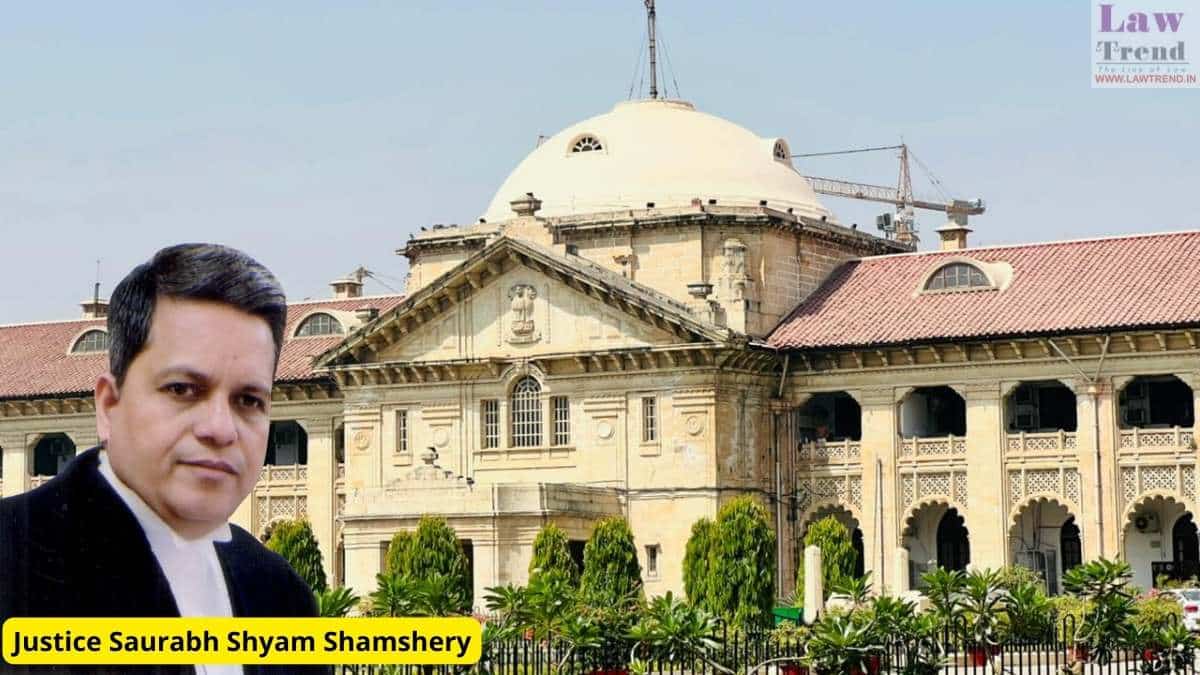

The High Court at Allahabad has dismissed a writ petition challenging the expunging of long-standing revenue entries, ruling that entries made suddenly and surreptitiously without a factual or legal basis cannot be sustained, regardless of their duration.

Justice Saurabh Shyam Shamshery delivered the judgment in Bachcha Lal and 5 others vs. State of Uttar Pradesh and 20 others (WRITB No. 3987 of 2025) on April 1, 2026. The Court upheld concurrent findings from three consolidation authorities, emphasizing that the petitioners failed to prove co-tenancy or provide a legal basis for the appearance of their predecessors’ names in revenue records after years of exclusive recording of another branch.

Background of the Case

The dispute originated from objections filed under Section 9A (2) of the U.P. Consolidation of Holdings Act, 1953. The Consolidation Officer, Pindara, Varanasi, by an order dated May 1, 2010, allowed the objections of the contesting respondents, expunging the names of the petitioners’ predecessors.

The petitioners’ case rested on revenue entries for plot numbers in Mahal Jwala Prasad and Mahal Jasoda Bibi. They argued that while Ganga s/o Shiv Dayal was the sole recorded tenure holder in 1291-F, their predecessor (Shiv Baran) and another relative (Sumer) appeared in the 1309-F Khatauni and continued through subsequent records (1334-F, 1356-F, 1378-F) up to the basic year of 1388-F. They contended that since the respondents never took steps to expunge these names for decades, the entries should be presumed genuine.

Arguments of the Parties

Petitioners: Senior Advocate Rakesh Pande, assisted by Sri Y.V. Bajpai, argued that the petitioners’ line had been recorded for a “very long period” (from 1309-F to 1388-F). He submitted that the Consolidation Officer wrongly rejected the Kursinama (family tree) showing a common ancestor. He further contended that the finding that Sumer’s name was first recorded in 1334-F was contrary to the record, as it first appeared in 1309-F.

READ ALSO  To Declare a Statutory Provision as Ultravires Specific Pleading and Relief Must be There: SC

Respondents: Sri Pradeep Kumar Rai, representing the contesting respondents, argued that the timing of the objections (at the commencement of consolidation) did not make the entries genuine if they lacked a legal or factual basis. He maintained that there was no substantive evidence of co-tenancy beyond the revenue entries themselves. He relied on the Supreme Court decision in Dharmraj and others vs. Chhitan and others (2006) to assert that co-tenancy requires more than just revenue entries.

Court’s Analysis

The Court examined the orders passed by the Consolidation Officer (CO), Settlement Officer of Consolidation (SOC), and Deputy Director of Consolidation (DDC). It noted that while the Kursinama was eventually largely accepted, it was insufficient to support the entries because the petitioners could not explain why Ganga was recorded as the sole holder in 1291-F and how their predecessors were “suddenly” recorded years later without any family partition or legal event.

READ ALSO  Truth Is No Defense Against Publishing Defamatory Content When No Public Interest is Involved: Jammu and Kashmir High Court

The Court observed:

“From Kursinama, it is evident that when name of only Ganga was recorded in 1291-F, there was no reference of Ram Dayal or Nanku or their successor allegedly brother of Ganga, therefore, without any basis name of Sumer was recorded in 1309-F… entries which were recorded suddenly and surreptitiously can not sustain and can be expunged.”

Regarding the nature of the entries, the Court highlighted that the 1309-F record categorized the petitioners’ predecessors as ‘sikmi’ (sub-tenant) cultivators for a fixed period. The Court held:

“Nature of entries of petitioners in 1309-F was ‘sikmi cultivator for fixed period, therefore, they can not be considered as co-tenure holder.”

READ ALSO  Limitation for Filing Motor Accident Claims Applies Prospectively from 1st April 2022: Kerala HC

Citing the Supreme Court in Vishwa Vijay Bharati v. Fakhrul Hassan (1976), the Court noted that while revenue entries are generally accepted at face value, the presumption of correctness applies only to “genuine, not forged or fraudulent, entries.” The Court also referenced Krishnanand (D) through LRs and others Vs. DDC (2015) to reiterate that a writ court should not interfere with concurrent findings of fact unless they are “patently perverse.”

Decision

The High Court found no perversity in the concurrent findings. It concluded that the petitioners failed to show a legal basis for the long-standing entries and that the theory of “re-settlement” was vague.

“Accordingly, present writ petition is dismissed,” the Court ruled, affirming the orders to expunge the petitioners’ names from the revenue records.

Case Details:

  • Case Name: Bachcha Lal and 5 others Versus State of Uttar Pradesh and 20 others
  • Case No.: WRITB No. 3987 of 2025
  • Bench: Justice Saurabh Shyam Shamshery
  • Date of Judgment: April 01, 2026

Law Trend
Law Trendhttps://lawtrend.in/
Legal News Website Providing Latest Judgments of Supreme Court and High Court

Related Articles

Latest Articles

