

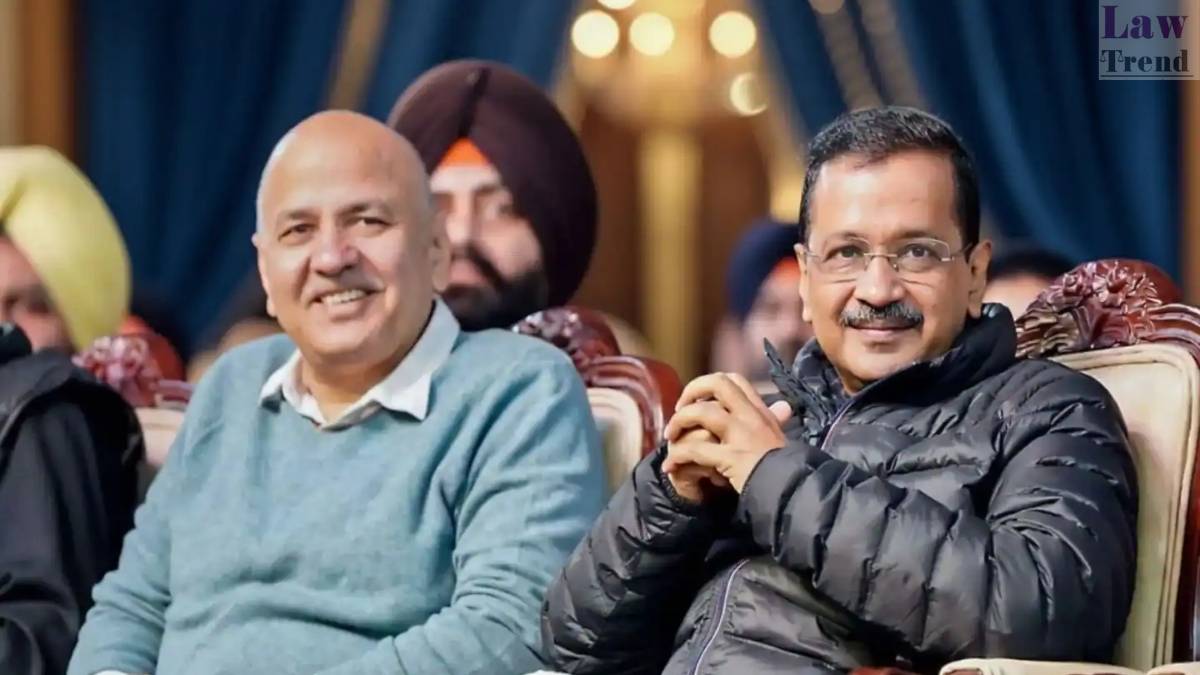
The Delhi High Court on Thursday granted a final opportunity to former Chief Minister Arvind Kejriwal, former Deputy Chief Minister Manish Sisodia, and several others to file their responses to a petition moved by the Enforcement Directorate (ED). The federal agency is seeking to expunge specific “unwarranted” remarks made against it by a trial court while discharging the leaders in the Delhi liquor policy case.
Justice Swarana Kanta Sharma, presiding over the matter, noted that despite being granted time during the previous hearing on March 19, almost none of the respondents had filed their replies.
“Last opportunity is granted to file reply, failing which the right to file reply will close. Arguments will be heard on the next date of hearing. List on April 22,” Justice Sharma observed.
The Enforcement Directorate’s challenge stems from a February 27 order by the trial court which discharged the Aam Aadmi Party (AAP) leaders. While the underlying case was being investigated by the Central Bureau of Investigation (CBI), the trial court included observations regarding the ED’s independent investigation under the Prevention of Money Laundering Act (PMLA).
Additional Solicitor General (ASG) S.V. Raju, representing the ED, informed the High Court that except for one respondent, Vinod Chauhan, others had not yet filed their responses.
The ED contends that the trial court’s remarks were “wholly extraneous” to the CBI case it was presiding over. The agency argued that it was not a party to those specific proceedings and was never given an opportunity to be heard before the remarks were passed.
In its petition, the ED stated: “If such sweeping, unguided, bald observations are permitted to stand… grave and irreparable prejudice would be caused to the public at large as well as the petitioner.” The agency further characterized the observations as a “clear case of judicial overreach.”
On February 27, the trial court had discharged Kejriwal, Sisodia, and others, ruling that the CBI’s case was “wholly unable to survive judicial scrutiny” and was “discredited in its entirety.” The judge at the time described the alleged conspiracy as a “speculative construct resting on conjecture and surmise,” asserting there was no admissible evidence to support the claims.
Crucially, the trial court’s order touched upon the broader implications of the PMLA. The judge highlighted that procedures allowing for prolonged or indefinite incarceration based on untested allegations risked “degenerating into a punitive process.”
The trial court’s order further observed that while the PMLA serves a legitimate objective, “statutory power, however wide, could not eclipse constitutional safeguards.” It noted a “disturbing inversion” where the money laundering offence appeared to subsist even when the foundational “predicate offence” was legally unsustainable.
The ED’s counsel previously argued that the respondents—Kejriwal, Sisodia, and others—might not even need to file replies as the plea is limited to expunging judicial observations and does not seek to overturn their discharge in this specific instance. However, the High Court has insisted on a formal response before proceeding with final arguments on April 22.




