

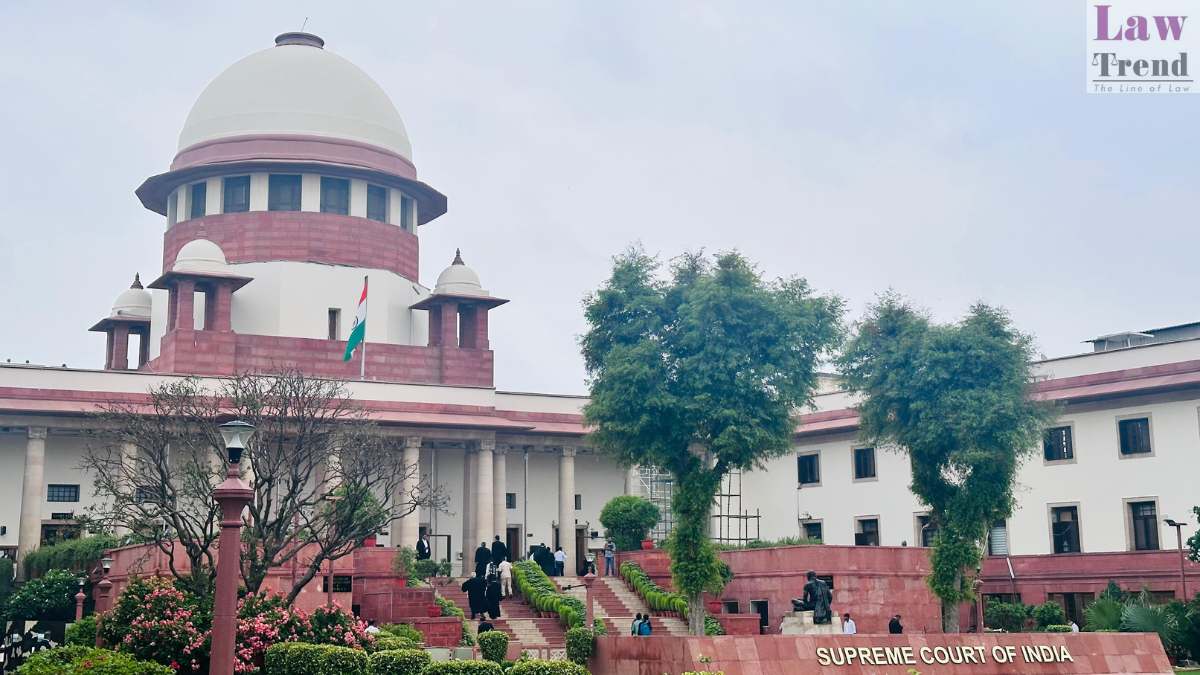
The Supreme Court of India on Wednesday delivered a landmark observation, asserting that the constitutional guarantee of “just compensation” for land acquisition cannot be undermined by the magnitude of the financial liability it imposes on the state. A bench comprising Chief Justice Surya Kant and Justice Ujjal Bhuyan clarified that solatium and interest payments are legal entitlements that remain independent of the budgetary constraints of acquiring authorities.
The ruling came as the court disposed of a review petition filed by the National Highway Authority of India (NHAI). The authority sought to revisit a February 4, 2025, verdict which held that a 2019 Supreme Court decision—granting compensation and interest to farmers whose land was acquired under the NHAI Act—would apply retrospectively.
The NHAI argued for a review on the grounds of a massive shift in projected financial liability. While the authority previously claimed the burden would be around ₹100 crore, it updated its estimate during the proceedings to approximately ₹29,000 crore (and at one point cited up to ₹32,000 crore). The NHAI contended that such a significant fiscal impact justified making the 2019 judgment apply prospectively rather than retrospectively.
Dismissing the argument that the scale of the payout should dictate the application of the law, Chief Justice Surya Kant stated:
“The grant of solatium and interest cannot be made contingent upon the magnitude of the financial burden. The constitutional guarantee of just compensation cannot be diluted on that basis. Mere projection of financial liability does not constitute a valid ground for review.”
The bench emphasized that even if the corrected, higher financial estimates were taken on record, they would not persuade the court to revisit the merits of its earlier order.
The court reaffirmed its 2019 stance that Section 3J of the National Highways Act—which excluded the applicability of the Land Acquisition Act of 1894 and denied solatium and interest—was unconstitutional. The court found this exclusion to be a violation of Article 14 (Right to Equality).
Consequently, the bench ruled that:
- Landowners are entitled to interest at the rate of 9 per cent as per the Land Acquisition Act.
- The 5 per cent cap on interest mentioned in the NHAI Act is not applicable in these cases.
While upholding the right to compensation, the court introduced a “limited clarification” to balance the rights of landowners with the need for legal certainty. The bench stated that the “endless reopening of settled claims cannot be permitted.”
The court noted:
- Finality: Landowners cannot reopen “concluded claims” that have already attained finality through prior court or arbitration proceedings.
- Cut-off Context: During earlier oral observations on February 23, the court indicated that matters that were “alive” or pending as of 2008 would continue to be eligible. However, cases that were fully settled before March 2018 generally cannot be resurrected solely to seek parity with the 2019 judgment.
- Parity: If a claim was legally active in 2008, a landowner might still seek parity in the early 2020s for solatium, though the court noted distinctions regarding interest in certain settled land acquisition matters.
The Supreme Court’s decision reinforces the principle that fundamental and constitutional rights—specifically the right to just compensation for property—cannot be traded off against the state’s administrative or financial difficulties. While the NHAI must now prepare for a significant financial outlay, the court has provided a safeguard against the reopening of ancient, concluded litigations to ensure “certainty in litigation.”




