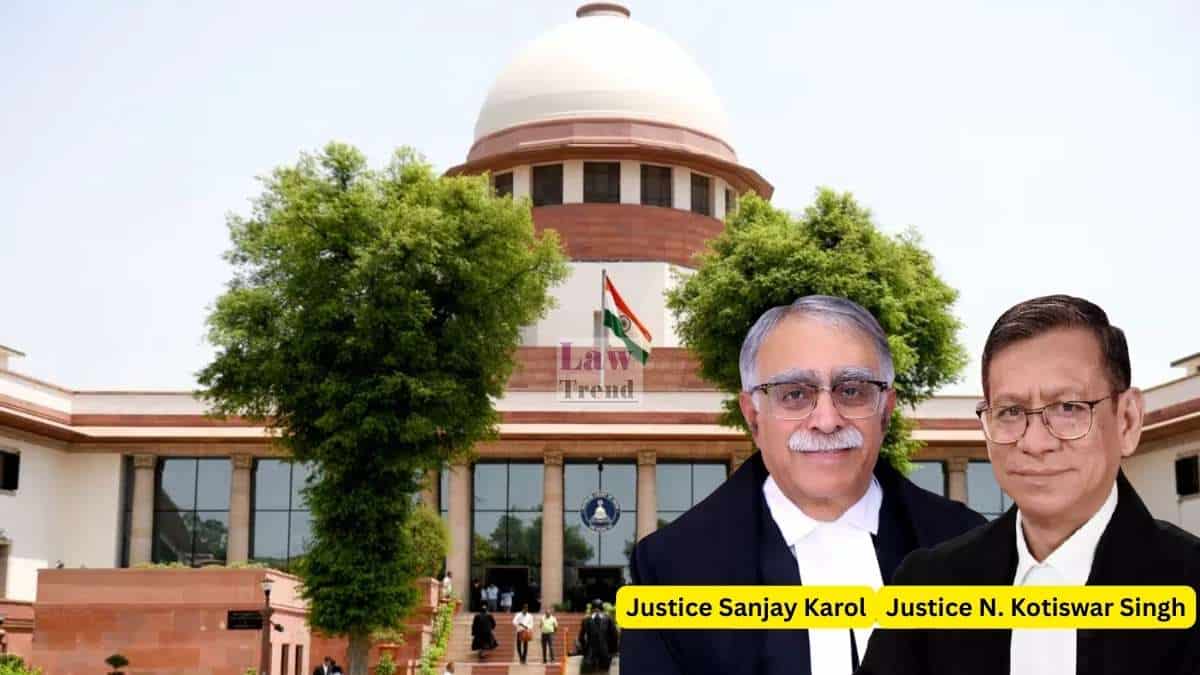
The Supreme Court of India has set aside a judgment of the Himachal Pradesh High Court that acquitted a man accused of sexually assaulting a nine-year-old girl, ruling that the High Court’s analysis of evidence was “misdirected.” A Division Bench comprising Justice Sanjay Karol and Justice Nongmeikapam Kotiswar Singh restored the conviction and sentence passed by the Trial Court, observing that minor inconsistencies or perceived improbabilities in the prosecution’s timeline cannot displace the credible testimony of a child victim and corroborating medical evidence.
Background of the Case
The case dates back to August 27, 2007, when a nine-year-old girl was sent by her mother to fetch buttermilk early in the morning. On her way back, she was lured into a cowshed by the respondent-accused (the neighbor’s son) and sexually assaulted. After the incident, the victim narrated the ordeal to her mother and later to her father, a mason, upon his return from work.
A First Information Report (FIR) was lodged the following day at PS Sunder Nagar. The police subsequently filed a charge sheet under Sections 376 (Rape) and 201 (Causing disappearance of evidence) of the Indian Penal Code (IPC), along with Section 3(xii) of the Scheduled Caste and Scheduled Tribes (Prevention of Atrocities) Act, 1989.
The Judicial Path: Trial Court and High Court
In September 2008, the Trial Court (District and Sessions Judge, Mandi) convicted the accused under Section 376 IPC and the SC/ST Act, while acquitting him under Section 201 IPC. He was sentenced to ten years of rigorous imprisonment. The court relied on the victim’s testimony and medical evidence showing paraurethral lacerations and a torn hymen.
However, the Himachal Pradesh High Court reversed this conviction in June 2014. The High Court found the prosecution version “improbable,” specifically questioning how a nine-year-old could travel 16 kilometers (to and fro) within two hours to fetch buttermilk. It also highlighted the “acrimonious relationship” between the families and noted contradictions in the testimonies of the parents and maternal uncle regarding the timing of reporting the incident.
Arguments and Analysis by the Supreme Court
The State of Himachal Pradesh challenged the acquittal before the Supreme Court. The Bench scrutinized whether the High Court was justified in setting aside the findings of the Trial Court.
1. Appreciation of Child Witness Testimony
The Bench reiterated established principles regarding child witnesses. Referencing State of Rajasthan v. Chatra (2025), Justice Sanjay Karol noted that the Trial Judge must be satisfied with the child’s ability to distinguish between truth and falsehood. The Bench stated:
“Corroboration of the testimony of the prosecutrix is not a requirement of law, but a guidance of prudence under the given facts and circumstances. Minor contractions or small discrepancies should not be a ground for throwing the evidence of the prosecutrix.”
2. Inconsistencies and the “Backbone” of the Case
Addressing the High Court’s focus on the 16km distance, the Supreme Court held that human perception and memory are naturally imperfect. Citing State of U.P. v. M. K. Anthony (1985), the Court explained:
“Variations in trivial matters that do not affect the core of the case should not lead to rejection of credible testimony in its entirety… In proving the occurrence of an offence within a particular time frame, the Court does not look for mathematical precision.”
3. Medical vs. Ocular Evidence
The Court emphasized that medical evidence (PW-7) squarely corroborated the victim’s identification of the accused and her description of the assault. The Court found that the High Court erred in ignoring credible ocular evidence based on an “alleged improbability of time.”
On Victim Anonymity and Judicial Indifference
The Supreme Court expressed strong disapproval of the fact that the victim’s identity was disclosed throughout the record, violating Section 228-A of the IPC. The Bench observed:
“The intent of this Section has been given a miss in these proceedings. The name of the victim is treated like that of any other witness and is freely used throughout the record. This must be deprecated in the strongest terms.”
The Court attributed this to “general indifference of the Courts below” and a “lack of awareness of the deep stigma that follows such offences.”
Decision
The Supreme Court allowed the appeal, setting aside the acquittal and restoring the Trial Court’s judgment of conviction. The respondent-accused was directed to “surrender forthwith and serve the remainder of the sentence.”
Case Details:
- Case Title: State of Himachal Pradesh v. Hukum Chand alias Monu
- Case Number: Criminal Appeal No. 1275 of 2015
- Bench: Justice Sanjay Karol and Justice Nongmeikapam Kotiswar Singh
- Date of Judgment: March 24, 2026