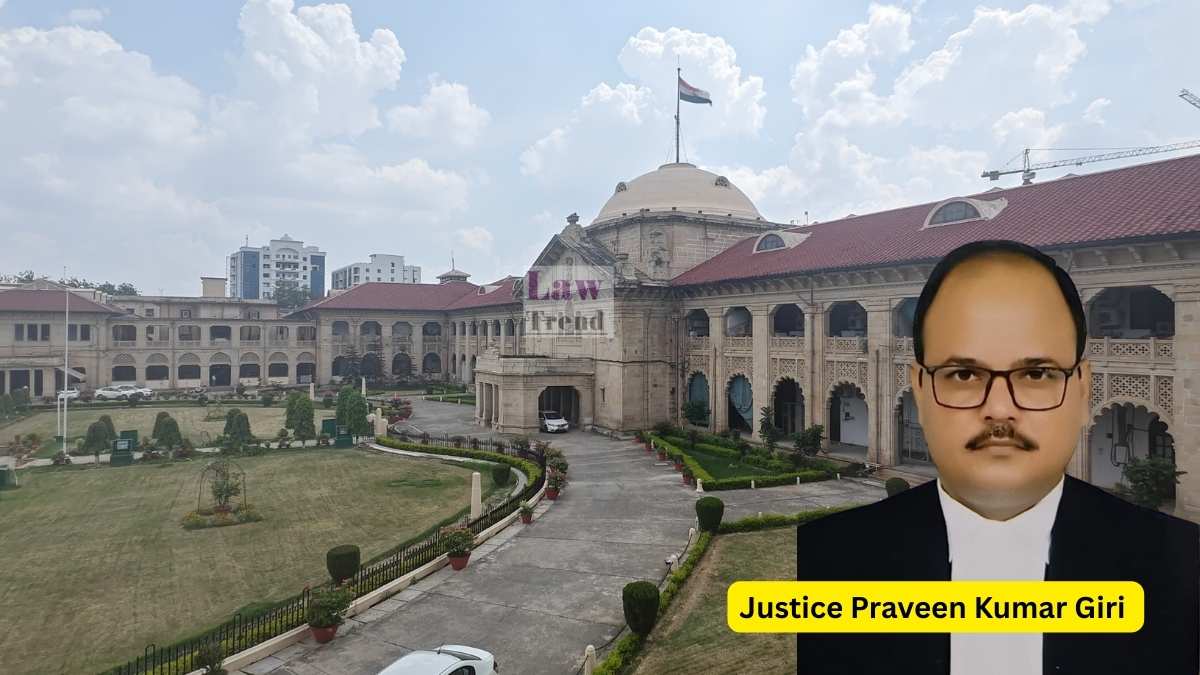
The High Court at Allahabad has ruled that a husband’s detention in civil prison for failing to pay maintenance arrears does not discharge his liability to pay the outstanding amount. The court emphasized that such detention is a mode of enforcement, not a mode of satisfaction of the legal obligation to provide for a wife and children.
The judgment was delivered by Justice Praveen Kumar Giri in a matter where the Court quashed an order passed by a trial court in Moradabad. The trial court had erroneously rejected a recovery application for ₹2,64,000/- on the grounds that the husband had already served 30 days in jail for the default.
Background of the Case
The applicant and the husband (Opposite Party No. 2) were married on May 23, 1990, and have a son who suffers from a disability. According to the applicant, she and her son were ousted from the matrimonial home in 1995. Following a temporary compromise in 2011, she alleged that she was thrown out again in 2017 and has since been residing in a rented house.
In 2017, the applicant filed for relief under Section 12 of the Protection of Women from Domestic Violence Act, 2005 (D.V. Act). On July 19, 2019, the trial court granted interim maintenance of ₹4,000 per month for the wife and ₹4,000 for the disabled son, totaling ₹8,000 per month. This order attained finality after being upheld in subsequent appeals and applications.
When the husband failed to pay arrears amounting to ₹2,64,000 (covering July 2019 to April 2022), an execution application was filed. On October 30, 2022, the husband was arrested and subsequently sent to civil prison for 30 days. Upon his release, he continued to withhold the arrears. The applicant moved a fresh recovery application, but the trial court rejected the claim for the ₹2,64,000/- arrears on January 23, 2023. The trial court cited Section 300 of the Cr.P.C. (double jeopardy), reasoning that since the husband had served a jail term for those specific arrears, he could not be penalized again.
Arguments of the Parties
Counsel for the Applicant: The learned counsel for the applicant argued that the trial court’s reasoning was “palpably myopic.” They contended that Section 300 Cr.P.C. is inapplicable because maintenance proceedings are civil in nature and do not result in a criminal “conviction.” It was further stated that a jail term is a deterrent and not a substitute for the actual financial support required for a destitute wife and disabled child.
Counsel for the Opposite Party (Husband): The learned counsel for the husband argued that the execution application was not maintainable under the specific provisions cited. They contended that the 30-day imprisonment served as a penalty, making the trial court’s order legally sound. Additionally, they raised an objection regarding the son’s age, claiming he had attained majority and was no longer entitled to monetary relief.
Court’s Analysis and Observations
The High Court categorically rejected the trial court’s invocation of Section 300 Cr.P.C. The Court observed:
“A proceeding under the Domestic Violence Act, seeking maintenance does not result in either a conviction or an acquittal… such detention does not fall within the purview of Section 300 Cr.P.C.”
Relying on the Supreme Court’s decision in Smt. Kuldip Kaur vs. Surender Singh (1989), the Court clarified the distinction between the enforcement of an order and the satisfaction of a debt:
“Sentencing a person to jail is a ‘mode of enforcement’. It is not a ‘mode of satisfaction’ of the liability. The liability can be satisfied only by making actual payment of the arrears… The purpose of sending him to jail is not to wipe out the liability which he has refused to discharge.”
The Court also cited the landmark ruling in Rajnesh vs. Neha (2021), noting that maintenance orders are social welfare measures intended to prevent vagrancy. The Court emphasized that these orders should be enforced as money decrees, including through the attachment of property. The judge remarked that the trial court’s decision indicated a “non-application of judicial mind.”
Regarding the husband’s conduct, the Court noted:
“A defaulter has to be dealt with an iron hand… This is an unpardonable offence and a sin whereby the extra-ordinary punishment has to be levied mercilessly.”
The Decision
The High Court allowed the application and quashed the trial court’s order dated January 23, 2023. The Court issued the following directions:
- The trial court must pass a fresh order for the recovery of all arrears, including 6% simple bank interest on delayed payments.
- If the husband fails to deposit the amount, the Magistrate is directed to attach his property.
- The proceeds from the property auction shall be applied directly toward the arrears and interest.
- The husband must continue to pay current monthly maintenance to the applicant and their disabled son regularly.
- The entire exercise of payment must be completed within 60 days.
The Court concluded with a stern warning that any unnecessary delay by the presiding officer in compliance would be viewed as a failure to exercise jurisdiction and may attract disciplinary action.
Case Details:
- Case Title: Smt. Hasina Khatoon vs. State of U.P. and Another
- Case Number: Application U/s 482 No. 7721 of 2023
- Bench: Justice Praveen Kumar Giri
- Counsel for Applicant(s): Sri Akshaya Kumar, Sri Jaideep Pandey
- Counsel for Opposite Party(s): G.A. (Sri Shashidhar Pandey), Sri Mahtab Alam, Sri R.K. Shukla
- Date: March 24, 2026