

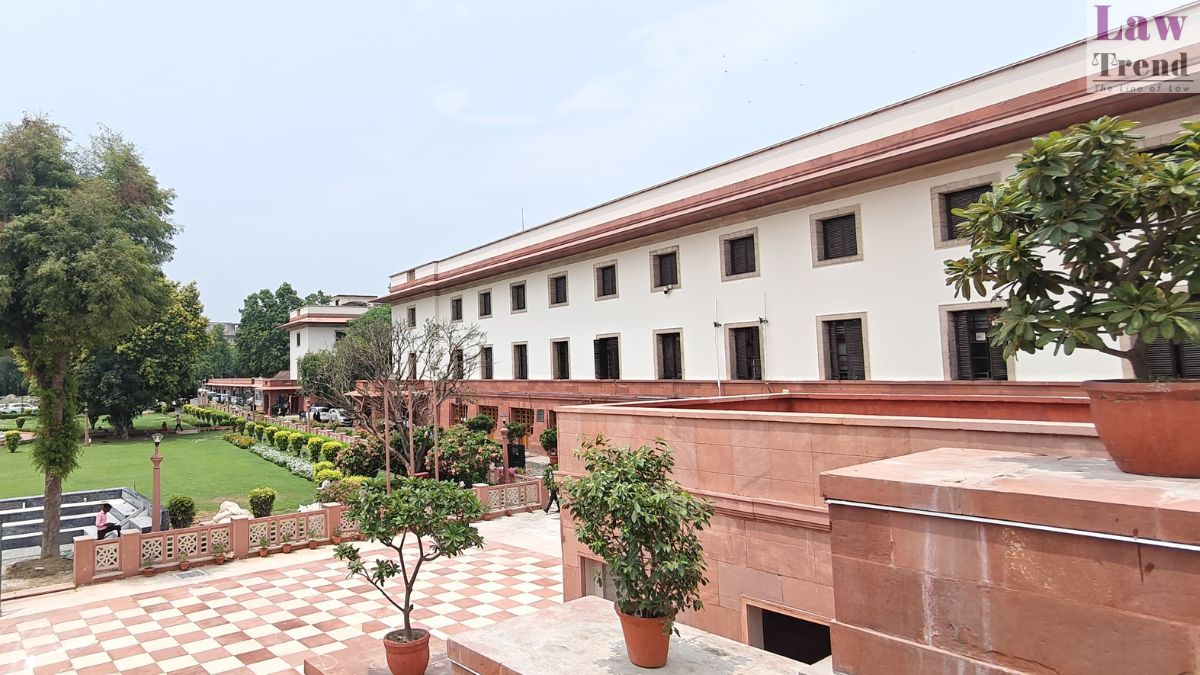
A nine-judge Constitution Bench of the Supreme Court on Thursday reserved its verdict on the long-standing legal dispute over the definition of the word “industry” under the Industrial Disputes (ID) Act, 1947. The decision follows a three-day intensive hearing aimed at determining whether the broad interpretation established nearly five decades ago remains legally sound in the current socio-economic landscape.
The Bench, led by Chief Justice Surya Kant and including Justices B.V. Nagarathna, P.S. Narasimha, Dipankar Datta, Ujjal Bhuyan, Satish Chandra Sharma, Joymalya Bagchi, Alok Aradhe, and Vipul M. Pancholi, is tasked with reviewing the landmark 1978 judgment in the Bangalore Water Supply and Sewerage Board case.
At the heart of the matter is Section 2(j) of the Industrial Disputes Act, 1947. In 1978, a seven-judge bench delivered a verdict that significantly expanded the scope of what constitutes an “industry.” That ruling, authored largely by Justice V.R. Krishna Iyer, brought millions of workers in educational institutions, hospitals, clubs, and government welfare departments under the protective umbrella of the ID Act.
The current nine-judge bench is examining whether the “triple test” and the expansive logic laid down in paragraphs 140 to 144 of the 1978 opinion still hold as correct law. A primary concern for the court is whether social welfare schemes and activities undertaken by government departments should be classified as “industrial activities.”
During the three-day hearing, the court heard submissions from high-ranking legal officers and senior counsel, including Attorney General R. Venkataramani, Additional Solicitor General K.M. Nataraj, and senior advocates Indira Jaising, Shekhar Naphade, C.U. Singh, and Sanjay Hegde.
The bench specifically formulated issues to address the intersection of judicial precedent and subsequent legislation. This includes evaluating the legal impact of:
- The Industrial Disputes (Amendment) Act, 1982, which seemingly never came into force.
- The Industrial Relations Code, 2020, which is set to take effect from November 21, 2025.
The court’s eventual ruling will clarify whether the 1978 “expansive interpretation” will continue to govern labour relations or if a more restrictive definition will be applied to government instrumentalities and charitable institutions.
On February 21, 1978, the Supreme Court’s decision in the Bangalore Water Supply case revolutionized labour law by focusing on the nature of the activity rather than the profit motive. By doing so, it granted industrial workers’ rights—such as protection against arbitrary dismissal and the right to collective bargaining—to employees in sectors previously considered non-industrial.
The nine-judge bench was constituted to resolve the inconsistencies that have arisen over the decades following that judgment, particularly regarding the state’s sovereign and welfare functions.


