

Assistant Professor Exam Cancellation Valid Where Paper Leak Compromised Integrity; Allahabad HC Dismisses Challenge to Fresh Exam
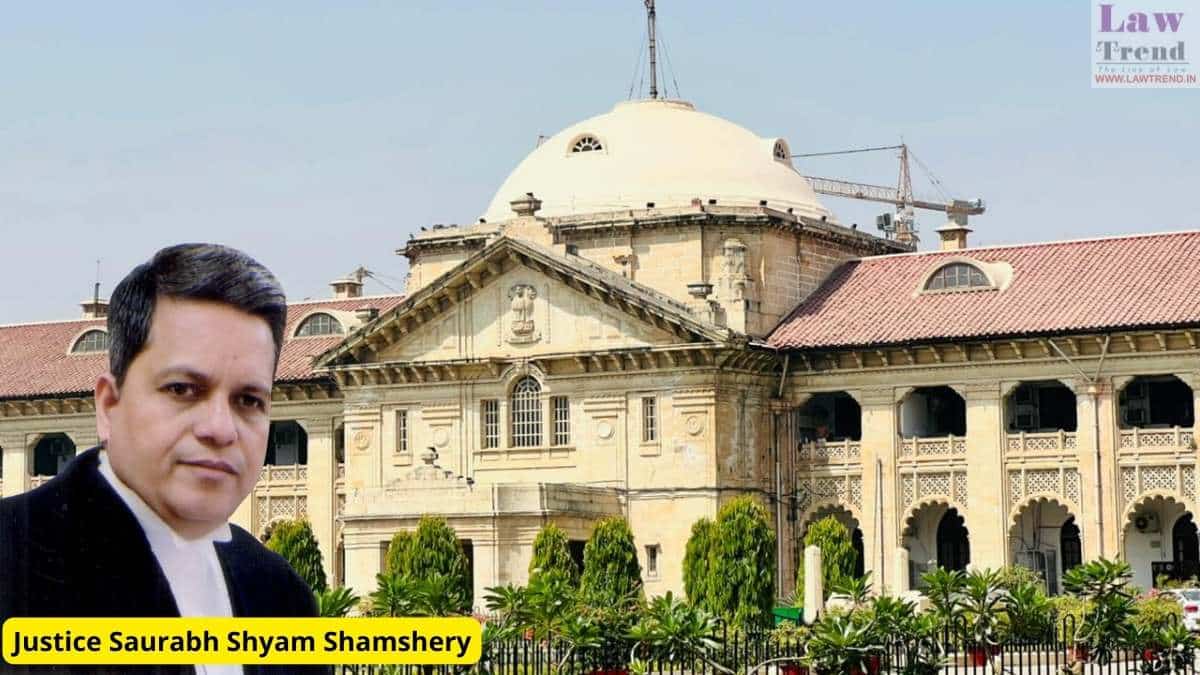

The High Court of Judicature at Allahabad has upheld the State Government’s decision to cancel the results of the written examination for the recruitment of Assistant Professors (Advertisement No. 51 of 2022). The court ruled that when systemic irregularities and widespread unfair means undermine the integrity of a selection process, the state is justified in cancelling the examination to maintain purity and public confidence.

The judgment was delivered by Justice Saurabh Shyam Shamshery in a bunch of writ petitions, the lead case being Km. Lakshmi and 10 Others vs. State of U.P. and Others (Writ-A No. 1760 of 2026).

Background of the Case

The recruitment process was initiated under Advertisement No. 51 of 2022 to fill 910 posts of Assistant Professors in aided non-Government Post Graduate Colleges. The U.P. Education Service Selection Commission conducted the written examination on April 16 and 17, 2025, across 52 centers for 33 different subjects.

Immediately following the exams, two First Information Reports (FIRs) were lodged in Lucknow (FIR No. 0144/2025 and 0181/2025) alleging that accused persons provided question papers to participants in exchange for money. While an initial decision was made to proceed with the evaluation based on a committee report, a subsequent investigation by the Special Task Force (STF) revealed deeper irregularities. Consequently, on January 20, 2026, the Commission cancelled the results declared on September 4, 2025, and announced a fresh examination schedule. This cancellation was challenged by 224 candidates who had qualified in the initial result.

READ ALSO  कथित फर्जी डिग्री मामले में डिप्टी सीएम केशव प्रसाद मौर्य के खिलाफ एफआईआर की मांग वाली याचिका हाईकोर्ट से खारिज

Arguments of the Parties

For the Petitioners: Senior Advocate Sri Ashok Khare argued that the State lacked “substantial material” to cancel the entire result. He contended that there was no evidence of “systematic irregularities” that compromised the entire selection. Referring to the STF report dated January 2, 2026, he noted that only 19 candidates were identified as suspected beneficiaries. He argued that, at most, the results of those 19 candidates should have been cancelled rather than scrapping the entire process. The petitioners relied on the Supreme Court judgment in Vanshika Yadav vs. Union of India (2024), arguing that untainted candidates should not suffer for the actions of a few.

For the State and Commission: Additional Advocate General (AAG) Sri Sanjeev Singh submitted that two charge sheets had already been filed for offences including “petty organized crime” and “cheating.” He argued that while 19 beneficiaries were detected through mobile data analysis, it was highly probable that the paper was leaked to others. The State contended that since the examination was localized to 910 seats in Uttar Pradesh (unlike the Pan-India NEET exam in Vanshika Yadav), even a small number of tainted candidates could compromise the fairness of the entire process.

READ ALSO  Security Cheques Can Be Used to Discharge Liability; Disputed Facts Cannot Be Examined at Quashing Stage: Punjab & Haryana High Court

The Court’s Analysis

The Court emphasized that the “utmost object” of any examination is fairness. Referring to the recent Supreme Court decision in State of West Bengal vs. Baishakhi Bhattacharyya (2025), Justice Shamshery identified several key principles:

  1. Systemic Malaise: When an in-depth factual inquiry reveals systemic irregularities, such as malaise or fraud, that undermine the integrity of the entire selection process, the result should be cancelled in its entirety.
  2. Probability Test: It is not necessary for the material collected to conclusively prove malpractice beyond a reasonable doubt. The standard of evidence should be “reasonable certainty of systemic malaise.”
  3. Narrow Scope: The Court observed that since the exam was for a limited number of posts (910) and subjects, the leakage of papers for at least five subjects—as per the STF report—was sufficient to quash the process.

The Court noted:

“The investigation has prima facie concluded that atleast 19 candidates were definitely benefited… A possibility is not ruled out that papers were leaked to other candidates also and that they may also get benefit of it, to be included in select list. Impugned decision is, therefore, justified by probability test also.”

Regarding the petitioners’ claim of being adversely affected, the Court observed:

READ ALSO  Is an Advocate Responsible for False Statements in an Affidavit They Attest? Supreme Court Says No

“Petitioners cannot claim that they were adversely affected being finally selected since they still have to go through rigor of interview… a candidate has no indefeasible right to be selected or to force the State to conclude an examination process which was tainted.”

The Decision

Dismissing the writ petitions, the High Court found no reason to interfere with the State’s decision to cancel the written examination. The Court held that the decision was based on a detailed inquiry and specific proof of compromised integrity. The Court concluded that the petitioners are eligible to participate in the fresh written examination for which a schedule has already been published.

Case Details

  • Case Title: Km. Lakshmi And 10 Others vs. State of U.P. and others (Lead Case)
  • Case Number: Writ – A No. 1760 of 2026
  • Bench: Justice Saurabh Shyam Shamshery
  • Date: March 17, 2026

Law Trend
Law Trendhttps://lawtrend.in/
Legal News Website Providing Latest Judgments of Supreme Court and High Court

Related Articles

Latest Articles

