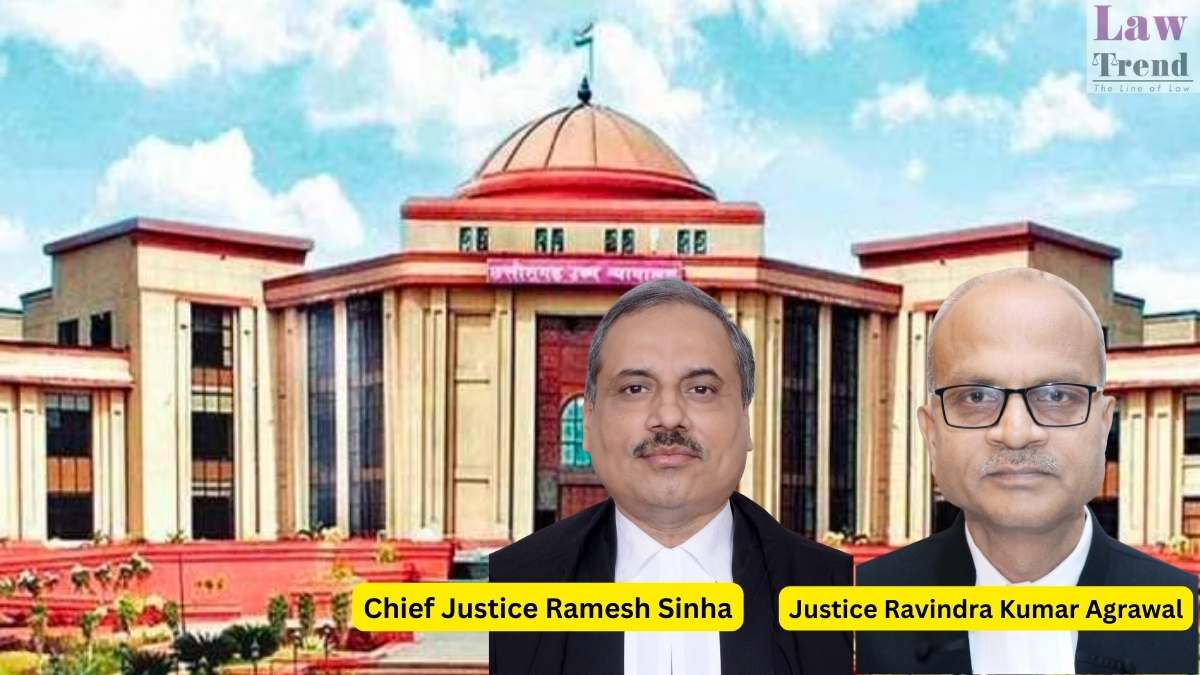
The High Court of Chhattisgarh has ruled that if an extension for investigation time under Section 43-D(2)(b) of the Unlawful Activities (Prevention) Act, 1967 (UAPA) is granted prior to the expiry of the initial 90-day period, it constitutes a valid enlargement of statutory time. The Court further held that in such circumstances, an accused cannot claim an “indefeasible right” to default bail under Section 167(2) of the CrPC (now Section 187(2) of the BNSS) upon the completion of the initial 90 days.
A Division Bench comprising Chief Justice Ramesh Sinha and Justice Ravindra Kumar Agrawal dismissed the appeal filed by Ramesh Mandavi, challenging the orders of the Special Judge (NIA Act), North Bastar, Kanker, which had extended his investigation period and subsequently rejected his application for default bail.
Background
The appellant, Ramesh Mandavi, a former Sarpanch and Ward Panch, was arrested on July 16, 2025, in connection with FIR No. 16/2022 registered at Police Station Amabeda. He was charged under various sections of the IPC, the Arms Act, and Sections 17, 18-A, 19, 23, 38(2), and 40 of the UAPA for alleged involvement with banned Naxalite organizations.
The statutory 90-day period for investigation was set to expire on October 14, 2025. However, on October 7, 2025, the Special Judge allowed an application by the Investigating Officer to extend the time for investigation to 180 days. Following the expiry of the initial 90 days, the appellant moved for default bail, which was rejected on October 17, 2025.
Arguments of the Parties
Counsel for the Appellant, Ms. Priyanka Shukla, contended that the extension order dated October 7, 2025, was “void ab initio” as the appellant was not produced before the Court, either physically or via video-conferencing. Relying on the Supreme Court judgment in Jigar alias Jimmy Pravinchandra Adatiya v. State of Gujarat (2023), she argued that production of the accused is a mandatory jurisdictional requirement. She further claimed that the extension was granted mechanically without an independent report from the Public Prosecutor, citing State of Maharashtra v. Surendra Pundlik Gadling (2019) and Hitendra Vishnu Thakur v. State of Maharashtra (1994).
Deputy Government Advocate, Mr. Soumya Rai, appearing for the State, countered that the extension was sought based on a detailed progress report citing the pendency of co-accused arrests, ongoing search operations, and pending statutory sanctions under Section 45 of the UAPA. He emphasized that the appellant’s counsel was present during the October 7 proceedings and raised no objection at that time.
Court’s Analysis
The High Court examined the provisions of Section 43-D(2)(b) of the UAPA, noting that the power to extend investigation time is conditional upon a report from the Public Prosecutor indicating progress and specific reasons for detention.
Regarding the non-production of the accused during the extension hearing, the Court observed:
“The order sheet indicates that the accused was represented through counsel on the relevant date… In these circumstances, it cannot be held that prejudice stood automatically occasioned so as to render the order non est.”
On the necessity of the Public Prosecutor’s report, the Court found that the essential statutory requirements were met. It noted that the application was accompanied by a progress report and presented through the prosecuting agency. The Court stated:
“The mere fact that the grounds relate to pending investigative steps does not ipso facto render the extension illegal; rather, such factors are germane to assessing the progress of investigation and necessity of continued custody in offences under the UAPA.”
Addressing the “indefeasible right” to default bail, the Bench clarified that this right is conditional. It accrues only when the prescribed period expires without a charge-sheet or a valid extension. The Court observed:
“Once such extension stood granted in accordance with law and within the permissible time frame, the statutory period for purposes of default bail automatically stood enlarged from ninety days to one hundred and eighty days. The legal consequence thereof is that the computation for accrual of the right under Section 167(2) CrPC / Section 187(2) BNSS shifts to the extended period.”
Decision
The High Court concluded that since the investigation period was validly extended to 180 days before the initial 90 days lapsed, no right to default bail had crystallized for the appellant on October 14, 2025. Finding no “patent illegality, perversity, or jurisdictional error,” the Court dismissed the appeal and upheld the orders of the Special Judge.
Case Title: Ramesh Mandavi v. State of Chhattisgarh
Case No.: CRA No. 2656 of 2025