

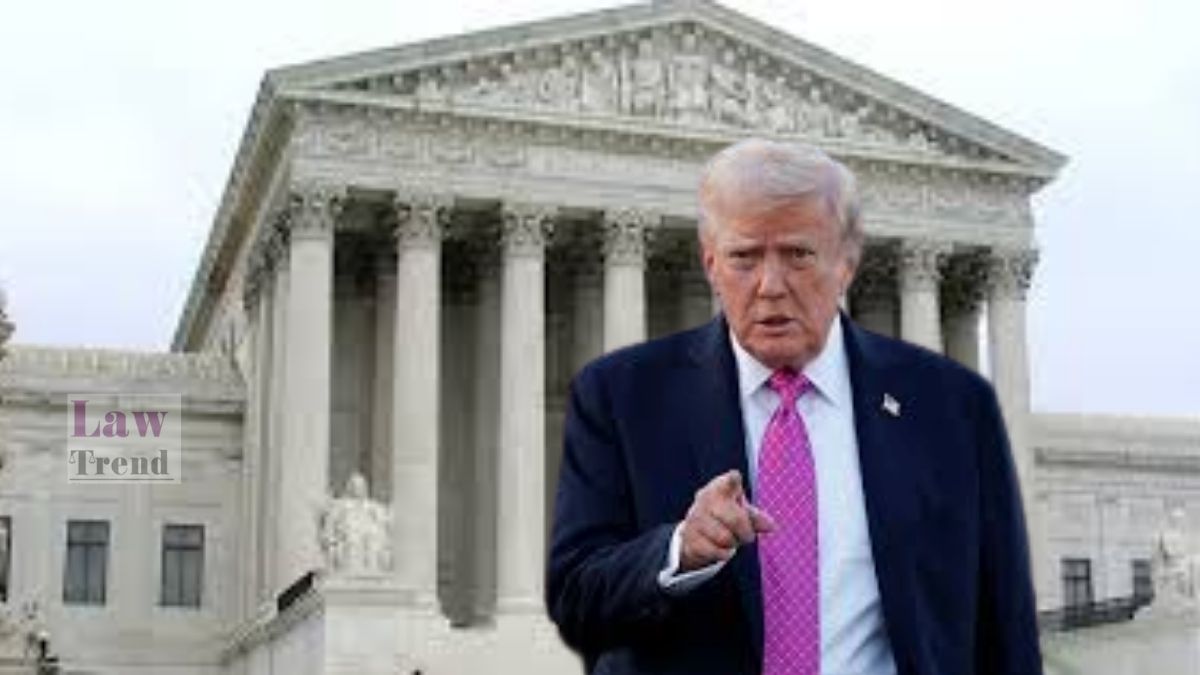
WASHINGTON, D.C. — In a landmark 6-3 decision, the United States Supreme Court has invalidated President Donald Trump’s sweeping global tariff regime. The Court ruled that the President exceeded his statutory and constitutional authority by unilaterally imposing widespread import duties under the International Emergency Economic Powers Act (IEEPA) of 1977. Chief Justice John Roberts authored the majority opinion, concluding that the Constitution firmly vests the power of taxation in Congress and that the IEEPA does not expressly grant the executive branch the power to levy tariffs.
The core legal question before the Supreme Court was whether the International Emergency Economic Powers Act (IEEPA)—a 1977 statute allowing the president to regulate commerce during declared national emergencies—authorizes the executive branch to unilaterally impose tariffs on imported goods. By a 6-3 vote, the Court answered in the negative. The majority, composed of Chief Justice Roberts, Justices Sonia Sotomayor, Elena Kagan, Ketanji Brown Jackson, Neil Gorsuch, and Amy Coney Barrett, struck down the tariffs. Justices Clarence Thomas, Samuel Alito, and Brett Kavanaugh dissented.
The legal dispute originated in 2025 following a series of executive orders issued by President Trump. Relying on the IEEPA, the Trump administration declared national economic emergencies, citing persistent U.S. trade deficits and the influx of illicit fentanyl. Under these emergency declarations, the President implemented broad trade restrictions, most notably the April 2025 “Liberation Day” reciprocal tariffs, which established a baseline duty of 10 percent on nearly all global imports, alongside additional tariffs ranging from 15 to 50 percent on specific nations. Furthermore, fentanyl-related duties were strictly applied to goods from China, Mexico, and Canada.
Following the implementation of these duties, coalitions of small businesses, a group of states, and various U.S. importers filed lawsuits in lower federal courts, challenging the legality of the executive action. Federal trade courts previously ruled that the Trump administration lacked the authority to impose the levies under the IEEPA, prompting the government to appeal the matter to the Supreme Court.
The plaintiffs, comprising businesses and states affected by the increased costs, argued that the imposition of tariffs is fundamentally a taxing power, which Article I of the U.S. Constitution explicitly reserves for Congress. They further argued that the IEEPA was designed to freeze assets and impose sanctions against foreign threats, not to serve as a mechanism for the unilateral restructuring of the entire U.S. tariff code.
The Trump administration argued that the text of the IEEPA grants the president broad flexibility during declared national emergencies. Specifically, the government pointed to a statutory provision permitting the president to “regulate… importation or exportation” to address unusual and extraordinary foreign threats, arguing that tariffs fall squarely within the definition of regulating importation.
The Supreme Court firmly rejected the government’s interpretation of the IEEPA. Chief Justice Roberts, writing for the majority, emphasized the constitutional separation of powers regarding taxation. “The Framers did not vest any part of the taxing power in the Executive Branch,” Chief Justice Roberts noted.
Analyzing the statutory text of the IEEPA, the Court highlighted the absence of explicitly delegated tariff powers. “IEEPA authorizes the President to ‘investigate, block during the pendency of an investigation, regulate, direct and compel, nullify, void, prevent or prohibit … importation or exportation,'” Roberts wrote. “Absent from this lengthy list of specific powers is any mention of tariffs or duties.”
The majority applied the principle that an assertion of vast executive power requires clear congressional authorization. “The President asserts the extraordinary power to unilaterally impose tariffs of unlimited amount, duration, and scope,” the majority opinion stated. “In light of the breadth, history, and constitutional context of that asserted authority, he must identify clear congressional authorization to exercise it. Had Congress intended to convey the distinct and extraordinary power to impose tariffs, it would have done so expressly, as it consistently has in other tariff statutes.”
Justice Neil Gorsuch filed a concurring opinion, emphasizing the legislative branch’s exclusive domain over the laws of the nation. “The Constitution lodges the Nation’s lawmaking powers in Congress alone,” Gorsuch wrote.
In his dissenting opinion, Justice Brett Kavanaugh, joined by Justices Thomas and Alito, argued that the executive actions fell within the statutory bounds provided by Congress. “The tariffs at issue here may or may not be wise policy. But as a matter of text, history, and precedent, they are clearly lawful,” Kavanaugh wrote.
The Supreme Court held that the IEEPA does not authorize the President to impose tariffs, thereby affirming the lower courts’ rulings and invalidating the emergency global tariffs.
The Court notably declined to address the complex issue of whether or how the federal government must refund the estimated billions of dollars in tariffs already collected from U.S. importers. Acknowledging this unresolved matter, Justice Kavanaugh noted in his dissent: “The Court says nothing today about whether, and if so how, the Government should go about returning the billions of dollars that it has collected from importers. But that process is likely to be a ‘mess,’ as was acknowledged at oral argument.”
The ruling does not invalidate duties implemented under other, more specific trade statutes, such as Section 232 of the Trade Expansion Act of 1962 or Section 301 of the Trade Act of 1974.




