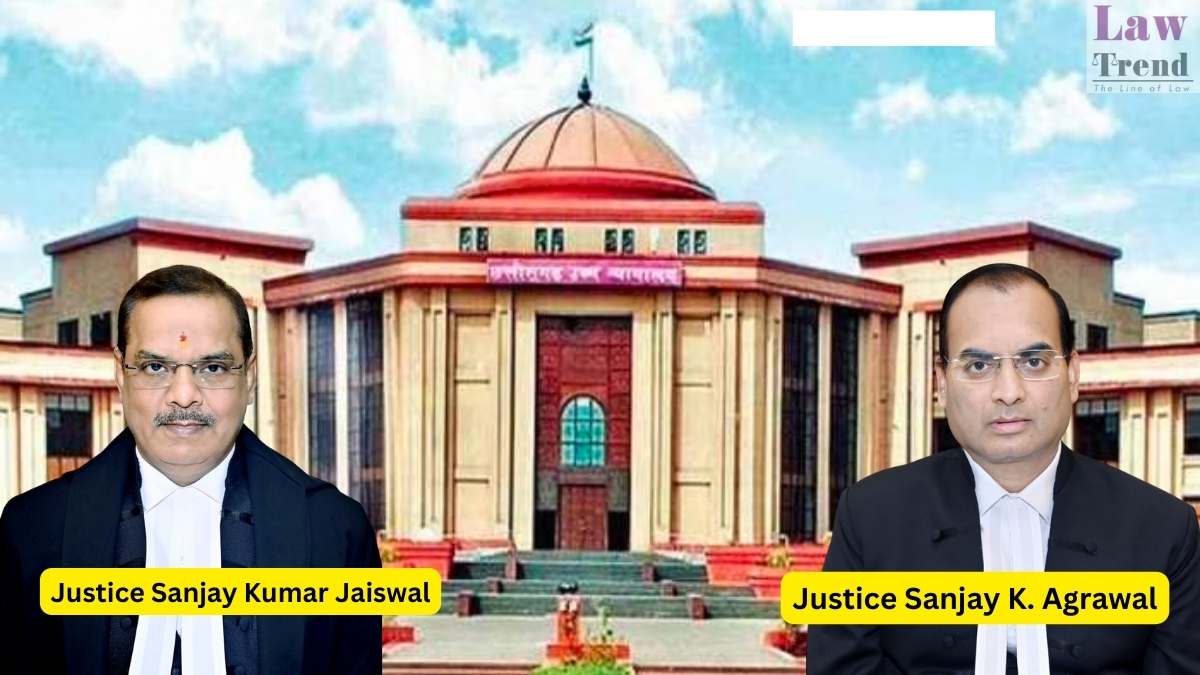
The High Court of Chhattisgarh has set aside an ex-parte judgment and decree of divorce passed by the Family Court, Janjgir, ruling that a court cannot proceed ex-parte against a defendant on a date fixed for reconciliation or interlocutory proceedings, as opposed to the actual “hearing” of the suit.
The Division Bench, comprising Justice Sanjay K. Agrawal and Justice Sanjay Kumar Jaiswal, further held that Family Courts are statutorily bound to provide free legal aid even upon an oral request by a litigant. The Court issued a significant direction mandating all Family Courts in the state to maintain a separate panel of legal experts to be appointed as Amicus Curiae under Rule 14 of the Chhattisgarh Family Courts Rules, 2007, rather than solely relying on the District Legal Services Authority (DLSA).
Background of the Case
The appeal was preferred by the wife (Appellant) against the judgment and decree dated February 22, 2024, passed by the Principal Judge, Family Court, Janjgir, in Civil Suit No. 356A/2022. The husband (Respondent) had filed the suit seeking dissolution of marriage under Section 13 of the Hindu Marriage Act, 1955.
The chronological sequence of events leading to the dispute is as follows:
- On November 28, 2023, the Family Court fixed the case for reconciliation and filing of the written statement. The matter was referred to the National Lok Adalat scheduled for December 16, 2023.
- The Appellant failed to appear before the National Lok Adalat, and consequently, the matter was returned to the regular court, fixed for January 16, 2024.
- On January 16, 2024, the Appellant did not appear, leading the Family Court to proceed ex-parte against her.
- On January 29, 2024, the Appellant appeared in person and orally expressed her inability to engage a counsel due to financial constraints. The Family Court advised her to approach the District Legal Services Authority. Later that same day, noting that she had not approached the DLSA, the Court recorded the plaintiff’s evidence.
- The final judgment and decree dissolving the marriage were passed on February 22, 2024.
Arguments of the Parties
Mr. Himanshu Kumar Sharma, counsel for the Appellant, argued that the Family Court was legally unjustified in proceeding ex-parte and subsequently passing the decree. He contended that the Court erred in refusing to provide legal aid merely because the Appellant failed to make a written application, despite her oral expression of indigence.
Mr. Shobhit Koshta, counsel for the Respondent-husband, supported the Family Court’s decision. He argued that since the Appellant failed to appear on January 16, 2024, the ex-parte order was valid. He further submitted that she was advised to approach the DLSA but failed to do so, justifying the Court proceeding with the plaintiff’s evidence.
Senior Advocate Mr. Manoj Paranjpe, appointed as Amicus Curiae by the High Court, submitted that January 16, 2024, was not a date fixed for “hearing” but was a continuation of the stage reached before the Lok Adalat reference (reconciliation/filing of written statement). He further argued that under Regulation 3(5) of the National Legal Services Authority (Free and Competent Legal Services) Regulations, 2010, oral requests for legal services must be entertained.
Court’s Observations and Analysis
The High Court adjudicated on two substantial questions of law:
1. Validity of Ex-Parte Proceedings on Interlocutory Dates
The Court examined whether the date fixed after the return of a case from Lok Adalat constitutes a “hearing” of the suit. The Bench referred to Section 20(7) of the Legal Services Authorities Act, 1987, which mandates that when a case is returned from Lok Adalat without an award, the court shall proceed “from the stage which was reached before such reference.”
Since the stage before the reference was reconciliation and filing of the written statement, the Court held that January 16, 2024, was not a date fixed for “hearing” (i.e., taking evidence or hearing arguments). Relying on the Madhya Pradesh High Court decision in Rambabu Ghasilal Goyal v. Bhagirath Prasad Basantilal (1983) and the Chhattisgarh High Court’s own decision in Smt. Umaravati Bai v. Brijmohan Sahu (2025), the Bench observed:
“As it was fixed for interlocutory proceeding and it was not fixed for hearing of suit, the Family Court was jurisdiction-less to proceed ex parte on 16-1-2024… subsequent proceeding is liable to be set aside being without jurisdiction.”
2. Right to Legal Aid on Oral Request
The Court strongly criticized the Family Court’s failure to provide legal assistance to the Appellant despite her oral plea regarding financial inability. The Bench cited Regulation 3(5) of the NALSA Regulations, 2010, which explicitly states that oral requests for legal services may be entertained in the same manner as written applications.
The Court observed that the Family Court “shirked from its responsibility” by merely advising the Appellant to approach the DLSA and then proceeding adversely against her when she failed to do so immediately. The judgment stated:
“The Family Court instead of obtaining information from the District Legal Services Authority… could have directed the DLSA to provide legal assistance to her, however, it has failed to do so, which resulted in serious miscarriage of justice… and ex parte decree was passed against her which resulted in violation of her fundamental right guaranteed under Article 21 of the Constitution of India.”
The Court relied on Supreme Court judgments in Khatri (II) v. State of Bihar, Suk Das v. Union Territory of Arunachal Pradesh, and Suhas Chakma v. Union of India to reiterate that free legal assistance at state cost is a fundamental right.
3. Mandate for Separate Panel of Amicus Curiae
The Court highlighted Section 13 of the Family Courts Act, 1984, and Rule 14 of the Chhattisgarh Family Courts Rules, 2007. Rule 14 requires Family Courts to maintain a panel of legal experts willing to be appointed as amicus curiae, with fees paid from state revenues.
The Bench noted a prevalent practice where Family Courts rely solely on DLSA panels without maintaining their own as per Rule 14(1). The Court termed this “not proper” and held that the responsibility to ensure legal representation cannot be treated as an “empty formality.”
“Accordingly, we direct the Family Courts in the State of Chhattisgarh who have not maintained a list of legal experts as mentioned in Rule 14 (1) of the Rules of 2007 to constitute and maintain a separate panel of advocates expeditiously… whenever it is found that a party is unable to engage an advocate and interest of justice so requires… the Family Court shall itself assign a legal expert from its panel so maintained to provide legal assistance, instead of referring the matter to the District Legal Services Authority.”
Decision
The High Court allowed the appeal with the following directions:
- The judgment and decree dated February 22, 2024, were set aside.
- The case was remanded to the Family Court to proceed from the stage it was at on November 28, 2023.
- The District Legal Services Authority, Janjgir-Champa, was directed to provide free legal aid to the Appellant.
- The parties were directed to appear before the Family Court on January 29, 2026.
A copy of the judgment was ordered to be sent to all Family Courts in the State to ensure compliance with Rule 14(1) of the Chhattisgarh Family Courts Rules, 2007.
Case Details:
- Title: Anchal Agrawal v. Arvind Agrawal
- Case No: FA(MAT) No. 197 of 2024
- Bench: Justice Sanjay K. Agrawal and Justice Sanjay Kumar Jaiswal