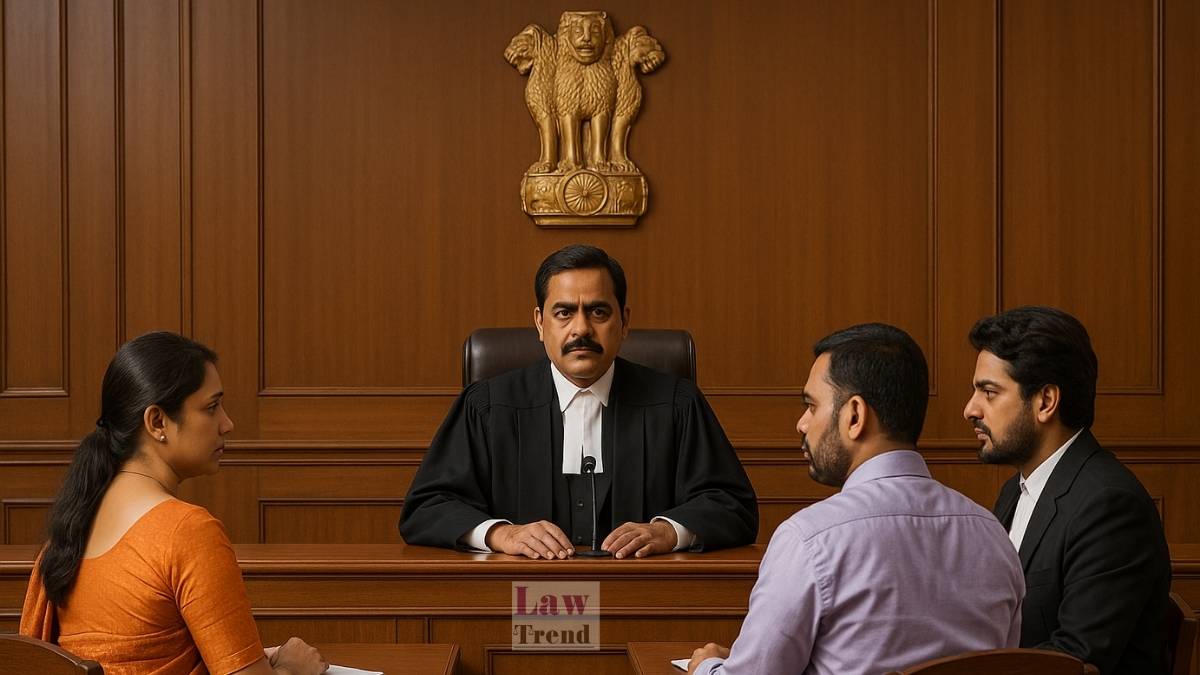
The Delhi High Court has ruled that at the stage of deciding interim maintenance under the Protection of Women from Domestic Violence Act, 2005 (PWDV Act), a court cannot deny relief to a wife merely on the basis of the husband’s unproven allegations that she is “living in adultery.”
Justice Swarana Kanta Sharma dismissed a revision petition filed by a husband challenging the interim maintenance awarded to his wife. However, the Court imposed a significant condition: if the trial court ultimately finds the wife is not entitled to maintenance on grounds of adultery, she will be liable to return the entire amount received with 6% interest.
Background of the Case
The petitioner-husband and the respondent-wife were married on September 26, 2014. Following matrimonial discord, the wife left the matrimonial home and filed an application under Section 12 of the PWDV Act, alleging sexual, verbal, emotional, and economic harassment, as well as dowry demands.
The learned Metropolitan Magistrate, Mahila Court, vide order dated October 22, 2021, allowed the wife’s application for interim relief and directed the husband to pay ₹26,000 per month. The husband challenged this order before the Sessions Court, which dismissed his appeal on October 31, 2023. Aggrieved by these orders, the husband approached the High Court.
Contentions of the Parties
The counsel for the petitioner-husband argued that the respondent was not an “aggrieved person” under Section 2(a) of the PWDV Act because she was allegedly living in adultery with another individual during the subsistence of the marriage. The husband relied on certain photographs purportedly showing the wife in a compromising position. He further contended that the lower courts erred in assessing his income at ₹79,000 per month, claiming he was merely a commission agent earning ₹25,000 per month, while the credit entries in his bank account were maturity proceeds of PPF and fixed deposits made by his parents.
Conversely, the counsel for the respondent-wife argued that she was subjected to severe domestic violence and that the husband had engaged in character assassination. Regarding the allegations of adultery, the counsel submitted that the photographs were morphed and fabricated, and such disputed questions of fact could not be decided at the interim stage. The wife also alleged that the husband himself was engaging in extra-marital relationships.
Court’s Analysis and Observations
Adultery Allegations at Interim Stage
The Court observed that while the husband relied on photographs to allege adultery, the wife contended they were fabricated. The Bench noted that these are matters of evidence to be proved during the trial.
Justice Sharma observed:
“At the stage of passing interim orders, the Court is required to take only a prima facie view based on the material placed on record… Therefore, at this stage, this Court is not inclined to interfere with the order granting interim maintenance only on the ground of allegations levelled by the petitioner-husband that the respondent-wife is living in an adulterous relationship.”
The Court distinguished the PWDV Act from the Code of Criminal Procedure (CrPC). While Section 125(4) of the CrPC expressly bars a wife living in adultery from receiving maintenance, the Court noted:
“Notably, unlike Section 125(4) of the Cr.P.C., there is no express statutory bar under the PWDV Act disentitling a woman from seeking reliefs merely on the allegation that she is living in adultery.”
However, the Court clarified that under Explanation II to Section 3 of the PWDV Act, the overall facts, including the wife’s conduct, would be relevant factors for final adjudication after evidence is led.
Referring to precedents, the Court cited Ajay Kumar v. Uma (2024) and Parveen Tandon v. Tanika Tandon (2021), reiterating that interim maintenance cannot be denied on unproven allegations of illicit relationships.
Assessment of Income
Regarding the financial capacity, the Court upheld the lower courts’ assessment. The Court noted that the husband’s bank statements showed credit entries totaling ₹28,45,120 over three years. The Court rejected the husband’s plea regarding the source of these funds at this stage, stating:
“…the plea of the petitioner-husband that he was earning only ₹25,000/- per month could not be accepted… Whether the said credit entries are attributable to income or otherwise is a matter which can be examined in detail during trial.”
Decision and Directions
The High Court dismissed the revision petition and upheld the interim maintenance of ₹26,000 per month.
However, to balance the equities, the Court issued the following directions:
- Expedited Trial: The Magistrate was directed to decide the Section 12 petition preferably within one year.
- Refund Clause: If the Trial Court ultimately concludes that the wife is not entitled to maintenance due to living in adultery, she shall be liable to return the entire interim maintenance amount to the husband with interest at the rate of 6% per annum.
- Undertaking: The wife was directed to file an affidavit before the Trial Court undertaking to return the amount with interest if she is found disentitled on the ground of adultery.
Case Details:
- Case Title: Ateet Jain v. Chhavi Jain
- Case Number: CRL.REV.P. 335/2024
- Coram: Justice Swarana Kanta Sharma