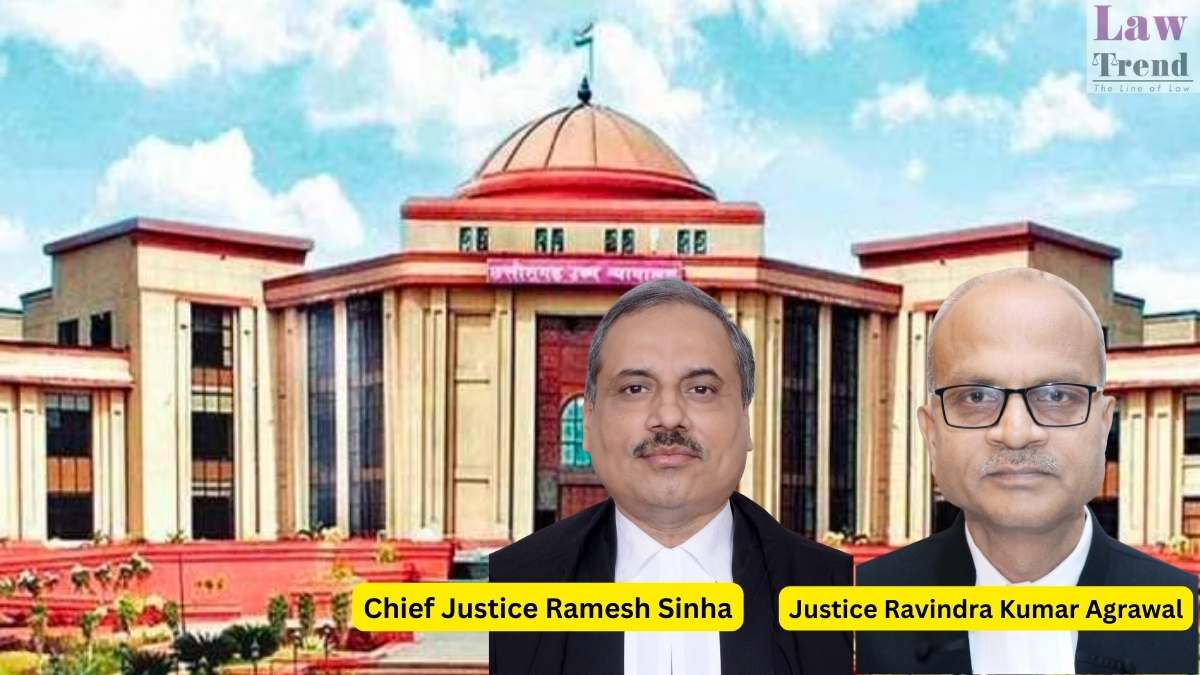
In a significant judgment defining the boundaries of administrative discretion in public recruitment, the High Court of Chhattisgarh has ruled that eligibility criteria notified at the commencement of a recruitment process cannot be changed midway unless the extant Rules or the advertisement explicitly permit such a change.
The Division Bench comprising Chief Justice Ramesh Sinha and Justice Ravindra Kumar Agrawal further held that even if such a change is permissible under the Rules, it must still meet the requirement of Article 14 of the Constitution of India and satisfy the test of non-arbitrariness.
Applying this principle, the Court allowed a Writ Appeal filed by Ravi Tiwari and quashed the appointments of numerous Sub Engineers (Civil) who had been appointed despite acquiring their educational qualifications after the prescribed cut-off date. The Court issued a Writ of Quo Warranto against these appointees, declaring their appointments void ab initio, notwithstanding their 14 years of service.
The Legal Principle: No Midway Changes to “Rules of the Game”
The core legal issue before the Court was whether the State Government could issue administrative instructions to relax eligibility criteria after the recruitment process had already begun. The Court referred to the “Head-Note” of its judgment, observing:
“Eligibility criteria for being placed in the select list, notified at the commencement of the recruitment process, cannot be changed midway through the recruitment process unless the extant Rules so permit, or the advertisement, which is not contrary to the extant Rules, so permit.”
The Bench clarified that administrative instructions cannot fill gaps in a manner that overrides statutory rules or introduces arbitrariness.
Background of the Case
The case pertains to an advertisement issued on February 23, 2011, by the Department of Panchayat and Rural Development for 275 posts of Sub Engineer (Civil). The last date for submission of applications was March 23, 2011. The advertisement mandated a three-year Diploma in Civil Engineering or an equivalent qualification.
However, during the selection process, the Department issued a clarification on November 17, 2011, permitting candidates who were appearing in their final year examinations to be considered. Consequently, several candidates who acquired their qualifications after the March 23, 2011 cut-off date were appointed.
The appellant, Ravi Tiwari, challenged these appointments, arguing that 89 candidates were ineligible on the cut-off date. Three state-constituted committees had also found these candidates ineligible, yet no action was taken to remove them.
Arguments Before the Court
Appellant’s Submission: Mr. Shalvik Tiwari, counsel for the appellant, argued that the appointments violated the statutory recruitment rules. He submitted that the eligibility must be judged as on the cut-off date prescribed in the advertisement. He contended that the subsequent administrative decision to include ineligible candidates amounted to changing the rules midway, which is legally impermissible.
State and Respondents’ Submission: The State, represented by Deputy Advocate General Mr. P.K. Bhaduri, and the private respondents argued that the Department took a “conscious policy decision” to allow final-semester students to participate to fill vacancies. They submitted that since the candidates eventually acquired the qualifications before their appointment and had served for nearly 14 years without any fraud, their appointments should be saved.
Court’s Analysis
1. On Changing Eligibility Criteria Midway: The Court relied on the Supreme Court’s decision in Tej Prakash Pathak & Ors. v. Rajasthan High Court, which held that the eligibility criteria notified at the start cannot be changed mid-stream. The High Court observed that the Recruitment Rules of 1999 did not empower the executive to relax essential educational qualifications via administrative notes.
“Administrative instructions permitting dilution of eligibility criteria cannot override statutory rules. Any such change must satisfy the test of non-arbitrariness under Article 14,” the Court noted.
2. Sanctity of the Cut-Off Date: Citing Sakshi Arha v. The Rajasthan High Court, the Bench reiterated that if the rules are silent, the last date for submission of applications is the decisive date for eligibility. The Court rejected the argument that eligibility could be determined on the date of selection or appointment.
3. Locus Standi and Public Interest: The Court rejected the respondents’ objection regarding the appellant’s locus standi. Citing Central Electricity Supply Utility of Odisha v. Dhobei Sahoo, the Court held that in a writ of Quo Warranto, the Court acts as a sentinel to prevent the usurpation of public office.
“Once lack of eligibility is established, the Court is duty-bound to intervene, irrespective of the length of service rendered by the incumbent.”
4. Length of Service No Cure for Illegality: Addressing the 14-year tenure of the respondents, the Court relied on Amrit Yadav v. The State of Jharkhand, holding that “length of service, confirmation, or absence of fraud cannot sanctify an illegal appointment.”
Decision
The High Court allowed the Writ Appeal in part:
- Appointments Quashed: The appointments of private respondents who acquired their qualifications after the cut-off date (March 23, 2011) were declared illegal and void ab initio. A Writ of Quo Warranto was issued against them.
- Exceptions: The Court upheld the appointments of Respondent No. 55 (Varsha Dubey) and Respondent No. 64 (Abhishek Bhardwaj), finding that they had acquired their degrees prior to the cut-off date.
- No Recovery: Recognizing the “undue hardship” caused by the State’s fault in appointing ineligible candidates, the Court directed that no recovery of salaries or dues already paid shall be made from the ousted employees.
Case Details
- Case Title: Ravi Tiwari v. State of Chhattisgarh and Others
- Case Number: WA No. 661 of 2025
- Coram: Chief Justice Ramesh Sinha and Justice Ravindra Kumar Agrawal