

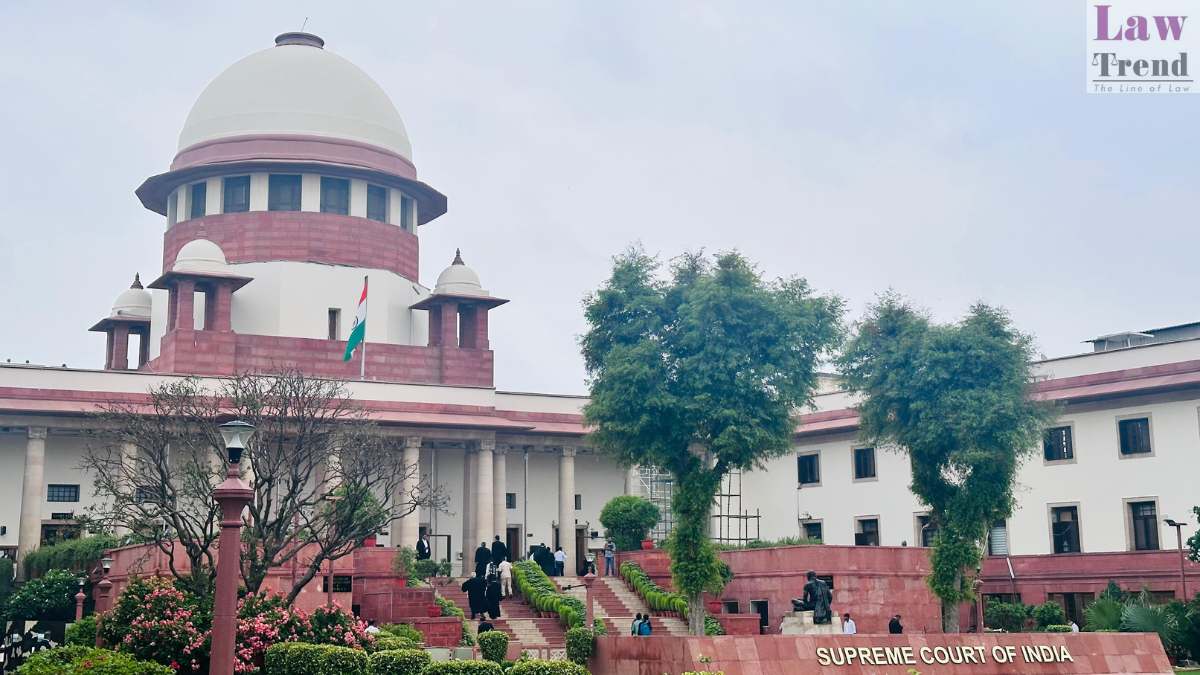
The Supreme Court on Monday sought responses from the Maharashtra government, the Slum Rehabilitation Authority, and the Municipal Corporation of Greater Mumbai (MCGM) on a plea challenging the Bombay High Court’s verdict that upheld the legality of permitting slum rehabilitation on land originally reserved for parks, gardens, and playgrounds.
A bench led by Chief Justice Surya Kant and Justice Joymalya Bagchi issued notice on a special leave petition filed by NGO Alliance for Governance and Renewal (NAGAR), and social activists Neera Punj and Nayana Kathpalia. The petition challenges the Bombay High Court’s June 19, 2025 judgment that validated Regulation 17(3)(D)(2) of the Development Control and Promotion Regulations (DCPR) 2034.
The Bombay High Court, in a detailed judgment delivered by Justices Amit Borkar and Somasekhar Sundaresan, upheld the impugned regulation that allows slum rehabilitation schemes on plots reserved for open public spaces, provided 35% of the land is restored for public use.
The court had dismissed the PIL filed by NAGAR, formerly known as CitiSpace, which argued that the regulation effectively legitimized illegal encroachments and violated the “Public Trust Doctrine”. The petitioners had pointed out that Mumbai’s open space per capita is alarmingly low—often less than one square metre per person.
Rejecting this contention, the high court ruled that the regulation represented a “constitutional equilibrium” between the right to a clean environment and the fundamental right to shelter. “The Constitution does not ask us to protect the environment by ignoring other rights, but to protect the environment alongside those rights (the right to shelter), in a way that respects both nature and human dignity,” the court observed.
While upholding the regulation, the high court laid down a 17-point safeguard framework to prevent “paper parks” and ensure the reclaimed green spaces are functional and accessible.
Among its directions, the court mandated that:
- The 35% open space must be contiguous, not scattered.
- It must be accessible to the general public, not just residents of rehab buildings.
- The open area must include features like jogging tracks, landscaping, and play equipment.
- These amenities must be completed before handover to the MCGM.
- The state must ensure that no further encroachments occur post-notification.
The court had noted that many of these lands are already 100% encroached upon and unusable by the general public, making the 65:35 model—where 65% is used for rehabilitation and 35% for green space—a “practical and proportionate” approach.
Senior advocate Shyam Divan, appearing for the petitioners, argued before the Supreme Court that Mumbai’s shrinking green cover needed judicial protection. He contended that the high court’s verdict allows irreversible loss of public spaces.
Taking note of these submissions, the top court directed that the petition be served to the standing counsel for the state and other respondents for early hearing.




