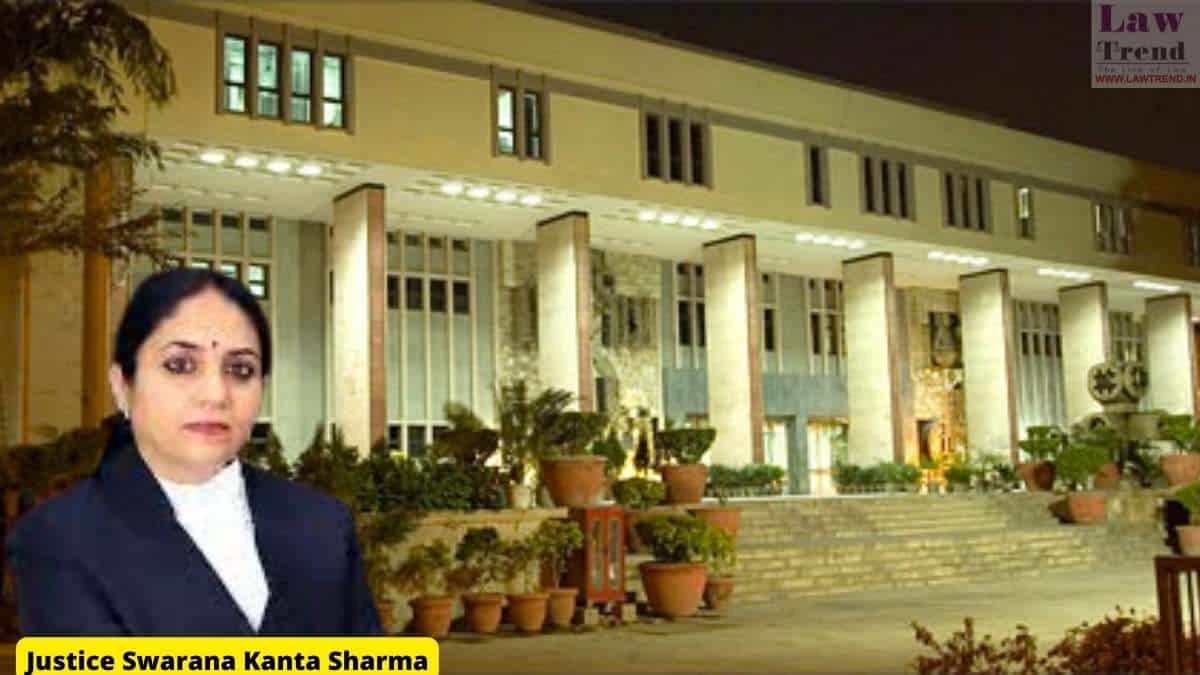
The Delhi High Court has upheld the conviction of an individual accused of kidnapping and rape in a 2008 case but reduced his sentence to the period of imprisonment already undergone. Justice Swarana Kanta Sharma observed that “no useful purpose would be served by sending the appellant back to custody” after a lapse of nearly 18 years since the incident.
The Court relied on the unamended Section 376 of the Indian Penal Code (IPC), applicable at the time of the offence, which allowed courts to impose a sentence of less than seven years for “adequate and special reasons.”
Factual Background
The appeal challenged the judgment of conviction dated November 9, 2010, and the order on sentence dated November 10, 2010, passed by the Additional Sessions Judge, South, Saket Courts. The appellant, Ravi Kumar, was convicted under Sections 366 (kidnapping, abducting or inducing woman to compel her marriage, etc.) and 376 (rape) of the IPC.
According to the prosecution, the FIR was registered on April 25, 2008, at Police Station Vasant Kunj. The prosecutrix alleged that on the intervening night of April 24-25, 2008, while she was going to attend the call of nature, the accused forcibly pulled her into his car, took her to a location near the Jal Board, and established sexual relations with her without her consent.
The Trial Court had sentenced Kumar to seven years of rigorous imprisonment for the offence under Section 376 IPC and five years for the offence under Section 366 IPC.
Submissions of the Parties
Counsel for the appellant argued that the conviction was based on conjectures. It was submitted that the appellant was falsely implicated due to prior enmity with the prosecutrix’s uncle. The defense highlighted the lack of independent public witnesses and contended that the medical evidence—specifically the fact that the prosecutrix’s hymen was intact—did not support the allegation of rape. Furthermore, the defense argued that the age of the prosecutrix was not conclusively proved to be that of a minor.
The Additional Public Prosecutor (APP) for the State defended the Trial Court’s judgment, arguing that the testimony of the prosecutrix was “cogent, natural, and consistent.” The State relied on forensic evidence, noting that the FSL report confirmed the presence of semen on the prosecutrix’s clothes and the car’s seat cover. The State asserted that minor discrepancies did not affect the root of the prosecution’s case.
High Court’s Analysis and Observations
On the Age of the Prosecutrix: The High Court noted the absence of documentary evidence like a birth certificate. The ossification test estimated her age between 16 and 18 years. Applying the margin of error in favor of the accused, the Court held that the prosecutrix “would be presumed major as on the date of incident.”
On Medical Evidence and Rape: Addressing the defense’s argument regarding the intact hymen and absence of external injuries, the Court rejected the contention. Justice Sharma observed that the absence of injuries does not rule out rape, as “even minimal penetration constitutes the offence of rape.”
The Court relied on the Supreme Court’s decision in State of H.P. v. Manga Singh (2019), quoting:
“In the absence of injury on the private part of the prosecutrix, it cannot be concluded that the incident had not taken place or the sexual intercourse was committed with the consent of the prosecutrix…”
On Consent and Investigation: The Court found the prosecutrix’s testimony consistent regarding forcible abduction and sexual assault. The Court noted, “The circumstances in which the prosecutrix was taken, the immediate disclosure made to her relatives, and the absence of any material suggesting a consensual relationship, clearly negates the defence of consent.”
Regarding alleged investigative lapses, the Court held that “the victim cannot be made to suffer for the lapses of the investigating agency.”
Decision on Sentence
While upholding the conviction under Sections 366 and 376 IPC, the Court modified the sentence. The Court noted that the incident occurred in 2008, prior to the Criminal Law (Amendment) Act, 2013. The unamended Section 376 IPC contained a proviso empowering the Court to impose a sentence of less than seven years for “adequate and special reasons.”
Justice Swarana Kanta Sharma observed:
“The appellant was about 26 years of age at the time of passing of the order on sentence and was newly married. As on date, the appellant is about 42 years old. He has already remained in judicial custody for more than three years and two months… Further, the appellant has been facing the ordeal of criminal proceedings for the last about eighteen years.”
Consequently, the High Court ruled:
“Taking into account the long lapse of time since the incident, the period of incarceration already undergone, the absence of any other criminal antecedents, and the proviso to Section 376 of IPC as it stood prior to the 2013 amendment, this Court finds that there are adequate and special reasons to reduce the sentence.”
The sentence was reduced to the period of imprisonment already undergone.
Case Details:
- Case Title: Ravi Kumar v. State
- Case Number: CRL.A. 1384/2010
- Coram: Justice Swarana Kanta Sharma
- Counsel for Appellant: Mr. Mukesh Singh and Mr. Ramashish Yadav
- Counsel for State: Mr. Naresh Kumar Chahar, APP with SI Pinky