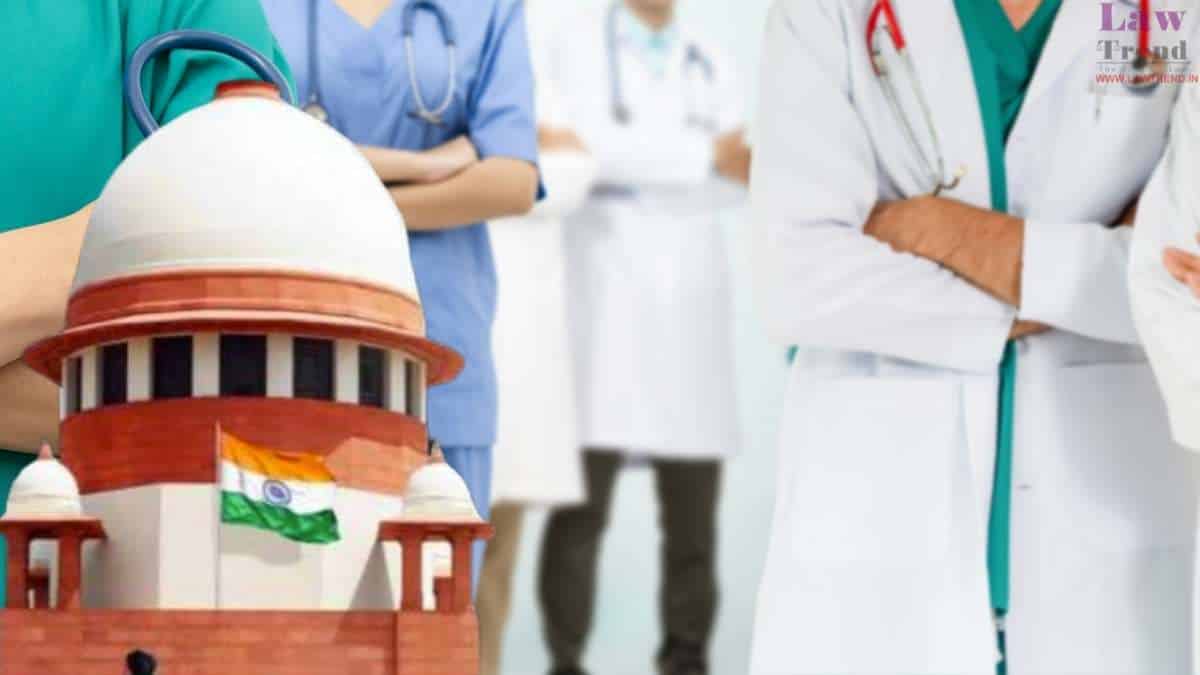
The Supreme Court of India has held that stem cell therapy for the treatment of Autism Spectrum Disorder (ASD) cannot be offered by medical practitioners as a routine clinical service. In a significant judgment delivered on January 30, 2026, the Bench comprising Justice J.B. Pardiwala and Justice R. Mahadevan ruled that such treatment must be restricted strictly to an approved and monitored clinical trial or research setting. The Court observed that administering unproven therapies outside of clinical trials constitutes a failure to meet the reasonable standard of care owed by medical professionals and amounts to professional misconduct.
Background of the Case
The judgment was delivered in a Public Interest Litigation (PIL) filed by Yash Charitable Trust & Ors. (Writ Petition (C) No. 369 of 2022). The petitioners raised concerns regarding the “rampant promotion, prescription and administration of stem cell ‘therapy’ for the treatment of Autism Spectrum Disorder” by various clinics across the country.
The petition alleged that despite stem cell therapy being at an experimental stage with no proven cure for ASD, clinics were advertising it as a treatment, violating the New Drugs and Clinical Trial Rules, 2019 (NDCT Rules, 2019) and the National Guidelines for Stem Cell Research, 2017 (NGSCR 2017) issued by the Indian Council of Medical Research (ICMR). The petitioners contended that individuals and parents were falling victim to these cost-intensive procedures due to a lack of awareness and regulatory enforcement.
Submissions of the Parties
The Petitioners argued that stem cell therapies are permitted only as clinical trials. They submitted that commercial administration of such therapy violates Rule 74 of the NDCT Rules, 2019, which prohibits the manufacture of new drugs for sale without permission. They relied on the recommendations of the Ethics and Medical Registration Board (EMRB) of the National Medical Commission (NMC), dated December 6, 2022, which termed the promotion of such therapy as “professional misconduct.”
The Union of India (Respondent No. 1) submitted that while “stem cell derived products” are regulated under the Drugs and Cosmetics Act, 1940, there are no specific provisions to regulate “therapies” or “treatments.” It referred to a clarification dated February 9, 2021, stating that stem cells undergoing “minimal manipulation” (such as rinsing or cleaning) for autologous use do not fall under the definition of “new drugs” under the NDCT Rules, 2019.
Respondent No. 9 (Neurogen Brain and Spine Institute) and Respondent No. 13 (Parents’ Forum for Stem Cells in Autism and Cerebral Palsy) opposed the petition. They argued that autologous bone-marrow derived cell therapy involves the patient’s own cells and is a “procedure,” not a “drug.” They contended that banning such treatments would violate the fundamental right of patients to choose medical treatment under Article 21, asserting that many patients had witnessed improvements. They relied on recommendations from the Drugs Technical Advisory Body’s (DTAB) 84th meeting, which suggested that routine therapies by doctors for their own patients should fall outside the purview of the Drugs Act.
Court’s Analysis
1. Standard of Care and Medical Negligence
The Court applied the “Bolam Test” regarding the standard of care owed by doctors, citing precedents like Indian Medical Association v. V.P. Shantha, Jacob Mathew v. State of Punjab, and M.A. Biviji v. Sunita. The Bench observed that a medical practitioner fails to meet the standard of reasonable care if they administer an intervention that “lacks credible scientific evidence of safety and efficacy.”
The Court relied on the EMRB-NMC Recommendations dated 06.12.2022 and the ICMR’s Evidence Based Status of Stem Cell Therapy for Human Diseases, 2021, which explicitly state that stem cell therapy is not recommended for ASD. The Court held:
“Therefore, we arrive at the conclusion that, since therapeutic use of stem cells in ASD is not recognised as ‘a sound and relevant medical practice’ as per the knowledge available at present, the medical practitioners who offer the same as a clinical service, outside of an approved and monitored research/clinical service, fail to meet the reasonable standard of care owed by them towards their patients.”
2. Legal Status of Stem Cells as “Drugs”
The Court examined whether stem cells fall under the definition of “drug” under Section 3(b)(i) of the Drugs and Cosmetics Act, 1940. While respondents argued that minimally manipulated autologous cells are not drugs, the Court rejected this interpretation. Relying on Chimanlal Jagjivan Das Sheth v. State of Maharashtra, the Court held that stem cells qualify as “substances intended to be used for… treatment of diseases” and thus fall under the broader definition of “drug,” even if they do not meet the specific criteria of a “new drug” under the NDCT Rules, 2019.
3. Regulatory Pathway: Clinical Trials Mandatory
The Court clarified that while minimally manipulated stem cells might not be “new drugs,” research involving them is governed by Chapter IV of the NDCT Rules, 2019 (Biomedical and Health Research). Rules 15 and 16(4) make the National Ethical Guidelines for Biomedical and Health Research Involving Human Participants, 2017 binding.
The Court cited Clause 7.9.1 of these guidelines, which states:
“Use of stem cells outside the domain of a clinical trial for any purpose is considered unethical and hence not permissible.”
Consequently, the Court ruled that “therapeutic use of any type of stem cell in Autism should be restricted to clinical trials only.”
4. Role of Department of Health Research (DHR)
The Court criticized an Order dated March 3, 2024, issued by the Department of Health Research (DHR) which dissolved the National Apex Committee for Stem Cell Research and Therapy (NAC-SCRT) and stated that no regulatory role is anticipated by DHR for stem cell research. The Court termed Clause 2(vi) of this order as “non est” (non-existent in law) because it conflicted with Rules 17 and 18 of the NDCT Rules, 2019, which empower the DHR to oversee Ethics Committees.
5. Informed Consent and Patient Autonomy
Addressing the argument on patient autonomy, the Court held that consent must be based on “adequate information.” Since there is a dearth of established scientific evidence on the efficacy of stem cell therapy for ASD, doctors cannot provide “adequate information” to secure valid consent. The Court observed:
“…patient autonomy cannot be stretched to seek an entitlement to subject oneself to a clinical procedure that is scientifically unvalidated, ethically impermissible, and outside the bounds of reasonable medical practice.”
Decision and Directions
The Supreme Court concluded that the administration of stem cell therapy for ASD as a routine clinical treatment constitutes professional misconduct.
The Bench issued the following directions:
- Restriction to Clinical Trials: Stem cell therapies for ASD cannot be offered as a clinical service and must be restricted to approved and monitored clinical trials.
- Professional Misconduct: Medical practitioners violating this mandate are liable for professional misconduct under Regulation 7.22 of the IMC Regulations, 2002, and action under the Clinical Establishments Act, 2010.
- Transitional Arrangement for Patients: Recognizing that abrupt discontinuation may affect patients currently undergoing treatment, the Court directed the Secretary, Ministry of Health and Family Welfare (MoHFW), in consultation with AIIMS and NMC officials, to “provide the best possible solution” to ensure such patients can continue receiving therapy until they can be re-routed to institutions conducting clinical trials.
- Legislative Reform: The Court suggested the Union consolidate rules to govern stem cell-based clinical trials, clearly define stem cells, and set up a dedicated authority (suggesting the reconstitution of NAC-SCRT).
The matter was treated as part-heard, with the MoHFW directed to file submissions within four weeks regarding the transitional solution for current patients.
Case Details
Case Title: Yash Charitable Trust & Ors. v. Union of India & Ors.
Case Number: Writ Petition (C) No. 369 of 2022
Bench: Justice J.B. Pardiwala and Justice R. Mahadevan