

Patna HC Invokes ‘Mahabharat’ on Fate of Aggressors, Confirms Death Penalty
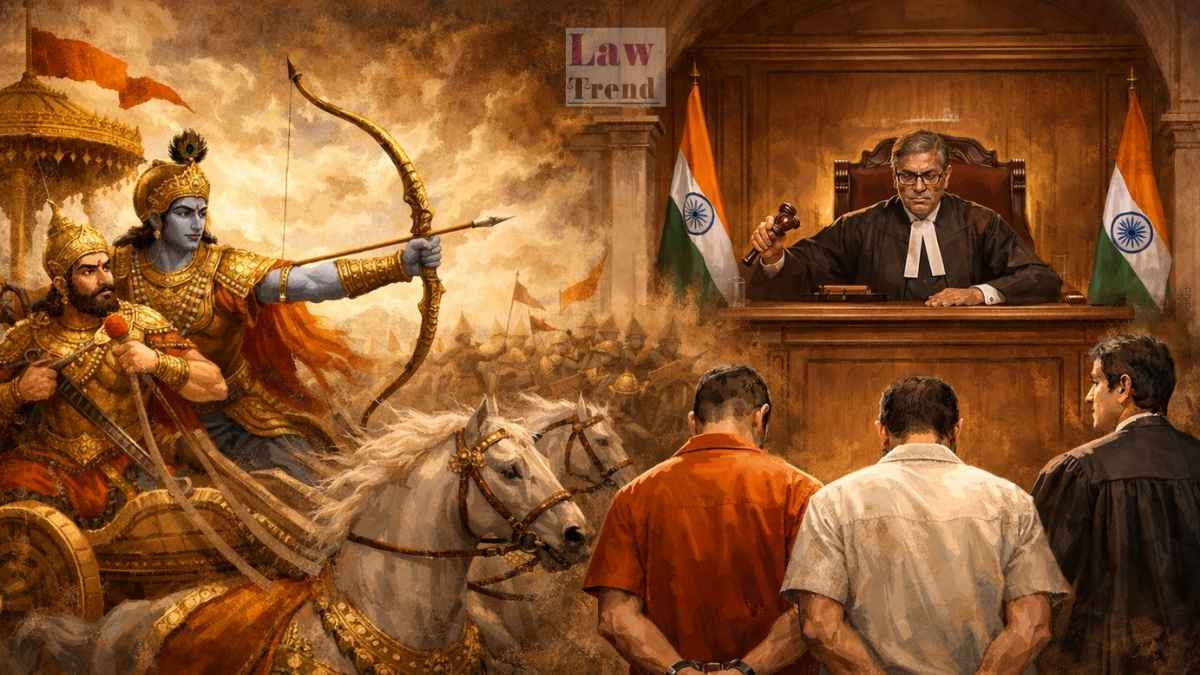
Patna: The Patna High Court has confirmed the death sentence awarded to two brothers, Aman Singh and Sonal Singh, for the “ruthless” murder of their uncle and two cousins over a land dispute. The Division Bench comprising Justice Rajeev Ranjan Prasad and Justice Sourendra Pandey dismissed the criminal appeal filed by the convicts and upheld the reference made by the trial court, categorizing the crime as falling within the “rarest of rare” category.

In a concurring opinion, Justice Pandey observed that the case was reminiscent of the epic Mahabharat, stating, “The story of Mahabharat leads us to one and only one conclusion that the appellants, who were the aggressors should be punished for their sin/crime, which has not only taken the three human lives but have also killed three women who after loosing their husbands have become lifeless.”

Background of the Case

The case stems from an incident on July 13, 2021, in Village Khudrao, under Darihat Police Station in Rohtas district. The prosecution’s case was based on the fardbeyan of Shakuntala Devi (PW-4), the wife of the deceased Vijay Singh.

According to the judgment, the accused—Ajay Singh (father) and his two sons, Aman Singh and Sonal Singh—began ploughing a disputed piece of land adjacent to the victims’ house. When Vijay Singh and his son Deepak Singh objected, they were assaulted. The victims fled to a neighbor’s door and then to their old house, but the accused chased them.

The prosecution stated that the appellants, armed with swords, attacked the victims. Sonal Singh allegedly assaulted Deepak Singh, causing fatal injuries to his neck, face, and chest. Aman Singh attacked the younger son, Rakesh Singh, severing both his hands and inflicting injuries on his neck and head. When Vijay Singh attempted to save his sons, he was attacked by Ajay Singh with a sword on his neck. All three victims were declared dead at the hospital.

READ ALSO  Patna HC Stays Trial Proceedings Against Rahul Gandhi in Sushil Modi’s Defamation Suit

The trial court, Additional Sessions Judge-19, Rohtas at Sasaram, had convicted the appellants under Section 302/34 of the Indian Penal Code (IPC) on May 2, 2024, and sentenced them to death on May 9, 2024.

Arguments of the Parties

Defense Arguments: Representing the appellants, Advocate Mr. Pratik Mishra raised several technical objections:

  • Delay in FIR: The defense argued there was an unjustified delay of approximately four hours in lodging the FIR, suggesting it was lodged after “much thought, deliberations, discussions and consultations.”
  • Suppression of Earliest Version: The counsel contended that the police had reached the spot and prepared inquest reports much earlier than the recording of the fardbeyan, implying the earliest version was suppressed.
  • Seizure List Irregularities: It was pointed out that the seizure list prepared at 7:35 PM already contained the Case Number and Section, even though the formal FIR was registered later at 11:50 PM.
  • Non-examination of Material Witnesses: The defense highlighted that ASI Bimlesh Kumar, who recorded the fardbeyan and prepared inquest reports, was not examined, causing prejudice.
  • Medical Evidence: The defense argued that the “lacerated wounds” found on the deceased were inconsistent with the alleged weapon (sword), which is a sharp-cutting instrument. They also relied on the presence of rigor mortis to challenge the time of occurrence.

Prosecution Arguments: Senior Advocate Mr. Ansul, appearing for the informant, and Mr. Manish Kumar No. 2, Additional Public Prosecutor, argued that:

  • The lapses by the Investigating Officer (I.O.), such as not examining the ASI, appeared to be “deliberately done to favour the accused persons” and should not benefit them.
  • The ocular evidence of the three widows (PW-2, PW-3, and PW-4) was consistent and reliable.
  • The medical evidence corroborated the prosecution’s story, as heavy sharp weapons like swords can cause lacerations.
READ ALSO  Practical Difficulties Make Joint Trial Impractical: Punjab & Haryana High Court Recalls Order in Irrigation Scam Case

Court’s Analysis

The High Court undertook a detailed analysis of the evidence and the investigation lapses.

On Investigation Lapses: The Court acknowledged that the I.O. had “created a mess by deliberately omitting to do what ought to have been done,” such as failing to record the statement of ASI Bimlesh Kumar. However, citing Supreme Court precedents like Dayal Singh vs. State of Uttaranchal, the Bench held that “contaminated conduct of officials should not stand in the way of evaluating the evidence,” and the prosecution evidence must be examined dehors such omissions.

On Medical Evidence: Addressing the defense’s contention regarding the nature of injuries, the Court rejected the argument that lacerated wounds could not be caused by a sword. The Court noted: “A lacerated wound may occur from a sword when the blade’s edge tears through skin and tissue, often with a crushing or stretching action creating irregular, ragged edges… A close perusal of the findings recorded by PW-6 in the postmortem reports would show that the kind of injuries found on the persons of the deceased corresponds to the nature of weapon i.e. sword (तलवार).”

On Ocular Evidence: The Court found the testimonies of the eye-witnesses, specifically the informant Shakuntala Devi (PW-4) and her daughters-in-law (PW-2 and PW-3), to be trustworthy. The Judges noted that the defense failed to suggest during cross-examination that the accused were not present at the scene.

On Sentencing: The Court agreed with the trial court’s finding that life imprisonment was inadequate. The judgment stated: “In this case altogether three unarmed persons have been ruthlessly butchered by these appellants who were armed with sword, for a dispute pertaining to a small piece of land… Consequent upon the death of the deceased persons, no male major person has been left to perform the rights and rituals… The happiness, pleasure and celebrations of the surviving family members have been done away for whole of their lives.”

Decision

The Division Bench upheld the conviction and the death sentence.

Justice Rajeev Ranjan Prasad wrote: “I confirm the death sentence in Death Reference No. 2 of 2024 and dismiss the Cr. Appeal (DB) No. 691 of 2024 preferred by the appellants.”

Justice Sourendra Pandey, in his concurring opinion, added: “The story of Mahabharat leads us to one and only one conclusion that the appellants, who were the aggressors should be punished for their sin/crime… I agree that it is one of the rarest of the rare cases in which the option to impose sentence of imprisonment of life or a special sentencing cannot be consciously exercised.”

The Court also directed the District Legal Services Authority, Rohtas, to award maximum compensation to the three widows of the deceased.

READ ALSO  Awards of Lok Adalat Are Deemed to be Decree, Further Appeals U/S 96 CPC Not Allowed: Jammu & Kashmir High Court

Case Details:

  • Case Title: The State of Bihar vs. Aman Singh and Sonal Singh (Death Reference No. 2 of 2024 with Criminal Appeal (DB) No. 691 of 2024)
  • Coram: Justice Rajeev Ranjan Prasad and Justice Sourendra Pandey
  • Counsel for Appellants: Mr. Pratik Mishra, Mr. Vatsal Vishal, Mr. Raushan Kumar
  • Counsel for State: Mr. Manish Kumar No. 2 (Addl. PP)
  • Counsel for Informant: Mr. Ansul (Sr. Advocate)
  • Amicus Curiae: Mr. Anil Singh, Mr. Manoj Kumar No. 1

Law Trend
Law Trendhttps://lawtrend.in/
Legal News Website Providing Latest Judgments of Supreme Court and High Court

Related Articles

Latest Articles


