

Cheque Bounce: Admission of Payment to Third Party and Non-Examination of Material Witness Rebuts Presumption; Karnataka HC Acquits Accused
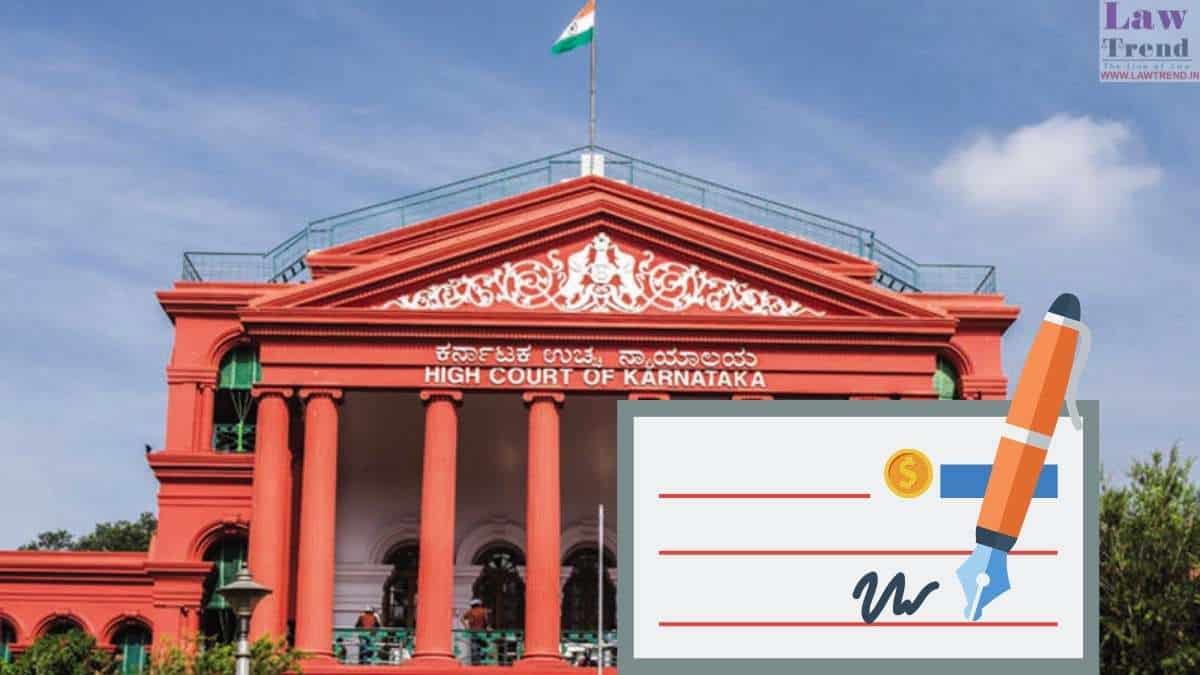
The Karnataka High Court has set aside the concurrent judgments of the trial court and the appellate court, acquitting the petitioner in a case filed under Section 138 of the Negotiable Instruments Act, 1881. The Court held that the failure to examine a material intermediary witness, coupled with the complainant’s admission that the loan amount was paid to said intermediary and not the accused, constituted a “material omission” fatal to the prosecution’s case.

The revision petition challenged the conviction of the accused for dishonour of a cheque amounting to Rs. 5,00,000. The High Court found that the lower courts had failed to consider significant admissions by the complainant regarding the lack of direct transaction with the accused and the failure to prove financial capacity. Consequently, the Court allowed the petition, setting aside the conviction and acquitting the accused.

Background of the Case

The revision petition was filed by Sri K.V. Vijay Kumar challenging the judgment dated April 17, 2021, passed by the LXIX Additional City Civil and Sessions Judge, Bengaluru, which confirmed the conviction order dated April 6, 2016, passed by the XXI Additional Chief Metropolitan Magistrate, Bengaluru.

The complainant, Sri V. Madaiah, had filed a private complaint alleging that the accused, a Telugu film distributor, was introduced to him by a close friend, R. Venkateshappa. The complainant claimed that on June 10, 2013, the accused borrowed a hand loan of Rs. 5,00,000, assuring repayment within three months, and issued a cheque (No. 320409) dated September 10, 2013. The cheque was returned with the endorsement “insufficient funds,” leading to the legal proceedings.

Arguments of the Parties

Learned counsel for the petitioner, Sri A. Madhusudhana Rao, argued that the lower courts failed to properly appreciate the defense that the cheque in question was one of 16 cheques collected by R. Venkateshappa for a chit subscription and subsequently misused.

READ ALSO  Allahabad HC Grants Big Relief to 301 Pharmacy Colleges- Quashes NOC Cancellation Order

The petitioner contended that he had filed a complaint against R. Venkateshappa on July 7, 2014 (Ex.D1) regarding the abuse of his cheques. Furthermore, the petitioner relied on a reply notice (Ex.D2) dated October 15, 2013, sent to R. Venkateshappa, wherein he detailed the 16 cheques issued for the chit subscription.

The counsel highlighted that the complainant, during cross-examination, admitted that the “accused had not approached him, but R. Venkateshappa had asked complainant to lend money.” The petitioner also disputed the financial capacity of the complainant, pointing out that the source of the Rs. 5,00,000 cash was not disclosed in the demand notice (Ex.P3).

The respondent was served but remained unrepresented in the High Court.

Court’s Analysis

Justice Ravi V. Hosmani observed that while the accused admitted his signature on the cheque (Ex.P1), thereby attracting the presumption under Sections 118 and 139 of the NI Act, the burden was on the accused to raise a probable defense to rebut this presumption.

READ ALSO  Private Agreement Between  PSUs is Not Subject to NHAI Act: Karnataka High Court

The Court referred to the Supreme Court judgments in M.S. Narayana Menon alias Mani v. State of Kerala & Anr., Basalingappa v. Mudibasappa, and APS Forex Services Pvt. Ltd. v. Shakti International Fashion Linkers and Ors. regarding the standard of proof required for the accused and the shifting of onus when financial capacity is disputed.

The High Court scrutinized the evidence and noted significant inconsistencies in the complainant’s (PW-1) testimony. The Court observed that PW-1 admitted “complainant had not informed accused about dishonor of cheque and that accused did not ask complainant for hand loan and that amount was paid to R. Venkateshappa, who had sought loan for accused.”

The Court termed the failure to examine R. Venkateshappa as a critical flaw. Justice Hosmani observed:

“When, it is admitted that complainant had given money to R Venkateshappa on behalf of accused and that accused had not asked him for loan, non-examination of R. Venkateshappa would be a material omission, probabilising defence set-up and upsetting presumption. Same would be in present facts and circumstances fatal to prosecution.”

READ ALSO  Even if a Blank Cheque Leaf is voluntarily signed and handed over by accused, it would attract the presumption under Section 139 of the N.I Act: Kerala HC

The Court further noted that the complainant “admitted not possessing any document to show availability of amount in cash to lend to accused as well as failure to disclose source of income,” calling this a “material omission.”

The High Court criticized the lower courts for proceeding solely on the admission of the signature on the cheque without proper consideration of the entire material on record. The Court stated:

“Thus, it has to be held, finding of both Courts are without consideration of entire material on record and as such perverse.”

Decision

The High Court allowed the Criminal Revision Petition. The judgment dated April 17, 2021, passed by the LXIX Additional City Civil and Sessions Judge, Bengaluru, and the judgment dated April 6, 2016, passed by the XXI ACMM, Bengaluru, were set aside. The accused, Sri K.V. Vijay Kumar, was acquitted of the offence punishable under Section 138 of the NI Act, and his bail/surety bonds were discharged.

Case Details:

Case Title: Sri K.V. Vijay Kumar vs. Sri V. Madaiah

Case No: Criminal Revision Petition No. 36 of 2022

Coram: Justice Ravi V. Hosmani

Law Trend
Law Trendhttps://lawtrend.in/
Legal News Website Providing Latest Judgments of Supreme Court and High Court

Related Articles

Latest Articles
