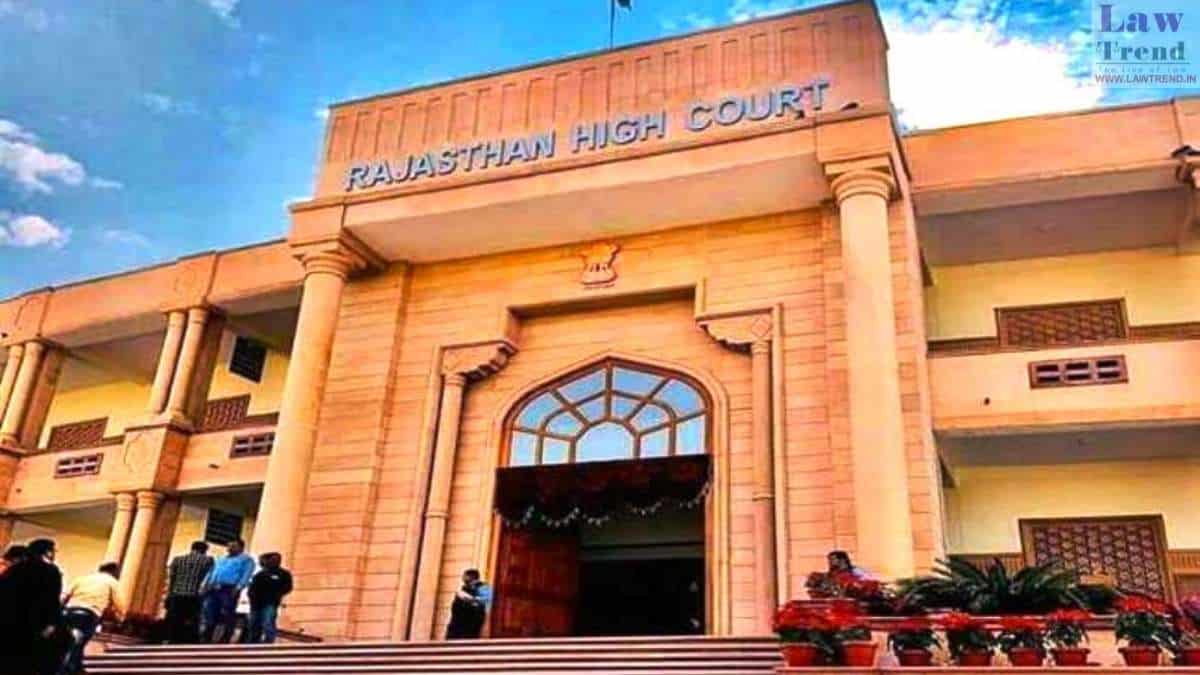
The Rajasthan High Court has upheld the life imprisonment sentence awarded to a man convicted of raping his own minor daughter. The Division Bench, observing that the crime reflected a “complete betrayal of the most sacred and natural relationship between a Father and Daughter,” dismissed the appeal filed by the convict and directed the State Government to pay ₹7 Lakh as compensation to the survivor.
The Division Bench comprising Justice Vinit Kumar Mathur and Justice Chandra Shekhar Sharma dismissed the criminal appeal preferred by the appellant, Manoj, against the judgment dated November 14, 2022, passed by the Special Judge (POCSO Act), Dungarpur. The trial court had convicted the appellant for offences under Sections 376(2) and 376AB of the Indian Penal Code (IPC) and Section 6 of the Protection of Children from Sexual Offences (POCSO) Act, sentencing him to life imprisonment till death.
Background of the Case
The case originated from a handwritten report lodged by the victim’s mother (the complainant) at Vardha Police Station on August 17, 2022. According to the prosecution, on August 11, 2022, the complainant had gone to her brother’s house to celebrate Raksha Bandhan, leaving her children and husband at home. Upon her return on the evening of August 13, 2022, her eldest daughter, a student of Class VII, revealed in tears that her father had sexually assaulted her on the night of August 12, 2022.
The victim further disclosed that the accused had committed similar acts on two earlier occasions when the mother was away for surgery and had threatened her into silence. Based on this report, FIR No. 60/2022 was registered. Following the investigation, the police filed a charge-sheet, and the trial court subsequently convicted and sentenced the accused.
Arguments Before the Court
Mr. Amardeep Lamba, the Amicus Curiae appearing for the appellant, argued that the prosecution failed to prove its case beyond reasonable doubt. He submitted that the complainant had serious matrimonial disputes with the appellant and desired a divorce, which the appellant had refused. He contended that the case was a result of false implication due to this marital discord. Furthermore, the defence highlighted that the Forensic Science Laboratory (FSL) and DNA reports were negative, arguing that the biological samples did not match the appellant, a vital exculpatory fact ignored by the trial court.
Mr. Rajesh Bhati, the Public Prosecutor representing the State, opposed the appeal. He supported the trial court’s judgment, asserting that the conviction was based on sound evidence and that there was no infirmity in the lower court’s findings.
Court’s Analysis and Observations
The High Court, after a close scrutiny of the record, held that the prosecution had successfully established its case. The Bench found the testimony of the victim (PW-1) to be “natural, cogent, and consistent,” noting that despite her tender age, her evidence bore the “stamp of truth.”
- Credibility of the Victim: The Court observed, “Being the victim of the crime herself, and there being no reason for her to falsely implicate her own father, her testimony constitutes the best possible evidence of the occurrence.” The Court noted that the delay in lodging the FIR was satisfactorily explained by the victim’s fear and the family circumstances.
- Presumption of Guilt: Citing Section 114(a) of the Indian Evidence Act and Section 29 of the POCSO Act, the Court emphasized that once the foundational facts are established, a statutory presumption of guilt operates against the accused. The Bench stated, “In the present case, the victim is a minor below 12 years of age, and therefore, the question of consent does not arise at all. The statutory presumption operates fully against the accused, and the accused has utterly failed to rebut the same.”
- Rejection of Defence Theory: The Court rejected the argument regarding false implication due to marital discord as “wholly unsubstantiated,” noting that no material was brought on record to show any animosity strong enough for a mother to implicate her husband in such a heinous offence at the cost of her daughter’s dignity.
- Medical Evidence: The Court found that the medical evidence, including the testimony of Dr. Leena Dandore (PW-9), corroborated the ocular testimony of the victim, specifically noting the finding of a torn hymen.
Observations on the Nature of the Crime
The Court expressed strong censure regarding the nature of the offence, stating:
“Sexual offences, particularly those perpetrated against children, inflict wounds that endure far beyond the immediacy of the act… Where the offender is the father—the very person entrusted as the child’s natural protector—the offence transcends ordinary criminality and assumes an abhorrent and grotesque character.”
Quoting ancient wisdom, the Court remarked: “Yatra naryastu pujyante ramante tatra devata…” (where women are honoured, divinity flourishes; where they are dishonoured, all acts become fruitless).
Decision
The High Court upheld the conviction and sentence passed by the trial court. Additionally, relying on the recent Supreme Court judgment in Bhanei Prasad @ Raju Vs. State of Himachal Pradesh (2025 INSC 934), the Bench emphasized the need for restitution.
The Court ordered: “We therefore direct the State of Rajasthan to pay a sum of Rs.7,00,000/- (Rupees Seven Lakhs Only) to the victim as compensation pursuant to the Scheme of 2018.”
The appeal was dismissed, and the conviction was confirmed.
Case Details:
- Case Title: Manoj S/o Shankar v. State Of Rajasthan & Anr.
- Case No: D.B. Criminal Appeal (DB) No. 41/2023
- Coram: Justice Vinit Kumar Mathur & Hon’ble Mr. Justice Chandra Shekhar Sharma
- Counsel for Appellant: Mr. Amardeep Lamba, Amicus Curiae
- Counsel for Respondent: Mr. Rajesh Bhati, PP