

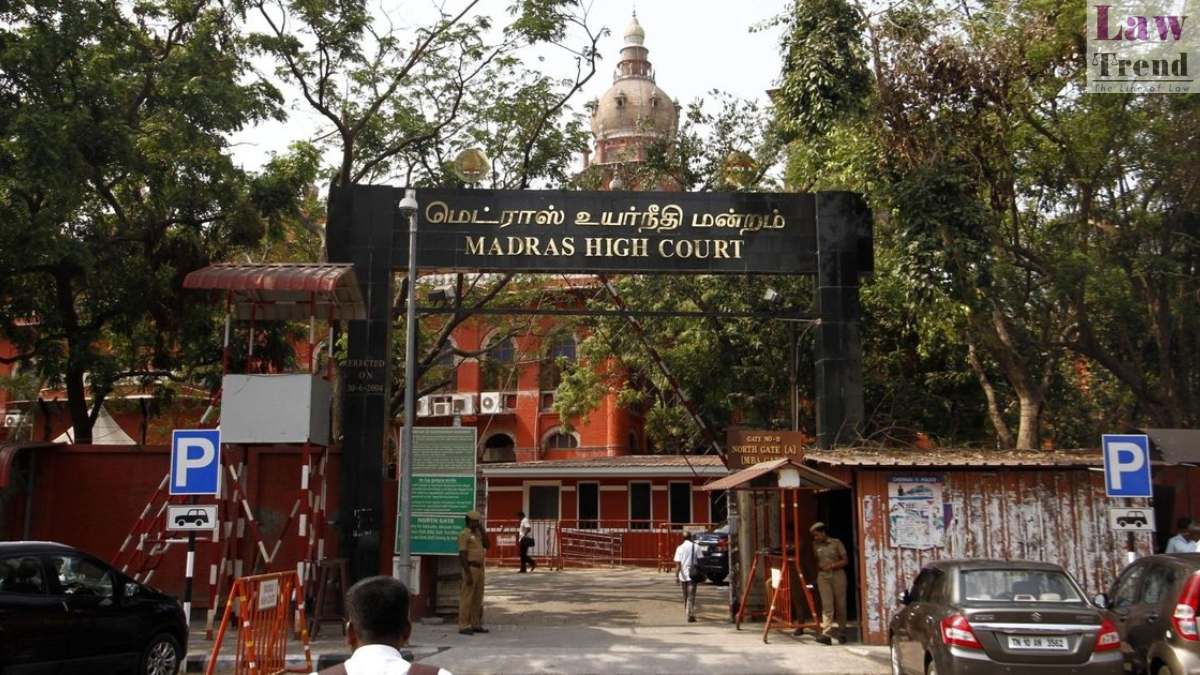
The Madras High Court on Wednesday heard sharp arguments from devotees opposing appeals against a single judge’s order that allowed the lighting of a ceremonial lamp on Deepathoon during the Karthigai Deepam festival at Thirupparankundram hill, with senior advocate S. Sriram asserting that official claims of possible public disorder were “non-existent” and aimed at curbing Tamil cultural practices.
A division bench of Justice G. Jayachandran and Justice K.K. Ramakrishnan continued hearing a batch of appeals challenging the December 1 order of Justice G.R. Swaminathan, which had permitted the lighting of the lamp on a stone pillar near a dargah atop the hill. The matter has been under hearing for several days, with the appellants concluding their submissions earlier this week.
Advancing arguments on behalf of the devotees, Sriram contended that concerns raised by district authorities over law and order were exaggerated and had not even been placed before the single judge earlier. He argued that invoking public order could not be used as a “gate pass to avoid scrutiny” of the devotees’ right to worship.
According to Sriram, when the state was unwilling to enforce such rights, the public was entitled to seek judicial protection. He maintained that lighting lamps and worshipping formed part of Tamil culture and Hindu religious practice, and stopping it on the ground of anticipated disorder lacked any factual basis.
During the hearing, the bench asked whether the devotees were open to negotiations to resolve the dispute, a suggestion that Sriram declined. Justice Jayachandran also remarked that both sides appeared to be overstating their case, questioning how authorities were interfering merely by asking that the lamp not be lit, and observing that the public order argument too seemed exaggerated.
Sriram, however, insisted that the authorities’ stance effectively subordinated the right to religion to public order concerns. He argued that the administration had taken a closed and biased approach, without explicitly naming any community, and that the objections were driven by factors unrelated to genuine safety concerns.
The senior advocate also rejected the appellants’ claims that the stone pillar in question could belong to Jains, a dargah, or might merely be a survey stone, calling such submissions not bona fide. He pointed out that the nature of the devotees’ right to worship had become entangled with issues involving the Waqf Board and the Archaeological Survey of India.
Referring to earlier submissions by the Arulmighu Subrahmanya Swamy Temple authorities that only one lamp could be lit on the hillock, Sriram said such arguments reflected a dismissive attitude toward Hindu devotees.
The appeals before the High Court have been filed by the State, the dargah, the Waqf Board, and Madurai district and temple officials. They challenge Justice Swaminathan’s December 1 order permitting the lighting of the Karthigai Deepam lamp on the hill. The appellants completed their arguments on December 16 after three consecutive days of hearings.
The bench is expected to continue hearing submissions before reserving orders in the matter, which has drawn attention for its intersection of religious rights, cultural practice, and claims of public order.




