

Referral Court Need Only Prima Facie Satisfy Existence of Arbitration Agreement; Issue of Individual Consortium Member’s Right to Invoke Arbitration Left to Tribunal: Supreme Court
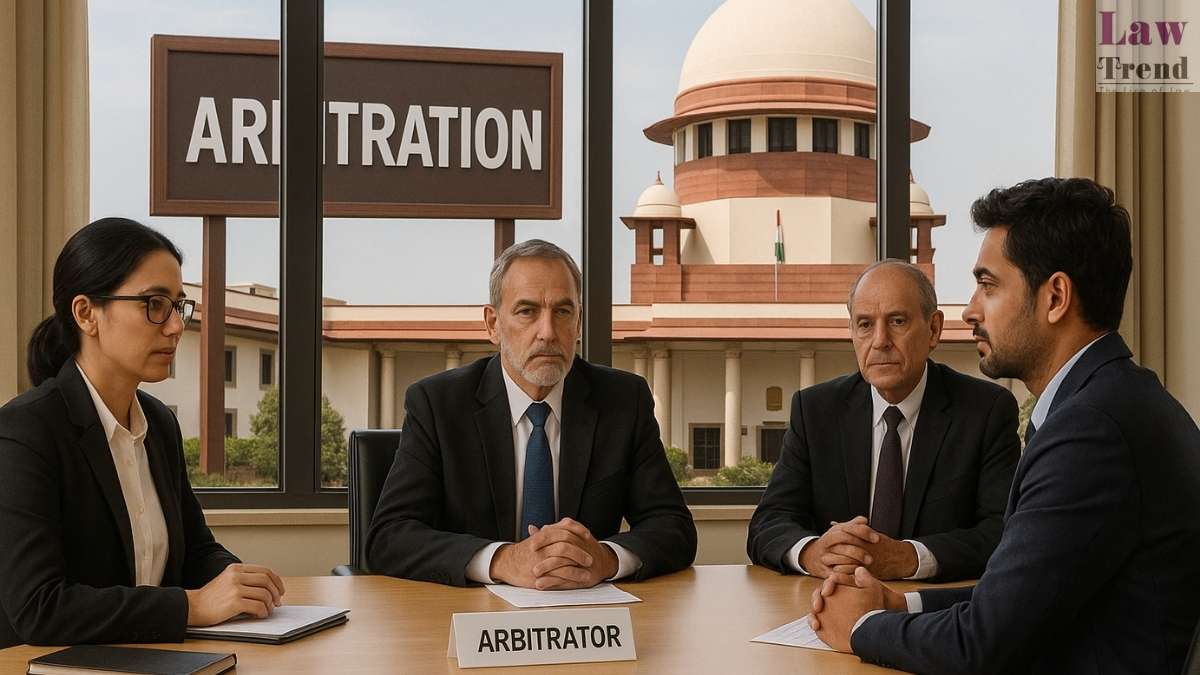

The Supreme Court of India has held that a referral court exercising jurisdiction under Section 11(6) of the Arbitration and Conciliation Act, 1996, is only required to be prima facie satisfied regarding the existence of an arbitration agreement. The Court clarified that complex questions, such as whether an individual member of a consortium can unilaterally invoke an arbitration clause contained in a contract with the consortium, should be left for the Arbitral Tribunal to decide.

The Division Bench comprising Justice Pamidighantam Sri Narasimha and Justice Atul S. Chandurkar dismissed the appeals filed by Andhra Pradesh Power Generation Corporation Limited (APGENCO) and M/s VA Tech Wabag Ltd., upholding the Telangana High Court’s order which had constituted an Arbitral Tribunal to resolve the disputes raised by M/s Tecpro Systems Ltd.

Background of the Dispute

The case originated from a tender floated by APGENCO for Engineering, Procurement, and Construction (EPC) works at the Rayalseema Thermal Power Plant. A Consortium comprising M/s Tecpro Systems Ltd. (Respondent No. 1), M/s VA Tech Wabag Ltd., and M/s Gammon India Ltd. was awarded the contract. Initially, Tecpro Systems was designated as the Lead Member.

During the execution of the project, Tecpro Systems encountered severe financial distress and was subsequently admitted into the Corporate Insolvency Resolution Process (CIRP), followed by liquidation orders. Due to project delays, the Consortium Agreement was amended in 2014, replacing Tecpro with VA Tech Wabag Ltd. as the Lead Member.

READ ALSO  राष्ट्रपति मुर्मू ने विधेयकों को स्वीकृति देने की न्यायिक समय-सीमाओं पर सुप्रीम कोर्ट से राय मांगी; राष्ट्रपति और राज्यपालों के विवेकाधिकार की न्यायिक समीक्षा पर उठाए महत्वपूर्ण संवैधानिक प्रश्न

Despite ceasing to be the lead member, Tecpro Systems issued a notice in 2017 claiming approximately Rs. 1951.59 crores from APGENCO for alleged breaches. When APGENCO did not respond to the invocation of arbitration, Tecpro filed an application under Section 11(6) of the Act before the High Court. APGENCO opposed the application, arguing that the arbitration agreement was with the “Consortium” collectively, and an individual member could not unilaterally invoke it. The High Court, however, allowed the application and referred the dispute to arbitration, leading to the present appeals before the Supreme Court.

Arguments Raised

The Appellants (APGENCO and VA Tech Wabag Ltd.) argued that no arbitration agreement existed between APGENCO and Tecpro Systems in its individual capacity. They contended:

  • The “Contractor” under the General Conditions of Contract (GCC) referred to the Consortium as a collective entity.
  • An individual member lacks the competence to invoke arbitration without the authority or consent of other consortium members.
  • Relying on Cox and Kings Ltd. v. SAP India Pvt. Ltd. (2024), they argued that the intention was to contract with the Consortium, excluding unilateral action.
  • Tecpro, being a defaulting and insolvent member who lost leadership, could not independently invoke the clause.

The Respondent (Tecpro Systems Ltd.) countered that:

  • The arbitration clause in the GCC was incorporated into the Purchase Orders.
  • The definition of “Contractor” included “legal successors in title,” and upon insolvency, the Consortium Agreement ceased, making members individual successors.
  • A Consortium is not a separate legal entity distinct from its members (New Horizons Ltd. v. Union of India).
  • The objection raised by the appellants pertained to the “capacity to invoke” rather than the “existence” of the agreement, which is a matter for the Tribunal to decide.
READ ALSO  SC Questions Implementation of Norms Against Unethical Pharma Practices

Court’s Analysis and Observations

The Supreme Court focused on the limited scope of judicial scrutiny at the referral stage under Section 11(6-A) of the Act. The Bench reiterated that the enquiry is confined to the “existence of an arbitration agreement.”

Referring to the Constitution Bench decision in Interplay Between Arbitration Agreements under Arbitration and Conciliation Act, 1996 and Stamp Act, 1899, In Re (2024) and SBI General Insurance Co Ltd v. Krish Spinning Mills Pvt Ltd (2024), the Court observed that the referral court must refrain from entering into contentious factual or legal issues regarding authority, capacity, or maintainability.

The Court held:

“Reference court will, however, confine its enquiry only to a prima facie satisfaction as to whether a member of a consortium qualifies as a ‘party’ to the arbitration agreement. This prima facie satisfaction is sufficient for the referral court to constitute and refer the dispute to the AT. Thereafter, it is for the AT to undertake the detailed enquiry as to whether a member of the consortium is in fact a veritable party to the arbitration agreement or not.”

READ ALSO  'Disciplinary Proceedings Are Still Pending' : Allahabad High Court Restrains Arrest Of Public Servant In Gangster Act Case

The Bench cited Cox & Kings Ltd., noting that the determination of whether a non-signatory or a specific entity is a “veritable party” involves complex factual and legal questions best suited for the Arbitral Tribunal under Section 16.

Addressing the specific issue of consortium members, the Court noted:

“The question whether a member of a consortium can itself invoke Section 11 of the Act, 1996 is not one that admits of a monolithic or a uniform answer. Answer to that question will necessarily depend on enquiry into the terms of the principal contract, as well as the Consortium Agreement.”

Decision

The Supreme Court concluded that the High Court had not committed any error in constituting the Arbitral Tribunal based on a prima facie finding. The Court dismissed the appeals but clarified that the Arbitral Tribunal is empowered to examine all objections.

The Court directed:

“The AT will consider all questions including preliminary objections relating to maintainability of the arbitration on their own merit.”

Case Details:

  • Case Title: M/s Andhra Pradesh Power Generation Corporation Limited (APGENCO) v. M/s Tecpro Systems Limited & Ors. (and connected appeal)
  • Case Number: Civil Appeal arising out of SLP (C) No. 8998 of 2023
  • Citation: 2025 INSC 1447
  • Coram: Justice Pamidighantam Sri Narasimha and Justice Atul S. Chandurkar

Law Trend
Law Trendhttps://lawtrend.in/
Legal News Website Providing Latest Judgments of Supreme Court and High Court

Related Articles

Latest Articles

