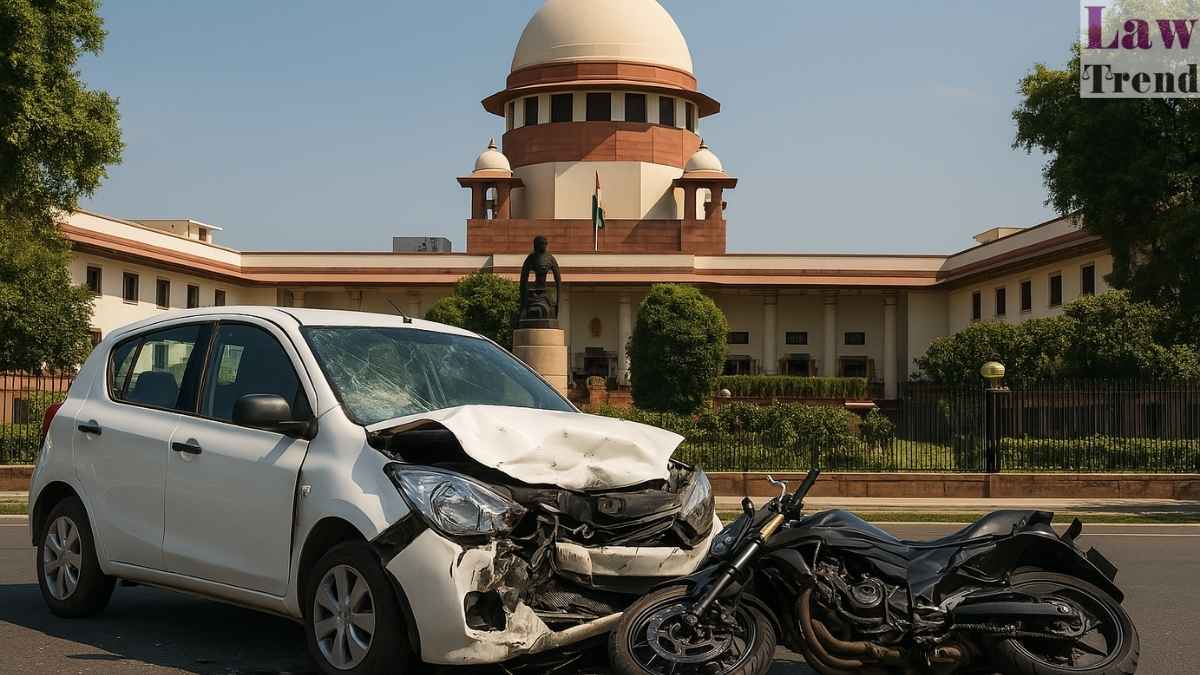
The Supreme Court has allowed an appeal filed by the National Insurance Company, modifying the compensation awarded to the family of a deceased transport contractor. The Court observed that the computation of income by the lower forums was based on “surmises and conjectures,” particularly noting the absence of Income Tax Returns despite the high income claimed. The Bench comprising Justice Ahsanuddin Amanullah and Justice K. Vinod Chandran recalibrated the award to ensure it constitutes “just compensation” rather than a windfall.
Background of the Case
The legal proceedings originated from a motor accident that occurred on August 29, 2017, resulting in the death of the victim. The deceased’s legal representatives—his wife and three children—filed a claim for compensation.
The Motor Accident Claims Tribunal framed issues regarding the cause of death and the quantum of compensation. The fact that the death was caused by the rash and negligent driving of the offending vehicle was not disputed. The litigation reached the Supreme Court solely on the question of the “exorbitant award made on an unconscionable computation of the income of the deceased.”
Arguments of the Parties
The Appellant (Insurance Company) challenged the determination of the deceased’s monthly income at Rs. 95,000. Learned counsel for the insurer argued that:
- An income of Rs. 95,000 per month would ostensibly attract income tax liability, yet no Income Tax Returns were produced by the claimants.
- The Tribunal’s assumption that the deceased’s income was double the EMI paid (Rs. 42,500 per month for two trucks) was without basis.
- The deceased’s accounts showed 15 defaults in EMI payments, indicating he did not have a regular income sufficient to pay the installments on time.
The Respondents (Claimants) contended that the accounts produced evidenced the due satisfaction of EMIs. They argued that if there had been continuous default, the bank would have proceeded against the defaulter. They relied on the judgment in Gurpreet Kaur v. United India Insurance Company Ltd. (2022) to support the compensation awarded by the Tribunal and confirmed by the High Court.
Court’s Analysis and Observations
The Supreme Court rejected the reliance on Gurpreet Kaur, distinguishing it on facts. In that case, the deceased was an earth-moving contractor who had cleared a loan for a tractor within a year, justifying the specific income assessment.
In the present case, the Court observed that while the deceased was described as a “reputed transporter” owning two trucks, the claim that he earned additional income by driving others’ trucks was not supported by evidence.
On the Absence of IT Returns: The Bench placed significant weight on the non-filing of tax returns, stating:
“The said contention was not at all established by way of any evidence and pertinently as noticed by the Tribunal itself, no income tax returns were filed, which assumes much relevance insofar as the claim of income exceeding the taxable limit as per the Income Tax Act.”
On the Continuation of Business: The Court noted that unlike a personal avocation, the deceased’s transport business could continue after his death. The Judges observed:
“The death of the victim in our opinion would not have put a stop to the income that could be generated from his business; especially from the two trucks he owned.”
Referencing the Constitution Bench decision in National Insurance Co. Ltd. v. Pranay Sethi (2017), the Court reiterated the principle that legal representatives “cannot expect a windfall from a tragedy, nor can the amounts granted be a mere pittance.”
Decision
The Supreme Court allowed the appeal and issued the following directions:
- Loss of Dependency: The Court held that the amount of Rs. 50,00,000 (Rupees Fifty Lakhs), which had been deposited on the Court’s directions, would suffice as compensation for the loss of dependency. This amount was noted to be half of the total loss of dependency originally computed by the Tribunal.
- Additional Heads: The claimants are entitled to Rs. 1,60,000 (Rupees One Lakh Sixty Thousand) over and above the deposited amount. This sum covers loss of consortium, loss of estate, and funeral expenses.
- Filial Consortium: Citing Magma General Insurance Co. Ltd. v. Nanu Ram & Ors. (2018), the Court affirmed that “not only the wife, the children are also entitled to loss of filial consortium.”
- Interest: The total award amount shall carry interest at the rate of 9% per annum from the date of the claim petition.
The Insurance Company has been directed to pay the balance amount to the claimants within one month from the receipt of the judgment.
Case Details
- Case Title: M/s National Insurance Co. Ltd. Versus Neeru Devi & Ors.
- Case Number: Civil Appeal @ SLP (C) No. 19462 of 2025
- Citation: 2025 INSC 1430
- Coram: Justice Ahsanuddin Amanullah and Justice K. Vinod Chandran