

Proviso to Section 34 SRA Not Attracted When Consequential Relief of Injunction is Sought; Non-Executant Need Not Seek Cancellation of Deed: Delhi High Court

The Delhi High Court has dismissed an application seeking the rejection of a plaint under Order VII Rule 11 of the Civil Procedure Code (CPC), clarifying the applicability of the proviso to Section 34 of the Specific Relief Act, 1963 (SRA). The Court held that the bar under the proviso, which prohibits a court from making a declaration where the plaintiff is able to seek further relief but omits to do so, does not apply when the plaintiff has sought the consequential relief of permanent and mandatory injunction.

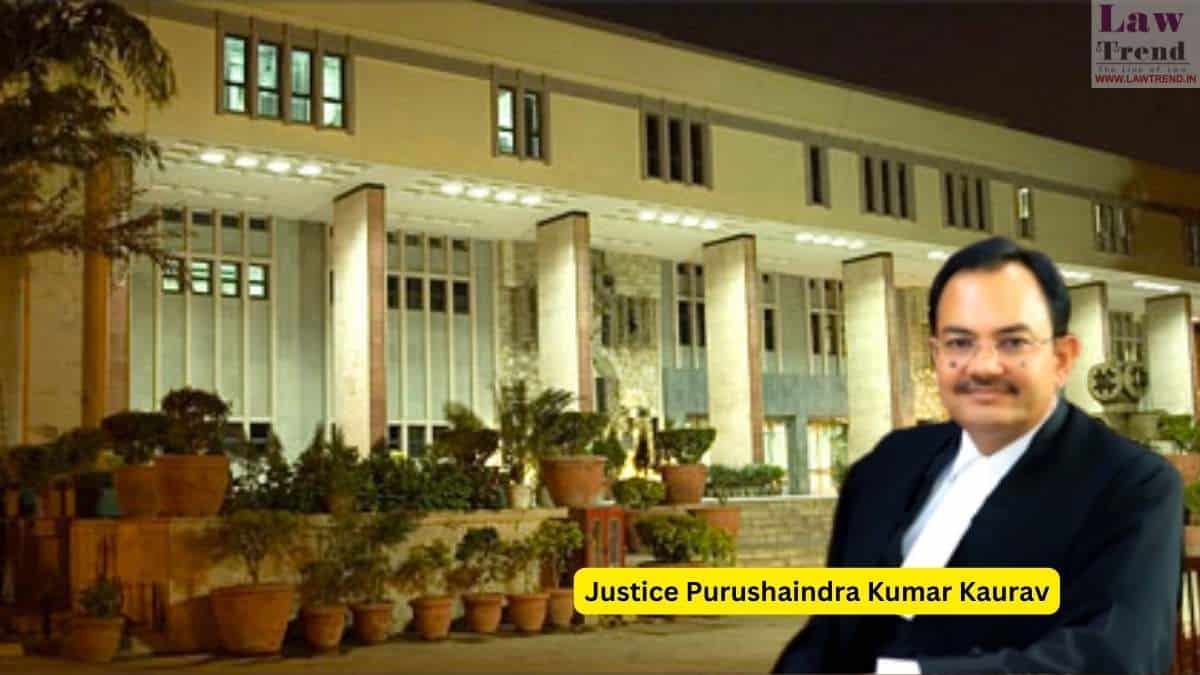
Justice Purushaindra Kumar Kaurav, while adjudicating the application in the case of Dr. Saroj Bahl v. Smt. Sushma Batra & Ors., further reiterated the settled legal position regarding court fees and the distinction between seeking cancellation of a deed versus a declaration of invalidity for a non-executant.

Background of the Case

The case pertains to a suit filed by Dr. Saroj Bahl (Plaintiff) concerning property bearing No. K-1/41, Model Town, Delhi. The Plaintiff sought a decree of declaration to declare a Release Deed dated October 23, 1982, an alleged General Power of Attorney, and Wills dated April 16, 2014, and February 3, 1977, as null and void. The Plaintiff alleged that she never executed the Release Deed in favor of her late mother and that the documents were forged and fabricated.

The Plaintiff also sought a decree of permanent and mandatory injunction restraining the defendants from creating third-party interests in the suit property.

Defendant No. 2 filed an application (I.A. 38413/2024) under Order VII Rule 11 CPC, seeking the rejection of the plaint on several grounds, including the bar under Section 34 of the SRA, incorrect valuation for court fees, and limitation.

READ ALSO  Delhi HC directs Major Reforms for Yamuna Revitalisation, water management

Arguments of the Parties

Defendant No. 2 (Applicant): The Applicant contended that the suit was barred by the proviso to Section 34 of the SRA because the Plaintiff had not sought the relief of possession. Reliance was placed on the Supreme Court judgment in TV Ramakrishna Reddy v. M. Mallappa and Anr. (2021). Furthermore, the Defendant argued that the suit was not maintainable as the Plaintiff had not sought the cancellation of the Release Deed dated 23.10.1982 and had failed to pay the requisite ad valorem court fees. The Defendant also invoked Section 41J of the SRA, claiming the Plaintiff had no personal interest in the matter, and argued that the suit was barred by limitation and suffered from non-joinder of a necessary party, Mr. Chaman Kumar Mehra.

Plaintiff: The Plaintiff maintained that she was a co-owner of the suit property and in joint possession, asserting that her articles were lying in the property. She averred that the Release Deed was a forged document which she never signed, making her a non-executant.

Court’s Analysis and Observations

On Section 34 of the Specific Relief Act: The Court rejected the Defendant’s contention regarding the bar under the proviso to Section 34 SRA. Justice Kaurav observed that the legislative purpose of the proviso is to prevent multiplicity of proceedings. Citing the Supreme Court in Akkamma and Ors. v. Vemavathi and Ors. (2021), the Court noted that “if in case a consequent/further relief is sought in the plaint, the bar of the proviso, without more, simply does not apply.”

READ ALSO  2020 दिल्ली दंगे: कोर्ट ने आगजनी के 3 आरोप ख़ारिज किए

The Court examined the prayer clause of the plaint and found that the Applicant/Defendant No. 2 had sought the relief of a permanent and mandatory injunction as a consequent relief. The Court held:

“Thus, by a straight application of the pronouncement of the Supreme Court in Akamma the argument pertaining to the bar of the proviso to S. 34 being attracted deserves to be rejected.”

The Court also took note of the Plaintiff’s specific pleading that she is “the co-owner of the suit property… as such she is also in joint possession of the suit property.”

On Cancellation vs. Declaration and Court Fees: Addressing the objection regarding court fees and the prayer for cancellation, the Court relied on the Supreme Court’s decision in Suhrid Singh v. Randhir Singh and Ors. (2010). The Court clarified the distinction between an executant and a non-executant of a deed.

The Court observed that the Plaintiff specifically pleaded that her signatures on the release deed were forged and that she was not privy to the deed. The Court held:

“It is settled law that cancellation is to be sought only by executors of documents and not by parties who are not privy to such deeds/agreements… This being the case, a declaratory relief, as prayed for by the plaintiff, is the appropriate legal remedy to seek.”

Consequently, the Court found the fixed court fees paid by the Plaintiff to be appropriate.

On Section 41J, Limitation, and Non-Joinder: Regarding the bar under Section 41J of the SRA (injunction when plaintiff has no personal interest), the Court stated that this provision “cannot straightway be made applicable at this stage without allowing parties to lead evidence,” as the Plaintiff’s claim of co-ownership is a triable issue.

READ ALSO  पति-पत्नी एक परिवार के दो स्तंभ हैं और एक स्तंभ टूटने पर सब कुछ गिर जाएगा- हाईकोर्ट ने तलाक़ आदेश की पुष्टि की

Similarly, on the issue of limitation, the Court noted that the Plaintiff claimed knowledge of the fraud in 2014/2015. The Court ruled:

“Whether the date of knowledge so claimed is true or not is again a triable question which needs to be answered after the parties have led evidence on the same. Limitation being a mixed question of law and fact, is, in the instant case, better left adjudicated during the course of the trial.”

Regarding the non-joinder of Mr. Chaman Kumar Mehra, the Court held that it did not appear to be an inherent defect warranting rejection of the plaint, especially when no relief was sought against him.

Decision

The High Court found the application under Order VII Rule 11 CPC to be “bereft of merit” and dismissed it. The matter was listed for further proceedings on February 24, 2026.

Case Details:

Case Title: Dr. Saroj Bahl v. Smt. Sushma Batra & Ors.

Case Number: CS(OS) 653/2023 & I.As.38414-16/2024 Coram:

Justice Purushaindra Kumar Kaurav

Date of Judgment: 12.12.2025

Counsel for Plaintiff: Mr. Gurpreet Singh with Mr. Bhavneet Singh, Advocates.

Counsel for Defendants: Ms. Geeta Luthra, Sr. Advocate with Mr. Anit K. Maurya and Mr. Anuj Singh (for D1 & D2); Mr. Shashi Kumar with Mr. Anshul Gupta (for D3); Mr. Preet Pal Singh with Ms. Tanupreet Kaur (for D4 & D5).

Law Trend
Law Trendhttps://lawtrend.in/
Legal News Website Providing Latest Judgments of Supreme Court and High Court

Related Articles

Latest Articles

