The Supreme Court of India has ruled that a pillion rider in a motor accident cannot be held liable for contributory negligence unless there is specific evidence establishing their contribution to the accident. The Court set aside the findings of the Tribunal and the High Court which had deducted 50% of the compensation payable to an injured claimant on the grounds of contributory negligence.
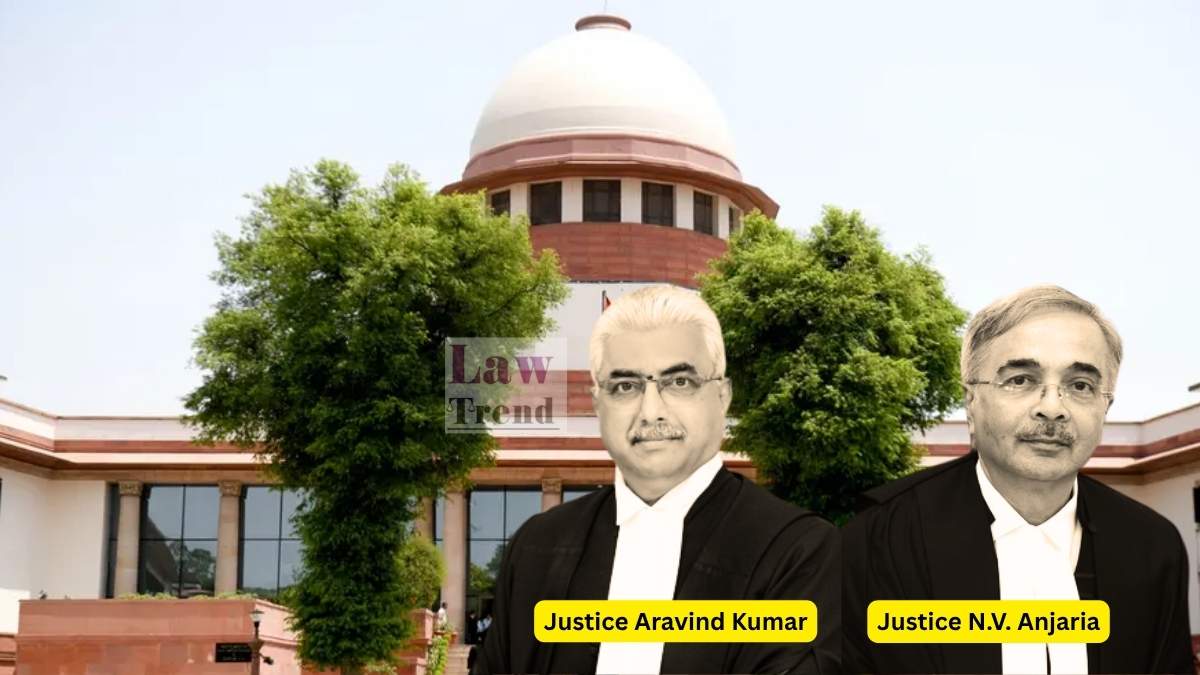
The Bench, comprising Justice Aravind Kumar and Justice N.V. Anjaria, observed that in a collision involving two vehicles, a third-party pillion rider falls under the realm of “composite negligence,” allowing them to recover the entire compensation from any of the tortfeasors.
Case Background
The appellant, Yashwant Krishna Kumbar, was involved in a motor vehicle accident on April 18, 2014. He was travelling as a pillion rider on a motorcycle from Sankeshwar towards Akiwat. According to the claimant, another motorcycle, driven in a rash and negligent manner, collided with their vehicle near Nagannavar land.
As a result of the collision, the appellant sustained multiple fractures and grievous injuries. He underwent major surgical procedures, eventually leading to the amputation of his right leg below the knee.
The appellant filed a claim petition under Section 166 of the Motor Vehicles Act, 1988, seeking compensation of Rs. 25,00,000. The Motor Accident Claims Tribunal (MACT) held that both motorcycle riders were negligent as they were riding on the wrong side of the road. Consequently, the Tribunal attributed contributory negligence to both parties and held that the insurer was liable to satisfy only 50% of the determined compensation. The Tribunal awarded a net sum of Rs. 3,79,075.
Upon appeal, the High Court of Karnataka affirmed the finding of contributory negligence but marginally enhanced the monthly income assessment of the claimant from Rs. 6,000 to Rs. 7,500. The High Court awarded a total compensation of Rs. 6,36,875 (after the 50% deduction). Aggrieved by this, the claimant approached the Supreme Court.
Arguments of the Parties
Counsel for the appellant, Mr. Manjunath Meled, argued that the compensation awarded was neither just nor reasonable considering the claimant’s age, his occupation as an agriculturist, and the permanent disability caused by the amputation. He contended that the functional disability should have been assessed at 100%. Furthermore, he argued that the finding of contributory negligence attributed to a pillion rider was “misconceived” and unsupported by evidence.
Conversely, Mr. Lalit Chauhan, counsel for the Respondent-Insurance Company, supported the High Court’s order. He contended that the High Court had already awarded just and reasonable compensation and that the accident occurred due to the rash and negligent riding of the motorcycle on which the appellant was travelling, justifying the apportionment of liability.
Court’s Analysis and Observations
The Supreme Court addressed two primary issues: the attribution of contributory negligence to the pillion rider and the quantum of compensation.
On Contributory Negligence: The Court observed that the lower forums proceeded on the “erroneous assumption” that because both drivers were negligent, the pillion rider must share the blame. The Bench clarified that the principle of contributory negligence requires a specific inquiry into the conduct of the injured person.
The Court stated:
“The principle of contributory negligence, however, mandates a specific inquiry into the conduct of the injured person and as to how he has contributed his negligence to the accident, and it cannot be inferred vicariously from the conduct of the rider.”
Citing the precedent in T.O. Anthony v. Karvarnan (2008), the Court distinguished between contributory and composite negligence. It noted that even if both riders were negligent, the case falls under “composite negligence” regarding the pillion rider. In such scenarios, the claimant is a third party and can recover damages from any of the wrongdoers.
The Court further held:
“In cases where contributory negligence is sought to be attributed to a pillion rider in a motor vehicle accident, the burden squarely lies on the party alleging such negligence to establish, by cogent material, that any act or omission on the part of the pillion rider contributed to the occurrence of the accident.”
Finding that the insurer led “no evidence to establish even remote negligence attributable to the claimant,” the Court set aside the 50% deduction.
On Quantum of Compensation: The Court found the income assessed by the High Court (Rs. 7,500) to be “wholly unrealistic for a self-employed farmer.” Although the claimant asserted an income of Rs. 5,60,000 per annum from agriculture and milk vending, no specific proof was tendered. However, considering the economic conditions and his age (36 years) at the time of the accident, the Court re-assessed the monthly income at Rs. 10,000.
Applying the law laid down in National Insurance Company Ltd. v. Pranay Sethi, the Court added 40% towards future prospects, bringing the notional monthly income to Rs. 14,000. With a 55% permanent disability and a multiplier of 15, the Loss of Earning Capacity was recalculated to Rs. 13,86,000.
Additionally, the Court enhanced the compensation for ‘Loss of income during treatment’ from Rs. 22,500 to Rs. 40,000, noting that an amputation would incapacitate a person for at least four months.
Decision
The Supreme Court allowed the appeal in part. It modified the judgment of the High Court and directed the respondents to pay a total compensation of Rs. 16,37,749 with interest at 6% per annum from the date of the claim petition.
The finding of contributory negligence against the appellant was set aside, and the insurer was directed to deposit the enhanced amount within eight weeks.
Case Details:
- Case Name: Yashwant Krishna Kumbar vs. The Divisional Manager, United India Insurance Co Ltd. & Ors.
- Case No.: Civil Appeal No. of 2025 (Arising out of SLP (C) No. 22599/2024)
- Bench: Justice Aravind Kumar and Justice N.V. Anjaria
- Counsel for Appellant: Mr. Manjunath Meled, Mrs. Vijayalaxmi Udapudi, Mr. Ganesh Kumar R. (AOR), Ms. Arushi
- Counsel for Respondent: Mr. Lalit Chauhan, Ms. Laxmi Chauhan, Mr. Anith Johnson, Ms. Khushi Sehrawat, Ms. Mrinal Gopal Elker (AOR)