The Supreme Court has held that the bar created by Rule 5 of Chapter VIII of the Allahabad High Court Rules, 1952, regarding the maintainability of special appeals, must yield to the “foundational principles of natural justice” when an order prejudicially affects a party who was not impleaded in the proceedings.
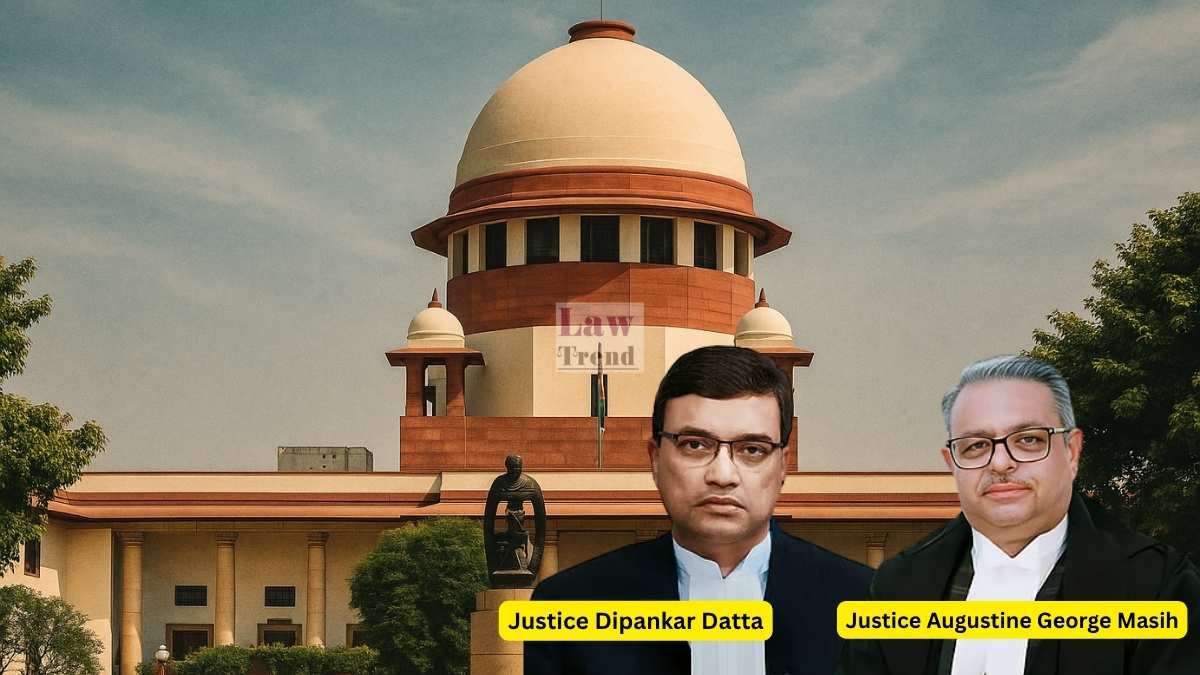
The Bench, comprising Justice Dipankar Datta and Justice Augustine George Masih, set aside an order of the Division Bench of the Allahabad High Court which had dismissed an intra-court appeal as not maintainable. The Apex Court restored the appeal to the High Court for hearing on merits.
Case Background
The Appellant, Abhishek Gupta, was allotted a fair price shop license following the revocation of the license held by Respondent No. 1, Dinesh Kumar, due to an alleged breach of terms. Respondent No. 1 challenged the revocation and the appellate order affirming it through a Writ Petition before the Allahabad High Court. Crucially, the Appellant was not impleaded as a party in this petition.
On June 10, 2025, a Single Judge allowed the writ petition, setting aside the revocation and directing the reinstatement of Respondent No. 1.
“Sensing the imminent consequence of the order of the Single Judge, i.e., he would be compelled to step down and make way for the respondent no.1,” the Appellant approached the Division Bench of the High Court with an intra-court appeal. He contended that the Single Judge’s order prejudicially affected his interest without affording him an opportunity of hearing.
On October 30, 2025, the Division Bench dismissed the appeal as not maintainable, relying on Chapter VIII Rule 5 of the Allahabad High Court Rules, 1952, and the Full Bench judgment in Sheet Gupta v. State of U.P. (AIR 2010 All 46).
The Legal Issue and Arguments
The primary legal question was whether a Special Appeal is maintainable by a person who was not a party to the writ proceedings but is prejudicially affected by the judgment, specifically in light of the statutory bar under Rule 5 of the 1952 Rules.
Rule 5 generally bars a special appeal from a judgment of a Single Judge passed in the exercise of jurisdiction conferred by Article 226 or Article 227 of the Constitution in respect of appellate or revisional orders made by the Government or any officer/authority under State or Central Acts.
The Division Bench had relied on the Sheet Gupta judgment, which interpreted Rule 5 to hold that special appeals are not maintainable in specific circumstances involving appellate or revisional orders.
Supreme Court’s Analysis
The Supreme Court examined Rule 5 and the Full Bench decision in Sheet Gupta. The Court observed that while the Full Bench correctly interpreted Rule 5, it “had not been called upon to examine whether an appeal with an application seeking leave to appeal, by a non-party to a writ petition under Article 226, would or would not be maintainable if the order under challenge in such petition is passed by the Government or officer or authority under a Central/State legislation.”
The Apex Court noted that this specific aspect “escaped the attention of the Division Bench.”
Rule 5 and Access to Justice
The Court emphasized that Rule 5 must be interpreted to advance the cause of “access to justice.” While acknowledging the object of Rule 5—to prevent a third tier of adjudication after a statutory appellate/revisional forum and a Single Judge’s review—the Court held that this purpose applies to parties who have already participated in the litigation.
Justice Dipankar Datta, writing for the Bench, observed:
“In the circumstances before us, the bar created by Rule 5 must yield to the foundational principles of natural justice, namely, the right to be heard and the right to a fair hearing.”
The Court stated that the “rigours of Rule 5 would not apply and stand relaxed” when an order adversely affects the rights of a party who was not a respondent before the Single Judge.
Principle of Non-Joinder
The Court reiterated that the principle of non-joinder applies to writ proceedings. It noted:
“An order passed in writ jurisdiction without impleading an affected or necessary party is liable to be invalidated on that ground alone.”
Right to Appeal for Non-Parties
Referencing the precedents of Smt. Jatan Kanwar Golcha v. Golcha Properties (P) Ltd. (1971) and State of Punjab v. Amar Singh (1974), the Court affirmed that an appeal could be preferred with an application for leave to appeal if the non-party appellant demonstrates that the order is “prejudicial to his interest or adversely affects him or is binding on him.”
The Court also invoked the maxim ubi jus, ibi remedium (where there is a right, there is a remedy), stating:
“A party suffering an adverse order in judicial proceedings where he is not noticed, because he was not a party, cannot be left without a remedy.”
The Court further noted that while a review petition is an option, its scope is “much narrow than an appeal and would not provide a remedy as effective as an appeal.”
Decision
The Supreme Court set aside the Division Bench’s judgment dated October 30, 2025, and restored the Appellant’s Special Appeal to its original file.
The Court directed:
- The Division Bench to hear and dispose of the appeal expeditiously.
- The allegation of non-joinder, if found to have merit, should lead the High Court to “either remand the matter to the Single Judge or decide it on the merits.”
Regarding the status of the fair price shop, the Court noted it was “not inclined to allow the appellant to run the fair price shop for the present.” Since the shop had already been allotted to Respondent No. 1 in compliance with the Single Judge’s order, the Court directed that “the same shall abide by the result of the Special Appeal.”
Case Details:
- Case Title: Abhishek Gupta v. Dinesh Kumar & Ors.
- Citation: 2025 INSC 1406
- Coram: Justice Dipankar Datta and Justice Augustine George Masih