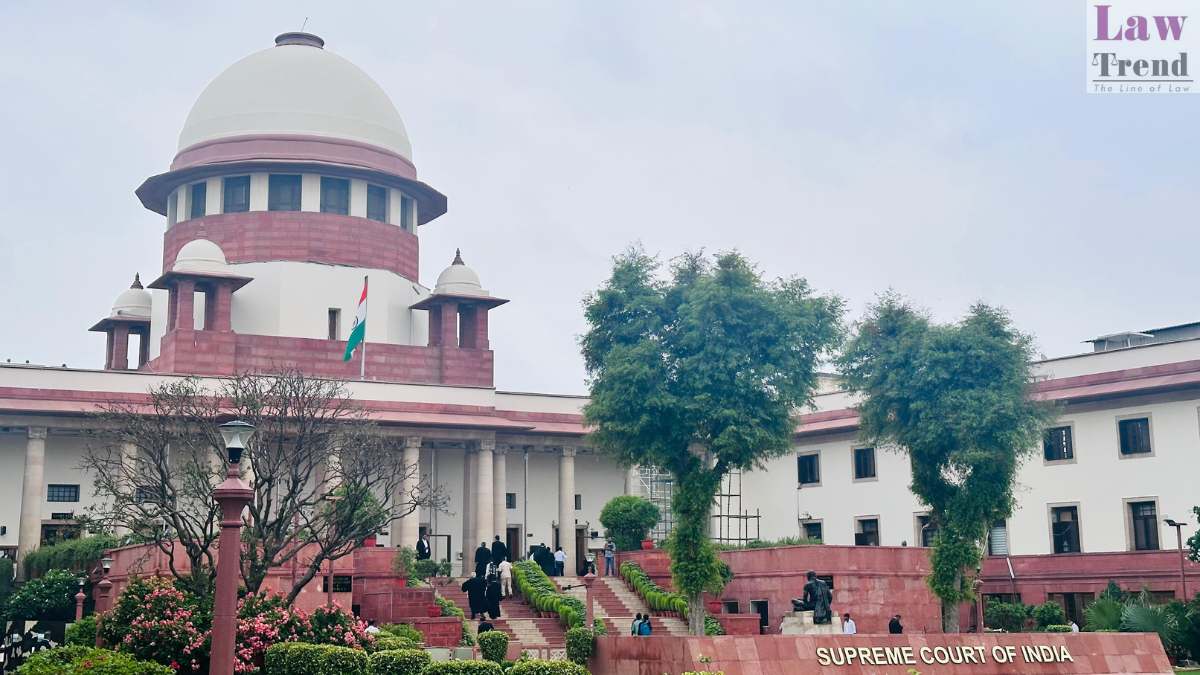
The Supreme Court of India has allowed the appeals filed by the Akola Municipal Corporation, setting aside the judgment of the Bombay High Court (Nagpur Bench) which had quashed the Corporation’s decision to revise property tax rates. The Bench, comprising Justice Vikram Nath and Justice Sandeep Mehta, held that the High Court exceeded its jurisdiction under Article 226 by interfering in an economic policy decision, emphasizing that the revision of tax after a gap of 16 years was not only justified but was a statutory obligation of the civic body.
Background of the Case
The appeals challenged the judgment dated October 9, 2019, passed by the Division Bench of the High Court of Judicature at Bombay, Nagpur Bench, in Public Interest Litigation (PIL) No. 42 of 2018, and the subsequent review order dated January 24, 2020.
The PIL was filed by Dr. Zishan Hussain, a medical practitioner and a Corporator of the Akola Municipal Corporation. He sought a writ of mandamus to declare the revision of property tax for the years 2017-18 to 2021-22 as “illegal, contrary to law” and made without following due process. The High Court had allowed the petition, setting aside the resolution passed by the Corporation.
The Akola Municipal Corporation contended that the assessment and revaluation of taxable values had not been done since the year 2001-02. Citing the necessity to strengthen the tax recovery system and meet the demands of public development, the Corporation initiated a revision of the tax structure in 2017.
Arguments of the Parties
The Appellant-Corporation’s Submission: The Corporation argued that property tax is its main source of income and had remained stagnant for over 16 years. It submitted that with the increase in built-up area and new constructions, the revenue from old assessments was insufficient. To address this, the Corporation published an e-tender in 2016 to appoint a technical consultant for a comprehensive door-to-door survey and assessment using GIS modules.
The Corporation asserted that the “matters of tax revision fell squarely within the domain of the appellant-Corporation,” and trivial errors in the process should not vitiate the entire regime.
The Respondent-Writ Petitioner’s Submission: The Respondent, Dr. Zishan Hussain, alleged “apparent and manifest irrationality in the arbitrary increase of property tax” and “grave procedural impropriety” in assessments done through private contractors. However, in the counter-affidavit filed before the Supreme Court, the Respondent admitted that the PIL “did not call into question the authority or competence of the appellant-Corporation to revise municipal taxes,” but was confined to the procedure adopted.
Court’s Analysis and Observations
The Supreme Court scrutinized the locus standi of the Respondent and the scope of judicial review in matters of economic policy.
1. Locus Standi and Nature of PIL: The Court observed that the Respondent, being a Corporator, would be privy to the functioning of the institution. The Bench noted that the Respondent had raised his “individual grievance” under the “garb of a public interest litigation.”
The Court stated:
“The writ petition purportedly in public interest was in fact, nothing but an action taken as a subterfuge to avoid filing of the appeals against the proposal to increase the property tax.”
The Court further noted that the Respondent questioned the tender issued to a private consultancy, observing that “possibility of the writ petition having been filed to agitate a conflict of business interest cannot be ruled out.”
2. Scope of Judicial Review in Economic Policy: The Bench held that the High Court “exceeded the well-settled tenets of scope of judicial review” by substituting its own opinion for that of the Corporation.
The Court referred to the following precedents:
- Shri Sitaram Sugar Co. Ltd. v. Union of India (1990): The Court quoted that “Judicial review is not concerned with matters of economic policy” and the court “does not supplant the ‘feel of the expert’ by its own views.” (Para 20)
- BALCO Employees’ Union v. Union of India (2002): The Bench reiterated that judicial interference by way of PIL is available only if there is injury to the public due to dereliction of constitutional obligations, noting that “Wisdom and advisability of economic policies are ordinarily not amenable to judicial review.” (Para 21)
- Kirloskar Ferrous Industries Ltd. v. Union of India (2025): The Court cited this recent judgment to emphasize the “doctrine of judicial restraint,” stating that courts should “defer to the expertise and discretion of the policy-makers” unless the policy is unconstitutional or violates statutory provisions.
The Court observed that the High Court cannot exercise writ jurisdiction in public interest for questioning economic or fiscal policy. It explicitly stated:
“Court cannot substitute its judgment for that of the legislature or its agents as to matters within the province of either.”
3. Justification for Tax Revision: Addressing the necessity of revenue generation, the Court observed:
“The scheme of municipal governance envisages financial autonomy as a necessary concomitant of administrative autonomy; without such independent revenue-generation mechanisms, including periodic revision of taxes… the very purpose for which these bodies are constituted would stand frustrated.”
The Bench remarked that the stagnation of tax rates for 16 years depicted “gross laxity on part of the authorities concerned” and held that the Corporation was “under a statutory obligation to revise the tax rates.”
Decision
The Supreme Court concluded that the High Court was not justified in invoking powers of judicial review to interfere in the economic policy decision of the Corporation.
“Ex facie, we are of the opinion that the aforesaid exercise was not permissible to be undertaken in the extraordinary writ jurisdiction of the Court and the decision of the appellant-Corporation regarding economic policies was beyond the scope of power of judicial review.”
Consequently, the Court allowed the appeals and set aside the impugned judgment dated October 9, 2019, and the order dated January 24, 2020, passed by the High Court.
Case Details:
- Case Title: Akola Municipal Corporation and Anr. v. Zishan Hussain Azhar Hussain and Anr.
- Case No: Civil Appeal No(s). 12488-12489 of 2024
- Coram: Justice Vikram Nath and Justice Sandeep Mehta