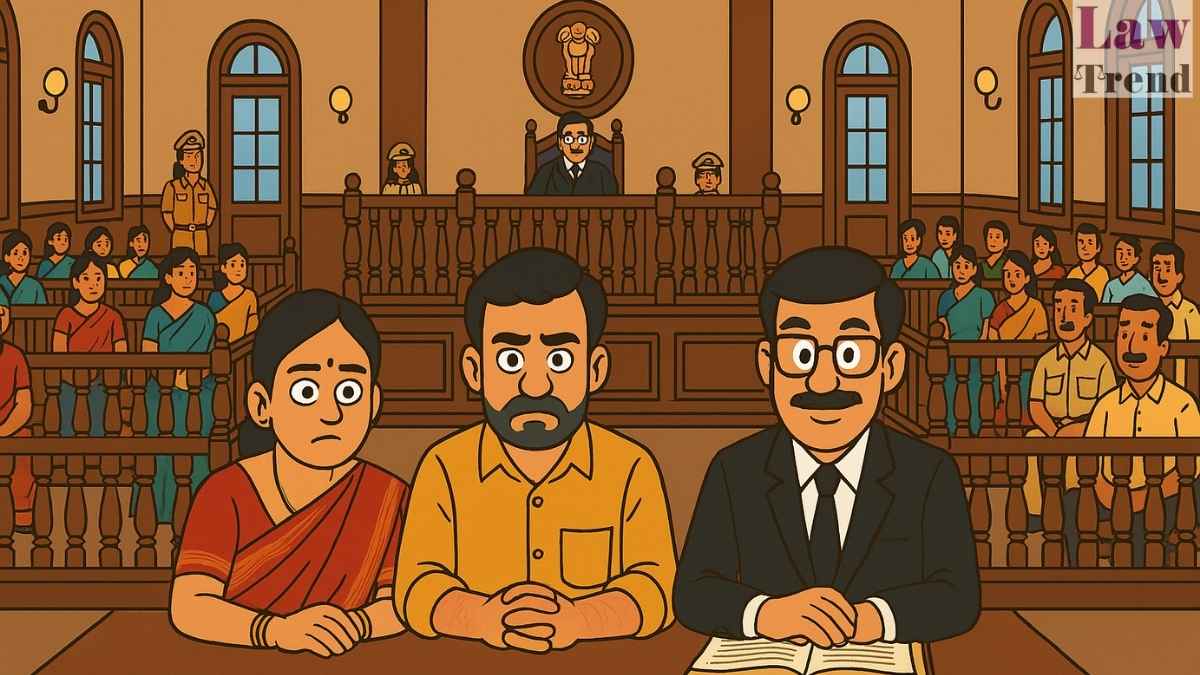
Working Wife’s Income Does Not Absolve Husband of Maintenance Liability; Father Cannot Hide Behind “Meagre Income” Plea: Delhi High Court

The Delhi High Court has held that a father cannot evade his financial responsibility towards his minor children by suppressing his true income or taking shelter behind the fact that his wife is employed. While modifying the quantum of interim maintenance, the Court emphasized that a working mother shoulders the “dual burden” of professional obligations and primary caregiving, which cannot be monetarily quantified.

The Single Bench of Justice Swarana Kanta Sharma was hearing a revision petition filed by a husband challenging the orders of the Trial Court and Sessions Court, which had directed him to pay ₹30,000 per month as interim maintenance for his three minor children.

The High Court modified the interim maintenance amount, reducing it to ₹25,000 per month, but firmly rejected the husband’s contention that he was earning only ₹9,000 per month. The Court observed that the petitioner, who holds an MBA degree, was deliberately understating his income to shirk his parental obligations.

Background of the Case

The marriage between the petitioner-husband and the respondent-wife was solemnized on January 26, 2014. The couple has three children—two daughters and a son. Disputes arose between the parties, with the wife alleging harassment on account of dowry demands and economic abuse. She subsequently filed a petition under Section 12 of the Protection of Women from Domestic Violence Act, 2005 (PWDV Act).

On December 23, 2023, the learned Metropolitan Magistrate (Mahila Court) directed the husband to pay interim maintenance of ₹30,000 per month (₹10,000 for each child). The Trial Court noted that while the husband claimed to work at his mother’s pharmacy for a salary of ₹9,000, his bank statements and credit card usage suggested otherwise.

The husband challenged this order before the Sessions Court, which dismissed his appeal on March 30, 2024. The Sessions Court termed the husband’s claim of earning a meagre salary while working in his family’s business as “contradictory” and not “bonafide.” Aggrieved by these findings, the husband moved the High Court.

READ ALSO  Delhi HC Directs District Courts to Allow Hybrid/ VC Hearings on Request of Lawyers/Parties

Submissions of the Parties

Petitioner-Husband’s Arguments: The counsel for the petitioner argued that the maintenance amount was excessive as the husband earned only ₹9,000 per month as a homeopathic pharmacist. It was submitted that the respondent-wife, who works at a university, earns approximately ₹34,500 per month, which is substantially higher than the petitioner’s income. The husband also claimed that his parents had debarred him from their property and that he was residing as a paying guest with his uncle.

Respondent-Wife’s Arguments: Conversely, the counsel for the wife argued that she had not sought maintenance for herself but only for the three minor children in her custody. It was contended that the husband is highly qualified (MBA and Diploma in Pharmacy) and was misleading the Court about his income. The counsel pointed out that despite the alleged “debarment,” the husband continued to work in his mother’s pharmacy and resided in the same property.

Court’s Analysis and Observations

READ ALSO  दिल्ली हाई कोर्ट ने उस इंजीनियर की माफी स्वीकार कर ली जिसने दिल्ली की न्यायपालिका को भ्रष्ट बताया था

Justice Swarana Kanta Sharma meticulously analyzed the financial status of both parties and the legal principles regarding child maintenance.

  • Concealment of Income: The Court found the husband’s claim of earning ₹9,000 per month legally untenable. The Bench noted that his Income Tax Returns (ITRs) for previous assessment years (AY 2020-21 and 2022-23) reflected an annual income between ₹4.5 lakhs and ₹5 lakhs.
    “The plea of earning only ₹9,000/- per month is further belied by the bank statements placed on record… This Court finds merit in the observation of the Courts below that it is difficult to reconcile the possession and usage of a credit card with the claim of earning only ₹9,000/- per month.”
    The Court also dismissed the husband’s claim of being debarred by his parents, noting that he continues to work in his mother’s pharmacy and resides in the family property.
  • Shared Responsibility and Dual Burden: Addressing the husband’s argument regarding the wife’s income, the Court clarified that while both parents have a legal and moral obligation to maintain their children, the wife’s employment does not exempt the father. The Court highlighted the “dual burden” faced by working mothers.
    “The conduct of the wife herein, who is a working woman, shows that she is compelled to shoulder a dual burden, i.e., of fulfilling her professional obligations alongside her responsibility of taking care of three minor children single-handedly… In such cases, the obligation of the father towards the minor children does not diminish merely because the wife has been forced to shoulder this dual responsibility.”
  • Legal Precedents: The judgment cited the Supreme Court’s ruling in Padmja Sharma v. Ratan Lal Sharma regarding proportionate contribution and Rajnesh v. Neha, reiterating that an able-bodied husband cannot hide behind a plea of low income without full disclosure.
READ ALSO  Delhi HC Grants Bail to ‘Hawala Operator’ in Cases Involving Sukesh Chandrasekhar

Decision

The High Court assessed the husband’s real income conservatively at ₹40,000 per month based on his past ITRs. Applying the formula from Annurita Vohra v. Sandeep Vohra, the Court determined that a consolidated amount of ₹25,000 per month was appropriate for the maintenance of the three children.

The Court reasoned that the total monthly expense for the children would be approximately ₹45,000. Since the wife earns ₹34,000, she would contribute financially (approx. ₹20,000) in addition to her non-monetary contribution as the primary caregiver.

“Accordingly… the impugned orders are modified to the limited extent that the interim maintenance payable by the petitioner-husband towards the three minor children shall stand reduced from ₹30,000/- per month to ₹25,000/- per month.”

The revision petition was disposed of with these directions.

Case Details:

  • Case Title: Hitesh Makhija v. Ritu Makhija
  • Case Number: CRL.REV.P. 723/2024
  • Coram: Justice Swarana Kanta Sharma

Law Trend
Law Trendhttps://lawtrend.in/
Legal News Website Providing Latest Judgments of Supreme Court and High Court

Related Articles

Latest Articles