

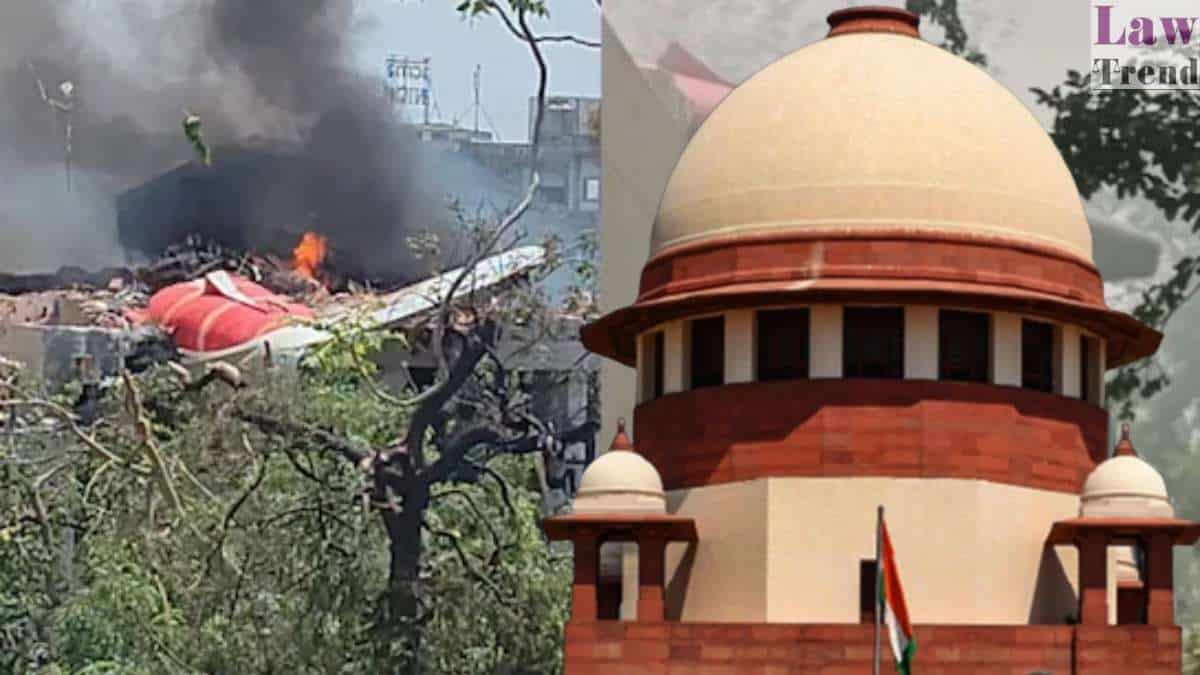
The Supreme Court of India on Wednesday dismissed a petition challenging the preliminary investigation into the June 2023 Air India crash in Ahmedabad, questioning the “motive” and “agenda” of the petitioner for seeking specific technical disclosures that the families of the victims had not requested.
The primary legal issue concerned a challenge to a Delhi High Court order which had rejected a Public Interest Litigation (PIL). The petitioner sought to “read down” the Aircraft Accident Investigation Bureau’s (AAIB) preliminary report and compel authorities to include a detailed “complete sequence of events,” specifically regarding engine flame-outs and fuel switch transitions.
A bench comprising Chief Justice Surya Kant, Justice Joymalya Bagchi, and Justice Vipul M. Pancholi dismissed the plea, refusing to entertain the petitioner’s request or direct the authorities to treat the petition as a representation.
On June 12, 2023, Air India flight AI 171, a Boeing 787-8 bound for London Gatwick, crashed into a medical college hostel complex shortly after takeoff from Ahmedabad’s Sardar Vallabhbhai Patel International Airport. The catastrophic event resulted in the aircraft bursting into flames, claiming the lives of 241 of the 242 people on board and 19 individuals on the ground.
Following the tragedy, the AAIB released a preliminary investigation report. The petitioner approached the Delhi High Court seeking a modification of this report to include a precise time-chart of engine “flame outs” and the nature of fuel switch transitions (mechanical or manual), while also demanding that such information be published in the public domain. On February 25, the Delhi High Court rejected the PIL, prompting the current appeal to the apex court.
During the proceedings, the Supreme Court expressed strong disapproval of the petitioner’s standing and intent. Chief Justice Surya Kant addressed the counsel for the petitioner, questioning why an unrelated party was pursuing technical modifications to an investigation report when the families of the deceased had not come forward with such demands.
“What is your deep-rooted agenda? As if we don’t understand the motive. The people who lost their lives, their family members are not filing [petitions] but you are filing,” the Chief Justice remarked.
The bench aligned with the Delhi High Court’s earlier assessment that the PIL was “highly misconceived.” The High Court had previously observed that if the petitioner required specific information, they should have utilized the Right to Information (RTI) Act rather than seeking a judicial mandate to alter a specialized technical report.
The High Court had noted:
“Such prayer in our considered opinion cannot be granted. If such information is worthy of being given under the RTI Act, it would be provided.”
The Supreme Court declined to interfere with the High Court’s order and dismissed the plea in its entirety. The court further refused to grant the petitioner’s alternative request to have the authorities consider the petition as a formal representation, effectively ending the litigation regarding the contents of the preliminary crash report.




