The High Court of Chhattisgarh has delivered a landmark ruling on the evidentiary value of a victim’s testimony in sexual assault cases. Setting aside a lower court’s acquittal, the High Court held that a victim of rape is not an accomplice and their testimony, if credible and trustworthy, does not require independent corroboration as a matter of law.
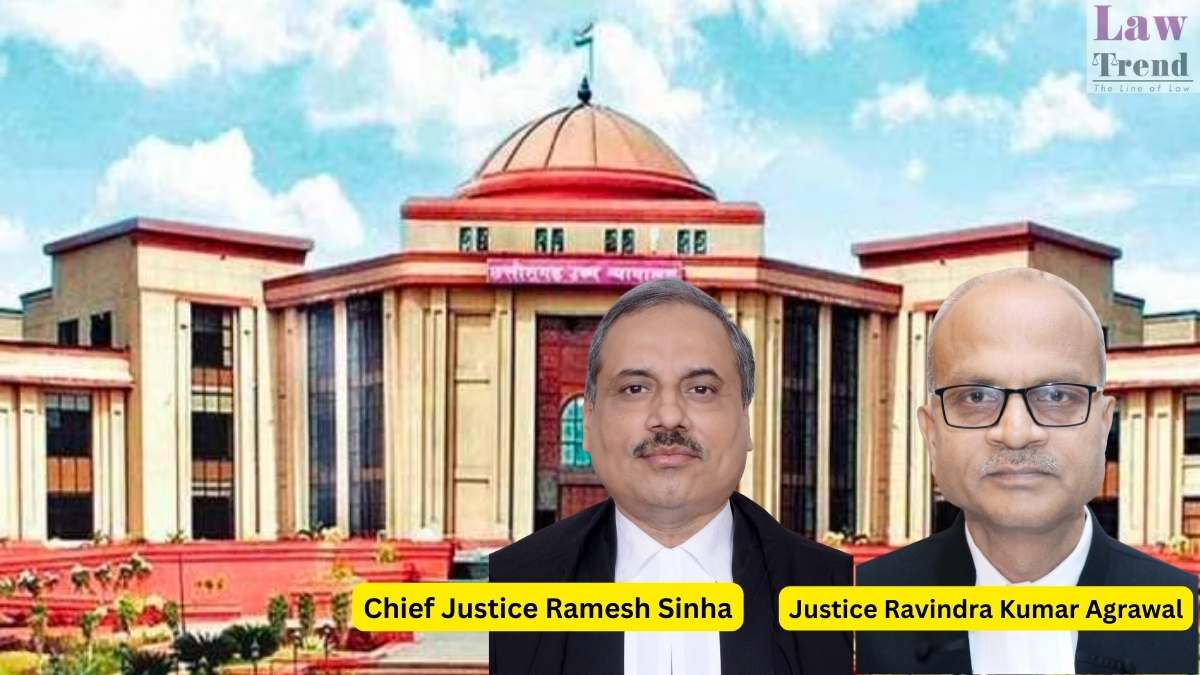
The Division Bench of Chief Justice Ramesh Sinha and Justice Ravindra Kumar Agrawal reversed the acquittal of a school principal and two staff members involved in the sexual assault of a 9-year-old girl in 2015.
The core legal question addressed by the Court was whether a conviction can be sustained solely on the testimony of a minor victim without independent supporting evidence. The Court’s official headnote clarified the legal position:
“A victim of rape or sexual assault is not an accomplice, and her evidence does not require corroboration as a matter of law. Corroboration is only a matter of prudence, not a condition for conviction. If the victim’s testimony is credible, natural, consistent, and trustworthy, and free from material infirmities, the Court may act upon it even without independent corroboration.”
Case Background
The incident occurred in September 2015 at Jyoti Mission School, Sarbhoka. The victim’s mother discovered the 9-year-old child bleeding and in pain after being alerted by a school security guard. The child revealed that she had been assaulted in the hostel. When she reported the matter to a staff member (Respondent No. 3), she was allegedly beaten and threatened to remain silent.
The Additional Sessions Judge (Fast Track Court), Baikunthpur, had acquitted the accused in 2017, leading to an appeal by the State.
Arguments of the Parties
The State (Appellant) argued that the trial court failed to appreciate the testimony of the victim (PW-2), which remained consistent throughout the proceedings. The State contended that minor omissions should not have been used to disbelieve the entire prosecution story.
The Respondents argued that the Test Identification Parade (TIP) was tainted by police interference and that the victim’s injuries could be attributed to medical conditions like a Urinary Tract Infection (UTI).
Court’s Analysis and Verdict
The High Court rejected the trial court’s approach, terming the acquittal “perverse” and “manifestly erroneous.” The Bench emphasized that in Indian society, a woman or girl is extremely reluctant to admit to incidents reflecting on her chastity, which provides an “inbuilt assurance” of the charge’s genuineness.
Relying on the principle of “sterling quality” witnesses, the Court noted:
“The evidence of a victim of sexual assault stands almost on a par with the evidence of an injured witness and to an extent is even more reliable.”
The Court found that the victim’s account was corroborated by medical findings of trauma and the Forensic Science Laboratory (FSL) report. The Bench dismissed the UTI defense, noting that while infections cause redness, they do not cause the swelling and bruising found on the child.
Final Decision
The High Court set aside the 2017 acquittal and passed the following orders:
- Respondent No. 2 (Joseph Dhanna Swami): Convicted under Section 6 of the POCSO Act and Section 376 of the IPC. Sentenced to Rigorous Imprisonment for Life and a fine of ₹10,000.
- Respondents No. 1 & 3 (Philomina Kerketta and Kismariya): Convicted under Section 119 of the IPC (Public servant concealing design to commit offense). Sentenced to seven years of Rigorous Imprisonment and a fine of ₹5,000 each.
The convicts have been directed to surrender within two weeks to serve their sentences.
- Case Title: State of Chhattisgarh vs. Philomina Kerketta & Ors.
- Case Number: ACQA No. 227 of 2018